Fighter Cut › Articles › Rules & weight classes
Rules & weight classes
Returning to training after a knockout
This article can tell you what the paperwork requires and where it runs out. It cannot tell you when you are ready, and neither can the paperwork.
The question people type is "how long after a knockout can I spar." It has no answer, and the reason it has no answer is the most useful thing on this page.
There are two entirely different things that get collapsed into one number. The first is an administrative medical suspension — a period set by a jurisdiction during which a commission will not license you to compete, and in some places will not let you spar. The second is medical clearance — a physician's judgement about one specific brain. The first is a calendar. The second is an examination. Only the second releases anyone to contact.
New York's regulation is the one that says it out loud, and it says it in four words. A licensed combatant who loses by knockout with evidence of head trauma "shall not participate in any combative sports contact sparring, contests or exhibitions for a minimum period of thirty (30) days and until proof of neurological clearance by a physician is provided to and approved by the Commission." Not or. Not then. And until. The days and the doctor are two separate gates, and clearing the first does nothing to the second.
Everything below was fetched from the issuing body's own document and verified on 22 September 2026. Where a figure has a jurisdiction, the jurisdiction travels with it. Where a rule that everyone believes exists turns out not to exist, that is said plainly. Nothing here overrides a physician, a commission or a gym's medical staff.
New York bars contact sparring, contests and exhibitions for a minimum of thirty days **and until** a physician's neurological clearance is filed with and approved by the Commission — two gates, not one
19 NYCRR §208.11(c), consolidated text in force, verified 2026-09-22
Nevada's unarmed combat regulations contain no fixed post-knockout period. A licensee found unfit by a physician is suspended until it is shown they are fit — open-ended, condition-based
NAC 467.562(1) as amended by LCB File No. R089-22, eff. 2022-12-28; full-text search of NAC ch. 467 and the Nevada Rules of Unarmed Combat, 2026-09-22
The ABC Unified Rules of MMA (version 8.2026) contain no medical-suspension, knockout-recovery or clearance provision whatsoever. An MMA fighter's suspension comes from their commission, never from the rule set
ABC, *Unified Rules of MMA 8.2026*, full-text searched 2026-09-22
Of 257 fighters surveyed, roughly 40% reported returning to training or competition the same day a head injury was sustained, and 21% endorsed concealing head-injury symptoms from medical providers and coaches
Bennett et al., *Phys Sportsmed* 2019;47(3):295–300 (n=257, self-report, single US cohort)
- A commission suspension is an administrative minimum. It is not a diagnosis, it is not an examination, and its expiry tells you nothing about your brain.
- New York is the clearest published statement of the distinction: the suspension runs for a minimum period and until proof of neurological clearance by a physician is provided to and approved by the Commission.
- Nevada has no codified knockout day count. The widely repeated "Nevada 60 days" is not in Nevada's regulations; the 60/30 pair is an Association of Boxing Commissions guideline for championship professional boxing, and it is enacted as actual law in Virginia.
- The Unified Rules of MMA contain no suspension language at all, which means an MMA fighter's protection is whatever their commission's general medical powers provide, and nothing more.
- The same knockout produces four different administrative answers in four states, and not one of those answers is a medical opinion.
- Where a rule names sparring, sparring is inside the suspension, not outside it — New York names "contact sparring," California names "contact boxing," Virginia names "any boxing activity."
- The international concussion consensus was not written for a sport whose object is head trauma; it contains no combat-sport return-to-competition guidance, and its clearance gate for anyone risking head impact falls before sport-specific work, not after it.
- Most knockouts in a fighter's life happen in a gym, where no commission is watching, no record is generated and, in survey data, no health-care professional is likely to be present.
- A suspension expiring is permission to be licensed. It is not permission to be hit.
The sentence that does all the work
New York's Athletic Commission regulates professional boxing and professional mixed martial arts under 19 NYCRR Parts 206 to 214. Section 208.11(c) covers what happens after a stoppage involving the head, and it is worth reading in full because the construction is unusual and deliberate:
"A licensed combatant losing by way of a technical knockout where there is evidence of head trauma, upon recommendation of the Commission physician, shall receive a medical suspension and shall not participate in any combative sports contact sparring, contests or exhibitions for a minimum period of thirty (30) days and until proof of neurological clearance by a physician is provided to and approved by the Commission. A licensed combatant losing by way of a knockout where there is evidence of head trauma shall, upon recommendation of the Commission physician, receive a medical suspension and shall not participate in any combative sports contact sparring, contests or exhibitions for a minimum period of thirty (30) days and until proof of neurological clearance by a physician is provided to and approved by the Commission. At the discretion of the Commission physician, longer suspension periods may be issued."
Read the conjunction. The minimum period is a floor with no ceiling attached to it. The clearance is a separate condition with no date attached to it. Satisfying one does not satisfy the other, and there is no arrangement of the calendar in which the floor alone lets anybody spar.
Two further subsections close the obvious gaps. Subsection (d) states that the section "shall in no manner restrict the authority of a Commission physician to issue a medical suspension any time he or she believes it necessary, in his or her professional medical opinion, in the interest of the health and safety of the licensed combatant." Subsection (e) provides the only exit: a suspended combatant may petition in writing for reduction or removal by furnishing proof of "a sufficiently improved medical or physical condition and overall fitness."
Note what the exit is made of. It is evidence about a body, filed with a physician. It is not the passage of time, and time is not an argument you can make in that petition.
What a medical suspension actually is
A medical suspension is a licensing action. It is the commission saying: while this is in force, we will not permit you on our cards, and promoters and matchmakers in our jurisdiction are on notice not to use you.
That is a real protection and it is worth having. It is also a protection with a shape, and the shape is administrative. It protects the commission's own events. It is generated by a commission physician at a commission event, recorded in a commission's records, and lifted by a commission's process. Outside of that machinery — in a gym, on a Tuesday, with nobody official present — it does very little, and for most people it does not exist at all.
This is why a fighter's instinct to treat the expiry date as a green light is not merely optimistic. It is a category error. The date was never a statement about the athlete. It was a statement about what the jurisdiction would permit at the earliest. A useful way to hold it: the day count is the earliest the paperwork could allow, not the day anything medical happens.
The federal framework says the same thing in its own vocabulary. Under 15 U.S.C. §6306, state boxing commissions must maintain procedures ensuring that no boxer boxes while under suspension from any commission for "a recent knockout or series of consecutive losses" or for "an injury, requirement for a medical procedure, or physician denial of certification." And the route out, at §6306(a)(4)(A), is a boxer who "has furnished further proof of a sufficiently improved medical or physical condition." Congress wrote the exit as evidence of condition, not as a date. That is the whole architecture in one clause.
Nevada has no number
This is the finding most likely to surprise a reader who came here after hearing one, so it gets stated without hedging.
A full-text search of Nevada Administrative Code chapter 467 — the unarmed combat chapter — and of the Nevada Rules of Unarmed Combat, both carried out on 22 September 2026, finds no rule setting a number of days a fighter must sit out after a knockout. Not for boxing, not for MMA. The number does not exist in Nevada's published regulations.
What Nevada has instead is NAC 467.562, which was amended by LCB File No. R089-22 with an effective date of 28 December 2022. The current subsection 1 reads:
"A licensee, unarmed combatant or person associated with unarmed combat who is determined by a physician to be unfit to compete, officiate or otherwise participate in a contest or exhibition must be suspended until it is shown that he or she is fit for further competition, officiating or participation."
Open-ended. Condition-based. No calendar anywhere in it. The subsection that follows adds that an unarmed combatant suspended for 30 days for their medical protection must take a medical examination as directed, and that the examining physician "may require any procedures during the medical examination, including an electroencephalogram if indicated" — a power granted to a doctor, not a schedule imposed on an athlete.
One practical warning for anyone who wants to check this themselves. The Nevada Legislature's own NAC chapter page still serves the pre-2022 text of several sections in this chapter, with pre-amendment history lines attached. The authoritative document is the adopted regulation filed with the Legislative Counsel Bureau, not the chapter page. Anyone reading the state's website alone will find text the state no longer enforces.
Nevada does have one automatic waiting period, and it is routinely mistaken for a concussion rule. NAC 467.472 sets a rest interval between contests, scaled to rounds fought: for boxing and kickboxing, four days after a bout of four rounds or fewer, rising through seven, fourteen and twenty-one days to thirty days after eleven or twelve rounds; for MMA, four days for each round the last bout lasted, with a round officially begun counting as a whole one. The Commission may grant exceptions. That rule is about scheduling a fighter's next booking. It says nothing about head injury and nothing about sparring, and it should never be quoted as though it did.
There is one thing this article cannot resolve. Whether Nevada's commission imposes longer periods as unwritten administrative practice — case by case, on a physician's say-so — is not determinable from published rules. The honest statement is that no such rule is published, not that no such practice exists.
Where "60 days" actually comes from
The 60-day figure is real. It is simply not Nevada's, and it is far narrower than its reputation.
Its origin is the Association of Boxing Commissions' Regulatory Guidelines and Rules, a document whose own first line limits its scope: it governs "all championship professional boxing competitions held within the United States of America, Puerto Rico, The Virgin Islands, District of Columbia, and any Indian reservation." Championship. Professional. Boxing. Within that scope it provides that a boxer losing by technical knockout from head blows receives a medical suspension of a minimum of thirty days, a boxer losing by knockout a minimum of sixty, and that "at the discretion of the physician, longer suspension periods may be issued for either the TKO or KO." A separate provision gives a mandatory seven-day rest period after competing, counted from the day after the event.
The ABC is an association of commissions, not a regulator. Its guidelines are adopted at each state's option, which means they are not law anywhere by themselves. The most important sentence in the document for our purposes is not a number at all: "In any/all cases, the decision by the physician to issue or extend a suspension is final."
Virginia is where that schedule became enforceable law. Under 18VAC120-40-342, effective 5 September 2007, a boxer who loses by knockout "shall be placed on medical suspension by the department on the boxer registry and shall not participate in any boxing activity for a minimum period of 60 days," and a boxer losing by technical knockout resulting from head blows carries a minimum of thirty, with the ringside physician able to impose a suspension at any time.
So: if an article says sixty days, the correct attributions are Virginia, by law, for boxing activity — or the ABC guideline, as guidance, for championship professional boxing. "In Nevada" is wrong. Bare, with no jurisdiction at all, it is not a fact about anything.
The same knockout, four different answers
Set the jurisdictions beside each other and the point makes itself. One fighter, one knockout, four places it could have happened.
New York. A minimum of thirty days and until proof of neurological clearance by a physician is provided to and approved by the Commission, longer at the Commission physician's discretion, covering professional boxing and professional MMA, and covering contact sparring by name.
California. Under 4 CCR §352, a boxer knocked out or given a technical knockout goes on the commission's ill and unavailable list for a period recommended by the ringside or commission physician, "but such period of time shall not be less than 30 days," and "a boxer shall not be permitted to engage in any contact boxing during this period without the approval of the commission physician." The section is titled for boxers and is written for boxers. Its first paragraph was last amended on 30 October 1995.
Virginia. A minimum of sixty days for a knockout, thirty for a head-blow technical knockout, expressed as a bar on "any boxing activity."
Nevada. No number. Suspension until it is shown that the athlete is fit.
Four jurisdictions, four answers, and the spread between them is a factor of two at one end and undefined at the other. That spread is the evidence. If these numbers described a biological process, they would agree. They differ because they are administrative settlements — reasonable, defensible, negotiated floors, written by different bodies at different times for different sports. None of them is a measurement of recovery, and none of them was ever intended to be.
California's own commission is unusually direct about the limits of its process. Its public guidance on medical testing notes that the number of knockouts a contestant has suffered in the last twelve months involving loss of consciousness is among the factors driving additional testing, and then states: "Passing medical testing does not guarantee that you will receive license and/or be allowed to compete." A regulator saying that passing its own tests guarantees nothing is a regulator being honest about what a test is.
What the Unified Rules of MMA do not say
An MMA fighter who goes looking for their sport's rule on this will not find one, and the absence is worth knowing precisely.
The ABC's Unified Rules of Mixed Martial Arts, version 8.2026 — the current file — was downloaded and searched in full on 22 September 2026. It contains no medical-suspension language whatsoever. No knockout day count. No return-to-training provision. No clearance requirement. Every instance of the word "knockout" in the document is part of a definition of how a bout may end. Searches for suspension, concussion and clearance return nothing relevant.
The ABC's Amateur MMA Unified Rules — now listed by the ABC as legacy or archived material and marked "Recommendations Only" as of 22 September 2026 — are the same. Their only medical provision is that medical requirements will be determined at the discretion of the sanctioning commissions.
This is not an oversight to be indignant about. The Unified Rules are a competition rule set: what scores, what fouls, how a bout ends, what the officials do. Medical regulation was always a commission function. But the practical consequence for a fighter is sharp. There is no sport-wide MMA rule protecting you after a knockout. There is only your commission's general medical-suspension power, whatever that happens to be, and in one of the four states above that power carries no number at all.
Boxing's position is different because federal law reaches it. The Professional Boxing Safety Act and its amendments cover professional boxing — not MMA, not kickboxing, not Muay Thai. Its reporting rule is the spine of the interstate system: "Not later than 48 business hours after the conclusion of a professional boxing match, the supervising boxing commission shall report the results of such boxing match and any related suspensions to each boxer registry." That is how a suspension in one state becomes visible in another. MMA has no statutory equivalent, and relies instead on commissions choosing to honour each other's decisions.
Nevada's version of that choice is written permissively. Its Commission may honour a suspension from another jurisdiction where the suspension was ordered for medical safety; separately, every promoter and matchmaker "shall take notice of the suspensions listed on registries recognized by the Commission" and shall not permit a suspended person to take part. The duty on promoters is mandatory; the recognition upstream is discretionary. The ABC's own guidelines are firmer in wording — "all medical and administrative suspensions placed on contestants by other athletic commissions will be recognized by the supervising Commission" — but they are guidance.
Sparring is inside the fence, not outside it
A lot of fighters read a suspension as a ban on fighting and assume training continues. In several jurisdictions that reading is simply wrong, and the regulations say so in words chosen to close exactly that gap.
New York bars "any combative sports contact sparring, contests or exhibitions." California bars "any contact boxing during this period without the approval of the commission physician." Virginia bars "any boxing activity." In those three, the question "when can I spar" is not a way around the suspension. It is the suspension.
New York goes further and defines its term, which removes the loophole most fighters construct in their own heads. Contact sparring is defined as "practice boxing, practice mixed martial arts, or other practice combative sport conducted between two participants for training purposes in which blows are landed to the head or body of both participants in an manner intended to mimic those that may be attempted in a match, whether or not headgear is used."
Whether or not headgear is used. Light technical sparring with big gloves and a mutual agreement to keep it friendly is still contact sparring by that definition, and the definition is the one that counts. If the planning question in your camp is how to keep rounds going while the paperwork runs, the honest reframing is that camp design and head-contact exposure are a single problem, not two — and the sparring load question is worth taking seriously on its own terms, not as a workaround.
New York also reaches the gym directly, and it is the only rule found in this research pass that does. Section 208.9 requires that a professional boxer or mixed martial artist who has sustained "any knockout, injury, accident or illness which may affect the boxer's health and/or safety whether or not such knockout, injury or accident occurs in a gymnasium" — or their manager — promptly submit a full report to the Commission. For licensed professionals in New York, a sparring knockout is a reportable event.
For nearly everyone else, it is nothing. No official sees it. No record is made. No suspension is generated, because there is no mechanism to generate one. Which is the real limit of this entire body of law: it is triggered by events that happen in front of a commission, and most of the head trauma in a fighter's life does not.
What the international consensus says, and what it was not written for
The current international consensus on sport-related concussion is the Amsterdam statement, from the 6th International Conference on Concussion in Sport, published in the British Journal of Sports Medicine in June 2023. As of 22 September 2026 no seventh statement has been published; Amsterdam is the standing document.
Two things about it matter here, and they pull in opposite directions from what most fighters have been told.
The first is what it says about clearance. The statement's return-to-sport strategy is a clinician-supervised progression, and the position of the medical gate inside it is the part that matters for a striker. The statement is explicit that if sport-specific training involves any risk of inadvertent head impact, medical clearance should occur before that sport-specific stage — earlier in the sequence than the point where most sports place it. For a fighter, whose sport-specific work is by definition head-impact work, the clearance gate therefore arrives early, not at the end. The statement's own framing is that medical determination of readiness to return to at-risk activities should occur prior to returning to any activities at risk of contact, collision or fall, and that a written determination of readiness should be provided by a health-care professional before unrestricted return, as directed by local laws and sporting regulations.
Note what that structure implies. The progression is not a ladder an athlete climbs on their own and reports back on. Advancement into anything carrying head-impact risk happens on a clinician's authorisation and after full resolution of symptoms, of abnormalities in cognitive function and of other clinical findings related to the injury, including with and after physical exertion. The published timing language in the statement is written for clinicians, addressed to clinicians, and describes what clinicians should expect rather than what an athlete should count. Nothing in it is a schedule a fighter can run alone, and the published averages for return come from sport in general and scatter so widely that they describe a literature rather than a recovery.
The second thing is the one that gets misquoted most. Amsterdam moved away from prescribed absolute rest. Health-care professionals, it says, "should avoid prescribing absolute physical and cognitive rest (ie, 'cocooning')" and should allow athletes to engage in activities of daily living, including walking, immediately following injury, even during the initial period of relative rest. This has been widely relayed to fighters as "the new guidance says get back to it," which inverts it. The statement is talking about walking and daily function, inside a supervised process whose head-impact gate is guarded by a doctor. It is not an argument for an early return to contact, and it contains nothing at all on return to combat-sport competition.
That last point deserves its own sentence, because it is the load-bearing limitation of the whole field. A full-text search of the Amsterdam statement finds no return-to-sport guidance for MMA, boxing, kickboxing or Muay Thai. The international concussion consensus was not written for a sport whose object is head trauma. Applying it to combat sport is an extrapolation, and a reasonable one, but an extrapolation — and the regulations above were not written from it either.
What actually happens in gyms
The regulatory picture and the lived picture are not the same picture, and the surveys that exist are blunt about the distance between them.
Bennett and colleagues surveyed 257 fighters — professional and amateur, recruited through a Las Vegas brain-health cohort — and reported that "approximately 40% of fighters reported returning to training or competition the same day a head injury was sustained, while 21% of fighters endorsed concealing symptoms of head injury from medical providers and coaches." The authors' own reading is that "confusion surrounding terms used to describe head injuries amongst fighters (e.g., concussions, knockouts), coupled with limited understanding of concussive symptoms and a desire to return to competition, likely contributes to significant underreporting of symptoms."
The limits of that finding should be stated with it. It is self-report. It is a single cohort in one American city, not a random sample of fighters anywhere. Likely contributes is the authors' word, not a measurement. What it establishes is that a substantial fraction of a real fighter population describes doing something the entire regulatory apparatus above assumes does not happen.
Follmer and colleagues surveyed 70 athletes and 35 coaches across MMA, boxing, kickboxing and Muay Thai — the only study located here covering all four of this article's sports. Two thirds of coaches, 68.5%, confirmed the likely absence of health-care professionals during training. Asked how a suspected concussion actually gets assessed in their environment, athletes named self-diagnosis (79%) and coaches' diagnosis (43.3%) as the most used methods. Only 5.7% of coaches properly recognised the level of traumatic brain injury a concussion represents; 68.8% were unfamiliar with any sideline assessment tool.
And on timing: most professional athletes in that sample, 55.5%, returned to full practice within a week of a concussion diagnosis. Among the female athletes, 54.5% did — though that subgroup is fifteen people and cannot carry weight on its own. Set those proportions beside the thirty and sixty-day administrative minimums above and the gap is not subtle.
The same survey reported an association worth naming carefully: athletes who correctly understood the level of brain injury a concussion represents did fewer sparring sessions per week than those who did not, at p = .05 in a small sample. That is one association in one survey, not a causal finding and not a recommended volume of anything. It is quoted here only because it suggests the gap is partly an information gap rather than purely a willingness gap.
Both surveys are small and self-selected, and the combat-sport concussion literature is overwhelmingly male. That is a limitation of the evidence, not a finding about women.
Second impact syndrome, honestly
The phrase a fighter has usually heard is that a second concussion before the first has healed is catastrophic or fatal. It is worth being accurate about the state of that claim, in both directions, because both the confident version and the dismissive version are wrong.
McCrory's 2001 review argued that "although postulated to occur after repeated concussion, the evidence for such a premise is not compelling," and that "rather than SIS being a complication of recurrent concussion, it is far more likely that the clinical condition represents 'diffuse cerebral swelling,' a well-recognized complication of traumatic brain injury." He noted that this condition "is more common in children and adolescents," and proposed abandoning the term.
A 2016 systematic review screened 338 articles and found eight case studies usable. Its conclusions: "Significant information regarding imaging and confirmed signs and symptoms is mixed or absent," and "at present, there lacks a unique presentation scheme of SIS to support a standardized WHO case definition."
Read those together carefully. What is contested is the entity — whether a specific syndrome caused by a second impact exists as a distinct thing, and whether the eight mixed-quality case reports underpinning it can define one. What is not contested is that catastrophic diffuse cerebral swelling after head trauma is real and recognised. The reviewers call for more research; they do not report that nothing happens.
So the defensible position is narrow and unsatisfying: nobody can quantify the risk of being hit in the head again before recovering, because the literature does not support a number in either direction. An argument for caution built on an uncertain mechanism is still an argument for caution. It is not an argument that can be converted into a waiting period, which is precisely why the jurisdictions that set waiting periods did not set them from this evidence.
One knockout, one month: how the gates actually stack
Take an invented case, framed as an illustration and nothing else. A professional MMA fighter is knocked out in the second round of a bout in New York on 1 March. What governs the next month?
The night of. New York requires a post-bout medical evaluation immediately after every bout, and the Commission may suspend the fighter until they are fully recovered, or extend a suspension already in place. Nothing about the calendar has started yet; a physician is looking at a person.
The administrative floor begins. Because the loss was a knockout with evidence of head trauma, the minimum is thirty days — and the suspension does not lift until proof of neurological clearance is filed with and approved by the Commission. The last day of March is the earliest the paperwork could permit anything. It is not a date on which anything medical happens, and nobody will examine the fighter because it arrived.
The floor is not the ceiling. The Commission physician may issue or extend a suspension at any time they believe it necessary. And had the identical bout happened elsewhere, the floor itself would move: sixty days in Virginia, thirty in California with no contact boxing without the commission physician's approval, and in Nevada no floor at all — just suspended until shown fit. Same knockout, four answers, none of them medical.
Sparring is not outside the fence. In New York the suspension names contact sparring, with or without headgear. The gym is not a loophole; it is inside the text.
The clinical track runs on its own clock and is not the athlete's to run. Independently of every administrative step above, the return to anything carrying head-impact risk is authorised by a clinician, after symptoms, cognitive findings and other clinical findings have resolved including with and after exertion — and for a striker, that authorisation is needed before sport-specific work, not after it. This track has no relationship to the thirty days. It can finish later. It cannot be completed by waiting.
Crossing a state line does not reset it. For professional boxing, federal law requires commissions to keep a suspended boxer from boxing while suspended anywhere, and results and suspensions reach the registries within 48 business hours. Nevada may honour another jurisdiction's medical suspension and its promoters must check the recognised registries. The ABC's guidance says out-of-state suspensions will be recognised. Note the asymmetry honestly: the statutory half of that machinery is written for boxing, so an MMA fighter's interstate protection depends on commissions choosing to cooperate rather than on a federal duty.
And then the part none of it touches. Roughly 40% of fighters in Bennett's survey said they went back the same day. Most professional athletes in Follmer's sample were in full practice inside a week. Two thirds of coaches said no health-care professional is likely to be present at training. None of that appears on any commission's paperwork, because none of it happens where the paperwork can see.
What a record is for
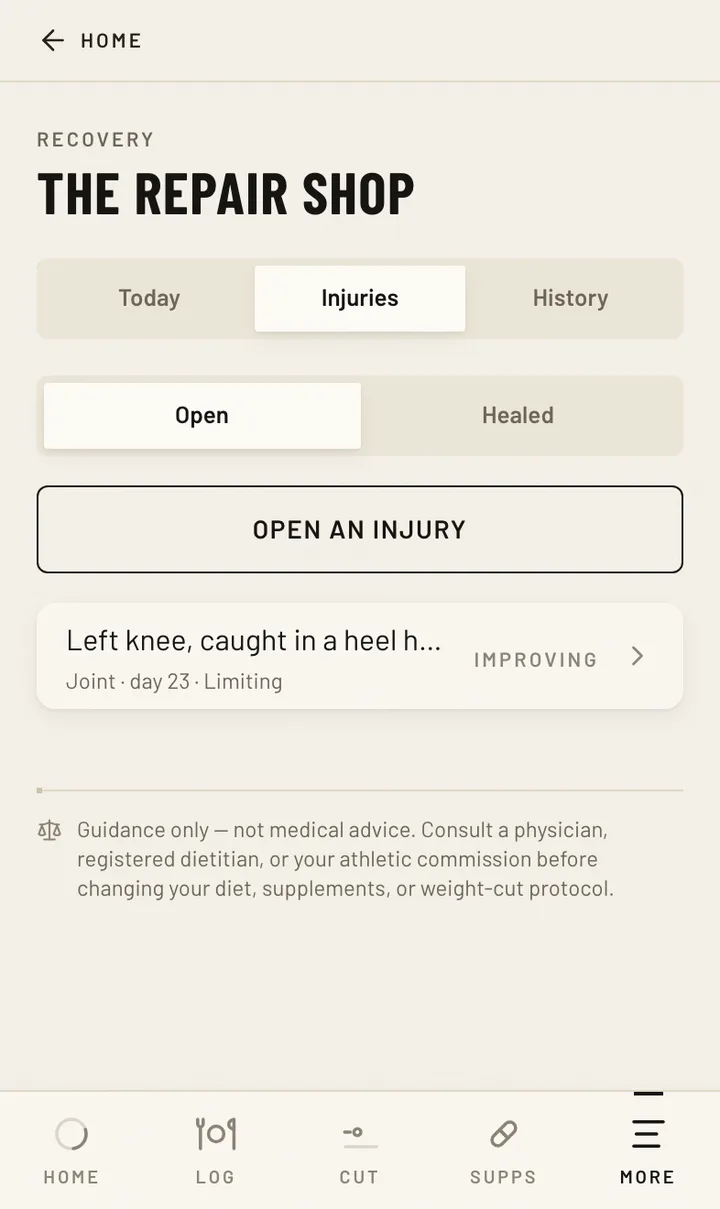
The gap this article keeps returning to — that the administrative machinery only sees what happens in front of a commission — has one partial, unglamorous answer. If nothing official records what happened in the gym, then whatever the athlete writes down is the only record that will exist when a physician finally asks.
That is a documentation function and nothing more. A dated entry saying what happened, what was missed and what changed is information a clinician can use. It is not an assessment, it is not a severity grade in any clinical sense, and it does not tell anyone whether it is safe to train. The general case for keeping an honest injury record in combat sports applies here with one extra caution: with a head injury, the record's only job is to be accurate and to be handed to someone qualified to read it.
The same caution applies to anything else recorded around a head injury. Symptoms overlapping with dehydration are a known diagnostic problem — the overlap between weight-cut symptoms and concussion symptoms is strong enough that it confounds assessment rather than clarifying it — and medication taken around an injury is its own conversation with a clinician, not a self-managed one, which the piece on painkillers in fight camp takes up in detail. A record makes those conversations better. It does not replace them.
Who these rules do not cover
The rules above are narrower than they look, and the gaps are where most people reading this actually live. More on how commission regulation is structured sits in the rules pillar, but the limits specific to this topic are these.
Amateurs. The federal statute covers professional boxing only. The ABC's amateur MMA material is archived and advisory. Amateur athletes across all four sports are governed by whichever sanctioning body is running the event, and those rule sets were not examined here. Do not assume a professional schedule reaches an amateur card.
Minors. None of the commission rules examined sets a different head-injury provision for minors. Nevada flags applicants under eighteen for Commission review, but not with a different concussion rule. California and Virginia are silent. Youth combat sport therefore sits between a consensus statement written for other sports and commissions that regulate adult professionals — and the one clinical note found here about diffuse cerebral swelling being commoner in children and adolescents sits in that gap with nothing to attach itself to.
Muay Thai and kickboxing. No post-knockout suspension schedule for either sport was located in this pass. Nevada's between-bouts rest table names kickboxing alongside boxing, but that is scheduling, not head injury. Treat both sports as covered only by whatever the local commission's general medical-suspension power says.
Women. No regulation examined distinguishes by sex in post-knockout suspension. The rules are sex-blind here. The only sex-disaggregated figure available is a fifteen-person subgroup in one survey, and the combat-sport concussion literature as a whole is overwhelmingly male. That is an absence of evidence, and it should not be filled by scaling a male finding.
Outside the United States. Nothing outside the US was examined. The United Kingdom, Thailand, Japan, Brazil and the European commissions are entirely absent from this article.
The one thing to carry
The day count and the clearance are two different objects, and only one of them is about you. A commission suspension is an administrative minimum: it is not a diagnosis, it is not an examination, and its expiry tells you nothing about your brain. It is a statement about what a jurisdiction will permit at the earliest, produced by a negotiation between regulators, and the fact that four states reach four different answers to the same knockout is the proof that it measures nothing biological.
The only thing that returns a fighter to contact is a physician who has examined them. New York wrote that relationship into the regulation itself with a conjunction — a minimum period and until proof of neurological clearance — and every other jurisdiction examined here routes the exit through a doctor too, even where the number is loud and the doctor is quiet in the text.
So the answer to "when can I spar" is not a date. It is a person, and a conversation, and a piece of paper that person signs. A suspension expiring is permission to be licensed. It is not permission to be hit. Nothing in this article overrides a physician, a commission or a gym's medical staff, and none of it is medical advice.
What we could not verify
- "Nevada suspends you 60 days after a knockout." Chased to origin on 22 September 2026 and not found in NAC chapter 467 or in the Nevada Rules of Unarmed Combat. The 60/30 pair belongs to the ABC guideline for championship professional boxing and is law in Virginia. Widely repeated media reporting of a mandatory 60-day Nevada suspension could not be traced to any Nevada regulation. Separately, whether the Commission imposes such periods as unwritten practice is not determinable from published rules — that is unresolved, not disproved.
- Any day count without a jurisdiction attached. There is no national rule in the United States, and the published floors differ by a factor of two where they exist at all. A bare number is not a fact about anything.
- "20% of boxers hide symptoms." The figure is 21%, the population is 257 fighters both professional and amateur, and the source is Bennett 2019. A 2022 review restated it as roughly 20% of boxers and attributed the same-day figure to amateur fighters; both drifted from the original and neither restatement is used here.
- A California schedule of 45 days with 30 days no contact. This surfaced only through fight-media reporting of event suspension lists, not through any commission-published schedule. The only California-primary figure verified is the statutory minimum in 4 CCR §352.
- "13% of MMA athletes sought medical attention for concussive symptoms," "over half returned to training in under two days," "26% of MMA athletes have a diagnosed concussion," and per-minute concussion rates for boxing and MMA. All surfaced in search summaries and none could be traced to a primary source in this pass.
- Second impact syndrome as a quantified risk. No mortality figure, no probability, no threshold. The two primary sources examined say the case definition is not standardised. The uncertainty is the finding.
- Post-knockout neuroimaging requirements. Nevada requires a brain MRI within the preceding five years and a cerebral MRA for first-time applicants; New York requires an MRI, an ECG and a dilated eye exam. Those are licensing requirements. No rule examined mandates a scan because a fighter was knocked out. Imaging after a knockout is ordered by a doctor, not by a regulation.
- Neuropsychological testing. No jurisdiction examined requires baseline or post-injury neuropsychological testing as a condition of return. The consensus statement notes such batteries may add value where accessible. That is a real gap and it is not filled here.
- Muay Thai, kickboxing, amateur and youth schedules, and any non-US jurisdiction — as set out above, none were located or examined.
- Whether any of these administrative minimums protect anyone. No study examined here tests whether a thirty or sixty-day floor changes any outcome. The floors are administrative settlements. Their effectiveness is unevaluated in the evidence reviewed.
Questions fighters ask
How long after a knockout can I spar?
There is no answer that is a number, and any source that gives you one without naming a jurisdiction is wrong. Two separate things have to happen. A commission's administrative minimum has to elapse — thirty days in New York and California, sixty in Virginia for a knockout, and no fixed period at all in Nevada, where the rule is open-ended. And a physician has to clear you. New York states the relationship explicitly: the suspension runs for a minimum period and until proof of neurological clearance is provided to and approved by the Commission. The date is the earliest the paperwork could permit. Only a doctor who has examined you decides anything about your head.
Does a suspension expiring mean I am cleared?
No, and this inversion is the single most dangerous misreading in the subject. A medical suspension is a licensing action taken by a commission about its own events. Its expiry means the commission will consider permitting you to be licensed; it is not a diagnosis, it is not an examination, and nobody looks at you on the day it lapses. In New York the regulation removes any ambiguity by making the clearance a separate condition joined to the minimum period with "and until." A suspension expiring is permission to be licensed. It is not permission to be hit.
Does Nevada really have no knockout suspension rule?
Nevada has no codified day count for a knockout. A full-text search of NAC chapter 467 and of the Nevada Rules of Unarmed Combat on 22 September 2026 found no rule setting a number of days after a knockout for boxing or MMA. What Nevada has is NAC 467.562, amended effective 28 December 2022, under which a licensee determined by a physician to be unfit must be suspended until it is shown that they are fit. That is open-ended and condition-based. It is not weaker than a day count; it simply relocates the decision to a physician rather than a calendar.
Where does the "60 days" figure come from then?
Two places, neither of them Nevada. It is in the Association of Boxing Commissions' regulatory guidelines, whose own first line scopes the document to championship professional boxing competitions in the US and associated jurisdictions — guidance, adopted state by state, and not law anywhere by itself. And it is enacted as actual law in Virginia, where 18VAC120-40-342 places a boxer losing by knockout on medical suspension for a minimum period of sixty days from any boxing activity. If you see the figure without one of those two attributions, it has escaped its jurisdiction.
Do the Unified Rules of MMA say anything about this?
No. The ABC's Unified Rules of MMA, version 8.2026, were downloaded and searched in full on 22 September 2026 and contain no medical-suspension language at all — no knockout day count, no return-to-training provision, no clearance requirement. Every occurrence of "knockout" is part of a definition of how a bout may end. The archived amateur MMA rules are the same, stating only that medical requirements are determined at the discretion of the sanctioning commissions. An MMA fighter's suspension comes from their commission, not from the rule set.
Does a suspension cover sparring or only fights?
It depends on the jurisdiction, and in several it plainly covers sparring. New York bars "any combative sports contact sparring, contests or exhibitions." California bars any contact boxing during the period without the commission physician's approval. Virginia bars "any boxing activity." New York further defines contact sparring as practice boxing, practice MMA or other practice combative sport between two participants for training purposes in which blows are landed to the head or body in a manner intended to mimic a match, whether or not headgear is used. Light technical sparring is inside that definition.
What if I was knocked out in the gym, not in a fight?
For most people, nothing administrative happens at all — no commission sees it, no record is created and no suspension is generated, because the machinery is triggered by events at sanctioned bouts. The one exception found in this research is New York, which requires a licensed professional boxer or mixed martial artist, or their manager, to report promptly any knockout, injury, accident or illness affecting health or safety whether or not it occurred in a gymnasium. Everywhere else, a gym knockout leaves the regulatory system entirely unaware, which is exactly why that system is nobody's safety net.
Can a suspension be lifted early?
In New York, a suspended combatant may petition the Commission in writing for reduction or removal by furnishing proof satisfactory to the Commission physician of a sufficiently improved medical or physical condition and overall fitness. Federal law for professional boxing describes the same route: a suspension is revoked where the boxer has furnished further proof of a sufficiently improved medical or physical condition. Note what is being filed in both cases — evidence about a body, assessed by a physician. The passage of time is not a ground for the petition.
Can a doctor make it longer than the minimum?
Yes, everywhere examined, and this is the direction the discretion runs. New York provides that longer suspension periods may be issued at the Commission physician's discretion, and separately that nothing in the section restricts a Commission physician from issuing a suspension at any time they believe it necessary. Virginia lets the ringside physician impose a suspension at any time. The ABC guidelines state that in any and all cases the physician's decision to issue or extend a suspension is final. The published number is a floor, never a ceiling.
What does the international concussion consensus say for fighters?
Nothing specific, and that is the important part. The Amsterdam statement published in the British Journal of Sports Medicine in 2023 is the current international consensus, with no successor published as of September 2026 — and a full-text search finds no return-to-sport guidance for MMA, boxing, kickboxing or Muay Thai. It was not written for a sport whose object is head trauma. What it does establish generally is that the return to any activity carrying head-impact risk is authorised by a clinician, after clinical findings have resolved including with and after exertion, and that for anyone whose sport-specific training risks head impact the medical clearance gate comes before that training, not after it.
Do amateurs, minors, Muay Thai or kickboxing fighters have equivalent protection?
Not from anything examined here. The federal statute covers professional boxing only. The ABC's amateur MMA material is archived and advisory, and defers medical requirements to sanctioning commissions. No commission rule examined sets a distinct head-injury provision for minors. No post-knockout schedule for Muay Thai or kickboxing was located at all; Nevada's rest table names kickboxing, but that is a between-bouts scheduling rule with nothing to do with head injury. These groups depend on a local commission's general medical powers and on whoever is sanctioning the event.
Are the rules different for women?
No regulation examined distinguishes by sex in post-knockout suspension — the rules are sex-blind on this question. The evidence base is a different matter: the combat-sport concussion literature is overwhelmingly male, and the only sex-disaggregated figure available in the studies examined here comes from a subgroup of fifteen women in a seventy-athlete survey, which is too small to carry any conclusion. Absence of a sex-specific rule is not evidence that the injury behaves identically; it means nobody examined here has regulated on the question.
Is a brain scan required after a knockout?
Not by any rule examined. Nevada and New York both require imaging to obtain a licence — Nevada a brain MRI within the preceding five years plus a cerebral MRA for first-time applicants, New York an MRI alongside an ECG and a dilated eye exam. Those are licensing requirements, not post-injury ones. What the rules do is empower physicians: Nevada's medical examination provision lets the examining physician require any procedures, including an electroencephalogram if indicated, and California counts recent knockouts with loss of consciousness among the factors that drive additional testing. Imaging after a knockout is a doctor's decision.
Will a suspension in one state stop me fighting in another?
For professional boxing, largely yes by statute: federal law requires commissions to have procedures ensuring no boxer boxes while suspended by any commission for a recent knockout or for an injury or denial of medical certification, and results and related suspensions must be reported to the boxer registries within 48 business hours of a bout. Outside professional boxing it is a matter of cooperation rather than statute — Nevada, for instance, may honour another jurisdiction's medically ordered suspension, while its promoters and matchmakers must check the recognised registries. The ABC's guidelines say out-of-state suspensions will be recognised, but they are guidance.
How risky is being hit in the head again before recovering?
Nobody can put a number on it from the published evidence, in either direction. The concept usually invoked — second impact syndrome — is contested: a 2001 review argued the evidence for it as a complication of recurrent concussion is not compelling and that the clinical picture is more likely diffuse cerebral swelling, and a 2016 systematic review of 338 screened articles found only eight usable case studies, with information on imaging and confirmed signs mixed or absent and no standardised case definition. That is not a reason to dismiss catastrophic swelling, which is real and recognised. It is a reason to treat the question as one for a physician rather than one an athlete can calculate.
Sources
Sourced to
- Consensus statement on concussion in sport: the 6th International Conference on Concussion in Sport — Amsterdam, October 2022 — Patricios JS et al., British Journal of Sports Medicine, 2023;57:695–711. DOI 10.1136/bjsports-2023-106898
- N.Y. Comp. Codes R. & Regs. Tit. 19 § 208.11 — Medical suspensions — New York State Athletic Commission regulations, via Cornell Legal Information Institute; text in force, verified 2026-09-22
- N.Y. Comp. Codes R. & Regs. Tit. 19 § 206.5 — Licenses required and applicable definitions — New York State Athletic Commission; definition of "contact sparring," verified 2026-09-22
- 19 NYCRR Parts 206–214 — New York State Athletic Commission regulations (consolidated PDF) — New York State Department of State; consolidated rules including §§208.8, 208.9, 208.10 and 208.12
- Cal. Code Regs. Tit. 4, § 352 — Boxers Knocked Out — California State Athletic Commission regulations, via Cornell Legal Information Institute; first paragraph amended 1995-10-30, verified 2026-09-22
- 18VAC120-40-342 — Bout termination, knockout, technical knockout, medical suspensions — Virginia Administrative Code, Department of Professional and Occupational Regulation; effective 2007-09-05, verified 2026-09-22
- Adopted Regulation of the Nevada Athletic Commission, LCB File No. R089-22 — Nevada Legislative Counsel Bureau; effective 2022-12-28, amending NAC 467.562 and NAC 467.027, verified 2026-09-22
- Nevada Administrative Code Chapter 467 — Unarmed Combat — Nevada Legislature; chapter text including NAC 467.472, 467.888 and 467.895, searched in full 2026-09-22. Note: this page has not been updated for several R089-22 amendments
- Unified Rules of Mixed Martial Arts, version 8.2026 — Association of Boxing Commissions and Combative Sports, August 2026; full-text searched for suspension, concussion and clearance language 2026-09-22
- Unified Rules and other regulatory information — Association of Boxing Commissions and Combative Sports; current and legacy rule sets, including the amateur MMA rules marked "Recommendations Only," checked 2026-09-22
- 15 U.S.C. §6306 — Safety standards — Professional Boxing Safety Act of 1996 as amended by the Muhammad Ali Boxing Reform Act, via Cornell Legal Information Institute; in force 2026-09-22
- 15 U.S.C. §6307 — Reporting — Professional Boxing Safety Act of 1996 as amended, via Cornell Legal Information Institute; 48-business-hour reporting requirement
- 15 U.S.C. §6305 — Registration — Professional Boxing Safety Act of 1996 as amended; sense of Congress on brain-injury disclosure
- Concussion reporting and perceived knowledge of professional fighters — Bennett LL, Arias JJ, Ford PJ, Bernick C, Banks SJ, The Physician and Sportsmedicine, 2019;47(3):295–300. DOI 10.1080/00913847.2018.1552481, PMID 30479188
- Understanding concussion knowledge and behavior among mixed martial arts, boxing, kickboxing, and Muay Thai athletes and coaches — Follmer B, Varga AA, Zehr EP, The Physician and Sportsmedicine, 2020;48(4):417–423. DOI 10.1080/00913847.2020.1729668, PMID 32067547
- Does second impact syndrome exist? — McCrory P, Clinical Journal of Sport Medicine, 2001;11(3):144–149. DOI 10.1097/00042752-200107000-00004, PMID 11495318
- The diagnostic credibility of second impact syndrome: a systematic literature review — Hebert O, Schlueter K, Hornsby M, Van Gorder S, Snodgrass S, Cook C, Journal of Science and Medicine in Sport, 2016;19(10):789–794. DOI 10.1016/j.jsams.2015.12.517, PMID 26795449
- California State Athletic Commission — licensing and medical requirements — California Department of Consumer Affairs; public guidance on medical testing and the statement that passing medical testing does not guarantee licensure, fetched 2026-09-22
Read next
Plan the descent, don't guess it
Fighter Cut builds a week-by-week plan from today to your weigh-in, classifies the rate you are actually losing at, and logs what you eat against it. It does not make a cut safe — nothing does. It makes the numbers visible early enough to change them.
Open Fighter Cut