Fighter Cut › Articles › Fight camp
Fight camp
Tracking injuries in combat sports
An injury rate is meaningless without the definition that produced it. A log's whole value is that it fixes one — and it still will not tell you what tissue is hurt.
Twenty-five studies have counted injuries at judo tournaments. Pool them and the reported rate runs from 10.9 to 109 injuries per 1,000 athlete-exposures. That is a tenfold spread, in one sport, at one kind of event, and almost none of it is judo changing.
It is the definition changing. Sixteen of those twenty-five studies counted an injury as something a tournament doctor was asked to look at. Five counted an injury as something that stopped the athlete training or competing. Under the first definition the range is 10.9 to 109 per 1,000 exposures. Under the second, at the same kind of event, it is 4.2 to 60. Expressed as a proportion of athletes rather than a rate, the gap is wider still: 2.5% to 72.5% of competitors injured under medical-attention definitions, against 1.1% to 4.1% under time-loss. The same problem runs through the published MMA injury rates and through the grappling figures, which is why the two sets of numbers cannot be laid side by side.
The review's own summary of this is one sentence: "The large variation in injury definitions explains a great proportion of the wide variety in reported injury incidences."
That is the whole subject of this article, and it applies as much to a fighter's own history as to a literature. If a change of definition can move a published number by an order of magnitude, then "I've had a few niggles this camp" carries no information at all — not to a coach, not to a physio, not to the fighter themselves in eight months' time. What a log does is not make the injury real. It fixes a definition and a date to it.
What follows is what the surveillance literature establishes about counting injuries, what the current methodology standard actually asks for, why severity in that standard is measured in days rather than in tissue, and where combat sports are simply not counted at all. Every rate below travels with the definition, the cohort and the sport that produced it, because separated from those it is not a number about anything.
Injury incidence per 1,000 athlete-exposures at judo tournaments under medical-attention definitions versus time-loss definitions — same sport, same setting, 25 studies, competition exposure only
Mooren et al., Transl Sports Med 2023, PMC11022761
The IOC 2020 consensus severity bands, in days the athlete is unavailable for training and competition. Not tissue grades, and not the five-label scheme often attributed to it
Bahr et al., BJSM 2020;54(7):372–389 / Orthop J Sports Med, PMC7029549
Proportion of variance in return-to-play time explained by BAMIC tissue grade across 169 MRI-graded muscle injuries in 90 male professional footballers — roughly 70% unexplained
Huber et al., Scand J Med Sci Sports 2025;35(10):e70147
Overuse problems in knee, lower back and shoulder recorded over 13 weeks in 313 athletes by a weekly functional questionnaire, against standard injury registration in the same athletes over the same weeks
Clarsen et al., BJSM 2013 (five Norwegian sports, no combat sports)
- Definition, not risk, is the biggest single driver of a published injury rate. Across 25 judo tournament studies the incidence was 10.9–109 per 1,000 athlete-exposures under medical-attention definitions and 4.2–60 under time-loss definitions, with injury proportions of 2.5–72.5% against 1.1–4.1%.
- The current methodology standard measures severity in days, not grades. The IOC 2020 consensus recommends recording severity as "the number of days that the athlete is unavailable for training and competition, from the date of onset until the athlete is fully available," and where categories are needed, bins of 0, 1–7, 8–28 and >28 days.
- Tissue grade is a weak predictor of time out. In 169 MRI-graded muscle injuries in 90 male professional footballers, BAMIC correlated with return-to-play time at r = 0.533 (r² = 0.285) and the MCS at r = 0.583 (r² = 0.302) — about 70% of the variance unexplained. The authors state that return-to-play prediction "should not be based solely on MRI imaging or classification systems."
- Recording function rather than diagnosis is the published precedent, not an improvisation. The OSTRC instruments ask weekly about participation, training volume, performance and symptoms, and in 313 athletes across five Norwegian sports that method recorded 419 overuse problems in knee, back and shoulder where standard registration in the same athletes over the same 13 weeks recorded 40.
- Memory loses the detail before it loses the event. The Muay Thai survey authors report that participants had near-perfect recall of whether an injury had occurred over a year, "with decreasing percentages of participants recalling the exact number, body region or diagnosis."
- Longer recall periods systematically undercount. In a 15,223-person household survey in Tanzania — general population, not athletes — non-fatal injury rates fell from 72 per 1,000 person-years at one-month recall to 32.7 at twelve-month recall, a 55% decline, and the decline appeared only for injuries causing fewer than 30 days of disability.
- Under-reporting is a decision, not a lapse. Of 797 former US collegiate athletes surveyed, 33.2% of those who recalled a concussion said they had not disclosed at least one; the four most common reasons were not wanting to leave the game or practice (78.9%), not wanting to let the team down (71.8%), not knowing it was a concussion (70.4%) and not thinking it serious enough (70.4%).
- Prior injury as a predictor is not settled in combat sports. In the hamstring literature, in male footballers, prior injury is the most consistent predictor of recurrence. In the 195-fighter Muay Thai survey, previous injury carried an odds ratio of 1.81 with a confidence interval of 0.98 to 3.3 — it did not reach significance, though the authors list it among the associated characteristics.
- Combat-sport injury surveillance is a competition-day literature about men. One BJJ cohort does not report sex at all, one BJJ championship study is male-only, the Muay Thai survey is 85.9% male, and gym sparring — where most exposure accumulates — is essentially unsurveilled.
1. The same sport, the same tournaments, ten times the rate
Start with the number, because it does the work.
A 2023 systematic review in Translational Sports Medicine assembled 25 studies of injuries at judo tournaments. These are not scattered contexts. They are competitions, with medical cover present, counting injuries in judoka. The design similarity is about as good as this literature gets.
The reported injury incidence rate per athlete-exposure — IIRAE, in the review's notation — "ranges from 10.9 to 109 for injuries requiring medical attention and 4.2 to 60 for injuries causing time loss." The injury incidence proportion, the share of competitors injured, "varied between 2.5% and 72.5%" under medical-attention definitions and "between 1.1% and 4.1%" for time loss.
Read those two proportion ranges beside each other. Under one definition, up to seven in ten judoka at a tournament are injured. Under the other, one in twenty-five at most. The judo did not change.
The review's stated definitions are worth having verbatim, because they are the ordinary ones used across the whole field. A medical-attention injury is "a physical complaint, for which assistance was sought from a tournament healthcare professional." A time-loss injury is "all injuries that resulted in an interruption of practice (competition or training)."
Those two sentences describe two genuinely different objects. The first counts a request for help. The second counts an interruption. A cut above the eye that gets a swab and a strip and no lost training is one injury under the first and zero under the second. A rib that hurts for a fortnight but was never mentioned to anyone at the venue is zero under the first and one under the second. Neither definition is wrong. They are answering different questions, and the answers differ by a factor of ten.
2. What this means for a fighter's own count
The literature's problem is a fighter's problem in miniature.
Ask a competitor how many injuries they have had this year and the number they give is generated by a definition they have never stated and are not aware of holding. Some fighters count only what stopped them training. Some count only what a doctor saw. Some count what still hurts today. Some count what they remember, which is a fourth definition entirely and the least stable of them.
Two athletes in the same gym, with identical bodies and identical years, will report counts that differ by an order of magnitude for exactly the reason the judo studies do. And unlike the studies, neither of them can tell you which definition they used, so the counts cannot be reconciled afterwards.
This is why the honest case for logging is narrow and specific. A log does not detect injuries. It does not grade them. It does not know anything the athlete does not know at the moment of writing. What it does is force a definition to be stated once, apply it consistently, and attach a date to it. Everything else that a log is claimed to do downstream — spot a pattern, inform a physio, contextualise a bad camp — depends entirely on that one property and is worthless without it.
The judo review is the demonstration that this is not a pedantic point. It is the single largest source of variance in an entire sport's published injury literature.
3. The standard that already exists, and what it asks for
There is a general methodology standard for this, and it is worth knowing what it does and does not do.
The current one is the International Olympic Committee consensus statement on methods for recording and reporting epidemiological data on injury and illness in sport, published in the British Journal of Sports Medicine in March 2020 and co-published in Orthopaedic Journal of Sports Medicine, which is where the open text sits. It introduced STROBE-SIIS, a reporting extension for injury and illness surveillance studies.
It is consensus guidance for researchers. It is not a rule any commission enforces, and no fighter is bound by it. Its value here is that it represents the assembled opinion of the people who have spent careers trying to make injury numbers comparable, and its recommendations are unusually blunt about what to record.
The statement is explicit that the two definitions from the judo review are the field's standing categories: "A health problem that results in an athlete receiving medical attention is referred to as a 'medical attention' health problem, and a health problem that results in a player being unable to complete the current or future training session or competition is referred to as a 'time-loss' health problem." It also notes that neither is exhaustive — "as not all health problems limit an athlete's ability to participate nor require medical attention, broader definitions (self-reported, symptom-based, or performance based) will capture more health problems."
That last clause is the one that matters for an athlete keeping their own record. The category most fighters actually live in — a shoulder that limits what can be drilled but stops nothing and sees nobody — is explicitly outside both standard definitions, and the consensus says so.
On exposure, it prefers hours to exposures: "In general, incidence-based measures that provide a standard time window for the population at risk (injuries per hour) are preferable to measures for which the time at risk varies across individuals (injuries per athletic exposure)." Nearly all the combat-sport data below is per athlete-exposure, which is the weaker denominator, because that is what tournament surveillance can capture.
And one recommendation is addressed almost exactly at the situation of a fighter writing their own log: "When injury data are reported by athletes or nonmedical staff, we recommend that reporting is limited to the body area, as their reporting of tissue type and abnormality is unreliable." Body area, not tissue. That is the ceiling on what a self-kept record is entitled to claim, stated by the standard itself.
4. Severity in the standard is days, not grades
The most useful thing in the consensus is the definition of severity, because it is not the one most people assume.
The recommendation is to "record severity as the number of days that the athlete is unavailable for training and competition, from the date of onset until the athlete is fully available for training and competition." Where investigators need categories rather than a continuous count, the statement gives four time bins: "0 days, 1 to 7 days, 8 to 28 days, and >28 days."
Two things follow. First, severity in this framework is a measurement of availability. It is not a measurement of tissue, and nothing in the severity section refers to a tissue grade. Second, the widely repeated five-label scheme — slight, minimal, mild, moderate, severe — is not in it. That lineage comes from the earlier football consensus work and is regularly and wrongly attributed to the IOC statement. If someone tells you the IOC classifies injuries as mild, moderate or severe, they are describing a different document.
The statement is also careful about the arithmetic. "When aggregating data across athletes, severity should be reported as the total number of time-loss days, together with medians and quartiles. Means and standard deviations should be interpreted with care, given that the distribution of time-loss days is likely to be right-skewed." A handful of long injuries drags an average away from anything typical, which is worth remembering the next time a mean return-to-play figure is quoted at you.
Days unavailable is a demanding thing to record honestly and an easy thing to record at all. It requires a date of onset, a date of full availability, and no opinion in between. That is within the reach of a fighter with a phone and outside the reach of a fighter relying on memory, for reasons the recall evidence makes concrete further down.
5. Tissue grade explains less of the time out than people think
The alternative framing — record the grade, and the grade tells you the timeline — is testable, and it has been tested.
Huber and colleagues, publishing in Scandinavian Journal of Medicine & Science in Sports in 2025, followed 90 male professional footballers over ten consecutive seasons, 2012/13 to 2021/22, and collected 169 acute muscle injuries with MRI performed at a mean of 2.3 days after onset. They graded every injury under two accepted systems — the British Athletics Muscle Injury Classification and the Munich Consensus Statement classification — and correlated each against actual return-to-play time.
BAMIC correlated at r = 0.533, which is r² = 0.285. The MCS correlated at r = 0.583, r² = 0.302. In plain terms: even with an MRI performed within two or three days by a professional club with full-time medical staff, the tissue classification accounts for something under a third of the variation in how long the athlete was actually out. Roughly seventy per cent of what decided the date was something the grade did not measure.
The paper does report that location matters — intratendinous injuries had a median return-to-play of 26.5 days against 12 days for myofascial injuries — so the grade is not noise. It shifts the distribution. It does not name a date.
The authors say both halves of this themselves. On the effect sizes: "Effect sizes of r² = 0.302 and r² = 0.285 are not particularly strong for both classifications and leave a wide interval of uncertainty." And on the practical conclusion: "The prediction of RTP should not be based solely on MRI imaging or classification systems, as they are only one piece of the puzzle in the assessment and management of sports-related muscle injuries."
That is football, in men, with imaging. It is borrowed evidence for a combat athlete and it is the strongest evidence available on the question. The longer treatment of severity against tissue grade goes through what the grading systems agree and disagree about between themselves. The point for a log is narrower: the variable those studies were trying to predict — days unavailable, what the athlete could and could not do — is the variable an athlete can record directly, and it is not a poorer version of the grade. It is the thing the grade was being used to guess at.
6. Recording function is the published method, not a shortcut
If severity is availability, then the instrument should ask about availability. That is what the Oslo Sports Trauma Research Center questionnaires do, and they are the reason a functional record is a defensible design rather than an app developer's convenience.
The OSTRC Overuse Injury Questionnaire was developed and validated by Clarsen and colleagues in a 13-week prospective study of 313 athletes across five Norwegian sports — cross-country skiing, floorball, handball, road cycling and volleyball. It is administered weekly, and it asks the athlete about four things: participation, training volume, performance, and symptoms. It does not ask for a diagnosis. A companion instrument, the OSTRC Questionnaire on Health Problems, extended the same logic to illness and acute injury, and updated versions of both were published in 2020.
None of those five sports is a combat sport, and the instruments were built for research surveillance rather than for an individual athlete's own use. Both of those limits are real and neither is fatal to the point, which is about method: a validated instrument in this field asks what the athlete can do, at a fixed interval, in the athlete's own report.
The severity ladder in a well-built injury log — a niggle that changes nothing, something limiting that changes what can be trained, something that stopped a session — is that structure. It is deliberately not a tissue grade, and the reason is the one the IOC statement gives outright: athlete-reported tissue classification is unreliable, and a grade recorded without imaging is not the same object the grading systems define.

7. Time-loss counting misses most of what a fighter carries
The strongest argument for asking about function rather than about time loss is what happens when you run both methods on the same athletes at the same time.
In that 13-week OSTRC study, the questionnaire recorded 419 overuse problems in the knee, lower back and shoulder, of which 142 were classified as "substantial" — meaning a moderate or severe reduction in participation, training volume or performance, or time loss. Across the same weeks, in the same athletes, in the same three anatomical areas, standard injury registration recorded 40 overuse injuries.
Weekly, an average of 39% of the athletes reported a problem and 13% reported a substantial one.
Hold the caveats firmly: five Norwegian sports, none of them combat sports; three body areas only; overuse problems, not acute trauma. This does not transfer as a rate to a fight gym. What transfers is the mechanism. A method that only counts interruptions counts almost none of what athletes are actually carrying, because most of what they are carrying does not interrupt anything. It changes what they will do, how hard, and how well — and those are precisely the things the time-loss definition is blind to by construction.
For a fighter this is the ordinary case rather than the edge case. A shoulder that turns hard rounds into technical rounds for three weeks produces zero time-loss injuries and one long, consequential problem. Under a time-loss log, that camp reads as clean.
8. Memory is the alternative, and it decays unevenly
The realistic comparison for a log is not a better log. It is no log, and a recollection produced on demand months later at a medical, an intake form, or a physio's first appointment. That comparison has been measured, in two useful ways.
The first is about recall period. Moshiro and colleagues, in Injury Prevention in 2005, surveyed 15,223 people in a Tanzanian community-based cluster sample about non-fatal injury, varying the recall period from one month to twelve. Their finding: "Longer recall periods underestimate injury rates compared with shorter recall periods." The rate fell from 72 per 1,000 person-years at one-month recall to 32.7 at twelve months — a 55% decline in the same population, from nothing but the length of the look-back.
The structure of the decline is the interesting part. "The decline was found for injuries resulting in fewer than 30 days of disability whereas rates for severe injuries (disability of 30 days or more) did not show a consistent variation with recall period." The authors' recommendation follows: "It is essential that a recall period of less than three months be used to calculate injury rates for less severe injuries."
That is a general population in Tanzania, not athletes, and it must be read as a mechanism rather than as a rate about anybody's sport. But the mechanism is exactly the one that matters. The injuries memory loses are the sub-30-day ones — which is nearly everything a fighter accumulates in a camp.
The second measurement comes from combat sport directly. The authors of the Muay Thai survey below restricted recall to six months for exactly this reason, and stated what they found about longer windows: "injury rates over a 1-year time period had perfect recall whether an injury had occurred, with decreasing percentages of participants recalling the exact number, body region or diagnosis."
That sentence is the precise case for writing things down. The fact survives. The detail does not. And the detail — which side, how long, what it stopped — is the entire content of a useful history.
9. Under-reporting is a decision, and it is not fixed by writing things down
A log fixes memory. It does not fix motive, and the motive evidence is worth stating so nobody oversells what a record achieves.
Kerr and colleagues, in the American Journal of Sports Medicine in 2016, surveyed 797 former US collegiate athletes; 214 recalled at least one concussion, and of those, 33.2% reported that they had not disclosed at least one of them at the time. Former football athletes were the most likely to report non-disclosure — 68.3% of those recalling a concussion. Men were around twice as likely as women to have withheld at least one (adjusted prevalence ratio 2.11, 95% CI 1.13–3.96).
The reasons given, with multiple responses allowed, were not confusion: did not want to leave the game or practice, 78.9%; did not want to let the team down, 71.8%; did not know it was a concussion, 70.4%; did not think it was serious enough, 70.4%.
Three of those four are decisions. This is retrospective self-report of concussion specifically, in a cohort with a 21.9% response rate and a mean age of 35.3, so it describes a population's remembered behaviour rather than measuring a rate of concealment as it happens. But the direction is unambiguous and it is the same in every gym: the athlete who does not want to be pulled out of sparring does not report the thing that would pull them out of sparring.
A private log changes the incentive slightly — nobody is taking the round away from you for writing "limiting" in an app — and it does not change it much. Any honest account of injury tracking has to say that a self-report system inherits the honesty of the person filling it in, and that in the one large cohort where this was asked, a third of them said they had not been honest.
10. Does a logged history predict the next injury? The evidence pulls two ways
The implicit promise of a long injury record is prediction. Here the honest answer has a genuine tension in it and the article that resolves the tension is misreporting one side of it.
In one direction: prior injury is the most consistently reported predictor of re-injury in the hamstring literature, where recurrence rates after a prior hamstring strain run roughly two to six times higher, and a prospective cohort of 508 male soccer players reported an odds ratio of 2.62 (95% CI 1.54–4.45) for previous acute hamstring injury. That is male footballers and hamstring strains. It is borrowed evidence twice over — wrong sport, one tissue — and it is the sturdiest finding on the question that exists.
In the other direction, the only combat-sport test of the same idea located here did not reproduce it. In the 195-fighter Muay Thai survey, previous injury carried an odds ratio of 1.81 with a 95% confidence interval of 0.98 to 3.3 against fight-related injury in multivariate analysis. The interval includes 1, so the association did not reach significance — though the paper's own conclusions name previous injury among the characteristics associated with increased odds, so this is a study whose estimate and whose summary sentence point in slightly different directions.
The correct reading of that pair is not "prior injury predicts re-injury" and not "it doesn't." It is that a well-established finding in one sport and one tissue did not clearly replicate in a retrospective self-report survey of a different sport, with a single most-severe injury per fighter and a six-month recall cap, and the question is therefore open in combat sports.
Which is a reason to keep the record rather than a reason not to. A log whose predictive value is unproven is still a history, and a history is what the physician examining the knee in eighteen months does not otherwise have.
11. The combat-sport numbers, each with the definition attached
Here is what has actually been counted, and none of these figures is comparable to any of the others.
Brazilian jiu-jitsu competition: 9.2 injuries per 1,000 exposures. Scoggin and colleagues, Orthopaedic Journal of Sports Medicine 2014, covered eight Hawaii state tournaments between 2005 and 2011 — 2,511 matches, 5,022 athlete-exposures — with board-certified orthopaedic surgeons on site. The definition was all injuries requiring on-site medical care, which is a medical-attention definition. Sex is not reported anywhere in the study. Within the same data, athletes aged 15 and under were injured at 4.1 per 1,000 exposures against 10.8 for those 16 and over.
The investigators name their own blind spot: "It is possible that certain injuries may have had delayed onset of symptoms and therefore, might not have been identified on the day of the competition." Day-of-competition medical cover cannot see anything that surfaces on Monday, and it cannot see anything an athlete chooses not to present.
BJJ no-gi world championship: a joint-injury rate of 24.9 per 1,000 exposures, ranging from 21.5 at blue belt to 35.1 at black belt, across 1,606 athlete-exposures in male competitors at one 2009 championship. This figure is from an abstract-level source and it counts joint injuries only, so it is not comparable with the 9.2 above despite both being BJJ competition rates. Two numbers from one sport, differing by nearly threefold, counting different things.
Muay Thai: 55.4% of fighters reported an injury in their most recent fight. Strotmeyer and colleagues, Injury Epidemiology 2016, ran a web-based retrospective survey of 195 fighters — 49.2% professional, 85.9% male, median age 26 — with recall restricted to six months and an injury defined as painful harm sustained in a sanctioned fight, one most-severe injury recorded per fighter. Extremities accounted for about 58% of injuries. Self-reported concussion was 5.4%, which in a self-report instrument with the disclosure evidence above sitting beside it is near-certainly an undercount. And 66.7% said the injury did not stop them finishing the bout — which is 55.4% injured and almost no time loss, the two definitions coming apart inside a single dataset.
Amateur boxing competition: around 54.7 injuries per 1,000 athlete-exposures, or 6.8 per 1,000 minutes of exposure, from a 2022 meta-analysis in the Journal of Science and Medicine in Sport, with head and neck the most-injured region at a median of 72% of injuries (range 46–100%) and pooled figures of 12.3% concussion, 21.4% laceration and 30.2% contusion. Those are pooled across studies using mixed definitions, which is the same problem the judo review named, so treat the central estimate as soft.
Elite and youth judo, at abstract level: 35.6 per 1,000 athlete-exposures (95% CI 22.8–53.0) at the 2015 U23 European Championships across 295 registered athletes, competition only; and 16.96 per 1,000 for female and 16.57 for male athletes in a 30-week prospective cohort of 154 elite youth judoka covering acute and overuse injury in both training and competition. That youth cohort is one of very few combat-sport datasets that reports women separately at all.
Lay those out and the useful observation is not any single rate. It is that no two of them answer the same question, and that a fighter comparing their sport's headline number to another sport's headline number is comparing definitions.
12. Who is missing from all of this
Four absences, all of which change how much of the above applies to any given reader.
Women. The BJJ tournament study does not report sex. The no-gi championship study is male-only. The Muay Thai survey is 85.9% male. The NCAA wrestling surveillance data most often quoted is men's wrestling. The one exception located is the 154-athlete youth judo cohort, which reports 16.96 per 1,000 for women against 16.57 for men — and it is a youth cohort, not senior. There is no basis in this literature for stating an adult female combat-sport injury rate, and there is no coefficient that converts a male one.
Adolescents. The BJJ study's 4.1 versus 10.8 per 1,000 split at age 16 is nearly the only age stratification in the set. The prospective amateur Muay Thai cohort often cited as adult data had a mean age of 17.3 — that is an adolescent dataset being read as an adult one, and it should be flagged every time it is used.
Amateurs and gym exposure. Almost all combat-sport surveillance is competition-day medical coverage at sanctioned events. Unsanctioned smokers, interclub matches and ordinary gym sparring — which is where the vast majority of an amateur's exposure accumulates — are essentially unsurveilled. The population most likely to be reading an injury-tracking article is the population least represented in the numbers it quotes.
Training exposure in MMA. No verified training-exposure injury rate for MMA survived the source check for this article. Two commonly circulated per-1,000-hour figures could not be traced to a readable primary and are named in the section below rather than printed here.
13. What the record is for, and what it is not
The regulatory version of an injury record already works the way this article has been describing, which is worth noticing.
In Nevada — and the text differs in every jurisdiction — the rule reads: "A licensee, unarmed combatant or person associated with unarmed combat who is determined by a physician to be unfit to compete, officiate or otherwise participate in a contest or exhibition must be suspended until it is shown that he or she is fit for further competition, officiating or participation." And: "An unarmed combatant suspended for 30 days for his or her medical protection shall take a medical examination upon the direction of the Commission or the Commission's representative."
Note the vocabulary. Fit, unfit, until shown fit. No tissue grade anywhere. A commission's record of an athlete's injury is a record of participation status and a physician's judgement, and the physician's decision is final. It is functional in exactly the sense the OSTRC instruments are functional and the IOC severity definition is functional. Nothing in a personal log shortens a commission suspension, overrides a ringside physician, or substitutes for an examination — the log records consequence, the clinician diagnoses tissue.
A worked scenario, and it is a scenario rather than anyone's case. Two fighters take a body kick in week three of an eight-week camp. Neither sees a doctor.
The first remembers it. Six months later, at a pre-fight medical, she says she hurt her ribs at some point last year. On the recall evidence that is precisely the class of injury memory loses — sub-30-day disability, where the twelve-month rate ran 55% below the one-month rate — and on the Muay Thai authors' own account she will correctly recall that something happened while losing the number, the side and the description.
The second logs it, at the level she is entitled to record: not a grade, which the IOC statement says athlete-reported tissue classification cannot support, but limiting — could do technical rounds, could not throw the left hook at full commitment — with a date of onset and a date she was fully available again. Nine days.
Next camp, the same kick lands in the same week. Now the second entry is not a feeling that this has happened before. It is a pattern with two dates, two durations and a stated functional consequence, which is a thing a coach can plan around and a physio can read. This is the shape the record takes in Fighter Cut, where severity is niggle, limiting or stopped and never a tissue grade, for the reason the IOC statement gives.
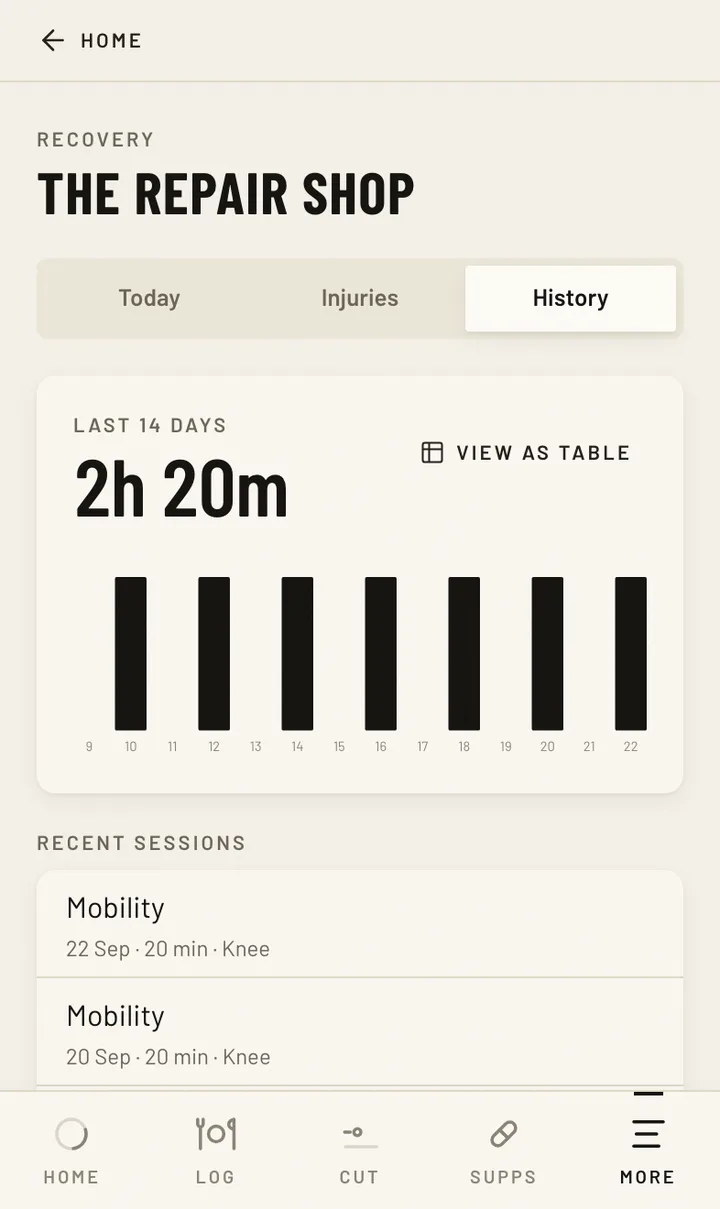
What the record is not: a diagnosis, a prediction, a clearance, or a reason to train through anything. The prediction question is open in combat sports, as section 10 sets out. The diagnosis belongs to a clinician who has examined the athlete. What a log adds is the one thing the judo review shows is scarce and expensive — a fixed definition, applied the same way twice, with dates attached — and the one thing the recall literature shows is otherwise guaranteed to be lost.
What we could not verify
An article this specific about other people's numbers owes an account of its own gaps.
- "7.0 injuries per 1,000 athlete-hours of MMA training" and "11.8 per 1,000 athlete-training-sessions." These circulate as a matched pair with confidence intervals attached, which is what makes them convincing. We could not identify the origin paper. They surfaced only as a search-level summary with no traceable primary, and they are not printed here.
- "1.4 injuries per 1,000 hours in MMA," competitive versus recreational. The paper it is attributed to exists; the abstract could not be retrieved and was never read. An unread abstract is not a source.
- "30 injuries per 100 minutes" in heavyweight amateur Muay Thai. This comes from a 92-athlete prospective study in which a single weight class may contain a handful of bouts. It is almost certainly a small-denominator artefact — a rate computed from a couple of events over a few hundred minutes — and refusing to print it is a better illustration of this article's argument than printing it would be.
- A 60-day mandatory suspension after a knockout in Nevada. Widely repeated. The Nevada Administrative Code section actually read for this article, NAC 467.562, does not contain it. Comparable 30- and 60-day figures do exist in the Association of Boxing Commissions' boxing guidelines and in some state regulation, which is a different document and a different sport. We do not attribute the figure to Nevada.
- "Between 12% and 78% of concussions go unreported." A range assembled across three heterogeneous studies with different definitions and populations, which then circulates stripped of all of them. The 33.2% figure from the 797-athlete collegiate cohort, with its cohort attached, is used instead.
- The NCAA men's wrestling injury rate, often quoted as 8.82 per 1,000 athlete-exposures. The Injury Surveillance Program report itself was not obtained, so the figure is not printed as fact here.
- Two body-text sub-figures from the Muay Thai survey — a head-injury share and specific contusion and laceration percentages — could not be reached in the abstract, which gives 58% for extremities. Only the confirmed figures appear above.
- No combat-sport dataset combining training load and injury exists. Not a weak one; none was located. Any claim that a load metric predicts a fighter's injury risk is running on other sports' data, and the training-load evidence itself is contested even there. The defensible claim is that a log of load beside a log of injury lets an athlete read their own history — not that a ratio forecasts anything.
- Amateur and gym sparring exposure is essentially unsurveilled. No registry publishes it, and no study located here counts it. That absence is not a gap in this article; it is a gap in the field, and it covers most of the training most fighters do.
Questions fighters ask
Why do injury rates for the same sport vary so much between studies?
Mostly because the studies are counting different things. Across 25 judo tournament studies, the reported incidence was 10.9 to 109 injuries per 1,000 athlete-exposures under medical-attention definitions and 4.2 to 60 under time-loss definitions — the same sport at the same kind of event, with a tenfold gap driven by the definition alone. The review's own conclusion is that "the large variation in injury definitions explains a great proportion of the wide variety in reported injury incidences." Study design, medical cover, event level and reporting quality contribute too, but definition is the dominant term. When you see a rate quoted without the definition attached, you cannot tell which of the two literatures it belongs to.
What is the difference between a "time-loss" injury and a "medical-attention" injury?
They are the field's two standard definitions and they count different events. A medical-attention injury is, in the judo review's wording, "a physical complaint, for which assistance was sought from a tournament healthcare professional." A time-loss injury is "all injuries that resulted in an interruption of practice (competition or training)." A cut that gets treated cageside but costs no training is one under the first definition and zero under the second. A back that hurts for two weeks but was never mentioned to anyone at the venue is the reverse. The IOC 2020 consensus uses both categories and notes that broader self-reported, symptom-based or performance-based definitions capture more health problems than either.
How does the IOC consensus say severity should be recorded?
In days. The recommendation is to "record severity as the number of days that the athlete is unavailable for training and competition, from the date of onset until the athlete is fully available for training and competition." Where categories are needed rather than a continuous count, it gives four bins: 0 days, 1 to 7 days, 8 to 28 days, and more than 28 days. It also advises reporting total time-loss days with medians and quartiles rather than means, because the distribution is likely to be right-skewed. Severity in this framework is a measurement of availability, not of tissue.
Does the IOC classify injuries as slight, minimal, mild, moderate and severe?
No. That five-label scheme is regularly attributed to the IOC statement and it is not in its severity section. The IOC 2020 severity bands are 0 days, 1–7 days, 8–28 days and more than 28 days, all expressed as days unavailable for training and competition. The slight/minimal/mild/moderate/severe labels belong to the earlier football consensus lineage. The distinction matters because the two schemes measure different things: one is a count of days, the other is a set of adjectives that different documents define differently.
Can an MRI grade tell you how long a fighter will be out?
Only partly. In 169 acute muscle injuries across 90 male professional footballers over ten seasons, with MRI performed at a mean of 2.3 days, the BAMIC classification correlated with return-to-play time at r = 0.533 (r² = 0.285) and the Munich system at r = 0.583 (r² = 0.302). That leaves roughly 70% of the variation in time out unexplained by the grade. Location did matter — intratendinous injuries had a median 26.5 days against 12 for myofascial. The authors' own conclusion is that return-to-play prediction "should not be based solely on MRI imaging or classification systems." This is football, in men, with full-time club medical support; no equivalent cohort exists in combat sports.
Should I record a diagnosis in my own injury log?
The IOC consensus is explicit on this point: "When injury data are reported by athletes or nonmedical staff, we recommend that reporting is limited to the body area, as their reporting of tissue type and abnormality is unreliable." Body area plus functional consequence plus dates is what a self-kept record can support. A grade written into a log without imaging is not the same object the grading systems define, and it can mislead the clinician who reads it later more than a blank field would. The diagnosis belongs to whoever examines the athlete.
How much does memory actually lose?
More than most people expect, and selectively. In a community survey of 15,223 people in Tanzania — general population, not athletes — non-fatal injury rates fell from 72 per 1,000 person-years at one-month recall to 32.7 at twelve-month recall, a 55% decline, purely from the length of the look-back. Critically, the decline appeared for injuries causing fewer than 30 days of disability; severe injuries showed no consistent variation with recall period. The authors recommend a recall period under three months for less severe injuries. Separately, the Muay Thai survey authors report that fighters had near-perfect recall of whether an injury had occurred over a year, "with decreasing percentages of participants recalling the exact number, body region or diagnosis." The event survives; the detail does not.
Does keeping a log stop athletes hiding injuries?
Not by itself. Among 797 former US collegiate athletes surveyed, 33.2% of those who recalled a concussion said they had not disclosed at least one at the time. The reasons given, with multiple responses permitted, were not wanting to leave the game or practice (78.9%), not wanting to let the team down (71.8%), not knowing it was a concussion (70.4%) and not thinking it serious enough (70.4%). Three of those four are decisions rather than lapses of memory. A private record removes one incentive to conceal — nobody pulls you from sparring for an entry in an app — but any self-report system inherits the honesty of whoever fills it in, and this is the largest cohort in which that has been asked.
Does a previous injury make the next one more likely in combat sports?
The evidence pulls in two directions and the question is open. In the hamstring literature, in male footballers, prior injury is the most consistent predictor of recurrence — roughly two to six times higher recurrence rates, with an odds ratio of 2.62 (95% CI 1.54–4.45) for previous acute hamstring injury in a prospective cohort of 508 players. But in the 195-fighter Muay Thai survey, previous injury carried an odds ratio of 1.81 with a confidence interval of 0.98 to 3.3 against fight-related injury, which does not reach significance, though the paper's conclusions list it among associated characteristics. A finding from one sport and one tissue did not clearly replicate in a retrospective survey of another. Nobody should claim it settled in either direction.
What is the injury rate in BJJ competition?
The most carefully collected figure is 9.2 injuries per 1,000 exposures, from eight Hawaii state tournaments between 2005 and 2011 — 2,511 matches, 5,022 athlete-exposures — assessed by board-certified orthopaedic surgeons on site, with the injury defined as requiring on-site medical care. Sex is not reported in that study. Within it, athletes 15 and under were injured at 4.1 per 1,000 and those 16 and over at 10.8. A separate abstract-level study of one 2009 no-gi world championship reports a joint-injury rate of 24.9 per 1,000 exposures in 1,606 male athlete-exposures — but that counts joint injuries only, so it is not comparable despite both being BJJ competition rates.
Do these injury numbers apply to women?
Largely they cannot be said to. The main BJJ tournament study does not report sex at all; the no-gi championship study is male-only; the Muay Thai survey is 85.9% male; the most-quoted NCAA wrestling surveillance is men's wrestling. The single exception located here is a 30-week prospective cohort of 154 elite youth judoka reporting 16.96 injuries per 1,000 athlete-exposures for female and 16.57 for male athletes — and that is a youth cohort, not senior. There is no defensible adult female combat-sport injury rate in this material, and a male rate does not become a female one by applying a multiplier.
Is anyone counting gym injuries, as opposed to competition injuries?
Effectively no. Almost all combat-sport injury surveillance is competition-day medical coverage at sanctioned events, which by construction sees only what happens at the venue and only what an athlete presents. The BJJ investigators state the limitation themselves: "It is possible that certain injuries may have had delayed onset of symptoms and therefore, might not have been identified on the day of the competition." Unsanctioned smokers, interclub matches and ordinary gym sparring — where an amateur accumulates the overwhelming majority of their exposure — are unsurveilled. No verified training-exposure injury rate for MMA survived this article's source check.
Can training load data predict injury in fighters?
No combat-sport dataset combining prospective training load and injury was located for this article, so the question has not been tested in these sports. Load-and-injury modelling comes from football, rugby, cricket and Australian football, and the acute-to-chronic workload ratio in particular has been substantially criticised on statistical grounds by its own literature. The defensible claim is much smaller than the one usually made: a record of load kept alongside a record of injury lets an athlete and a coach read their own history and see what preceded what. That is not the same as a ratio forecasting risk, and nothing in the combat-sport literature supports the stronger version.
Does a personal injury log affect a commission suspension?
Not at all. Commission records are about participation status and a physician's judgement, and the physician's decision is final. Nevada's rule — and the wording differs in every jurisdiction — states that a licensee or unarmed combatant "determined by a physician to be unfit to compete, officiate or otherwise participate ... must be suspended until it is shown that he or she is fit," and that a combatant suspended 30 days for medical protection "shall take a medical examination upon the direction of the Commission or the Commission's representative." A log is a personal history that may be useful to show the clinician who examines you. It carries no weight of its own with a commission and it shortens nothing.
What should actually go in an injury entry?
Four things a self-reporting athlete can support: the body area, the date of onset, the functional consequence in the athlete's own terms, and the date they were fully available again. That structure follows the IOC severity definition, which measures days unavailable from onset to full availability, and the OSTRC instruments, which ask weekly about participation, training volume, performance and symptoms rather than about a diagnosis. What should not go in is a tissue grade, for the reason the IOC statement gives about athlete-reported tissue classification being unreliable, and for the reason the football MRI data gives: even a professionally read grade explains under a third of the variance in time out.
Sources
Sourced to
- International Olympic Committee consensus statement: methods for recording and reporting of epidemiological data on injury and illness in sport 2020 (including STROBE Extension for Sport Injury and Illness Surveillance, STROBE-SIIS) — Bahr R, Clarsen B, Derman W, et al., British Journal of Sports Medicine, 2020;54(7):372–389 (co-published Orthopaedic Journal of Sports Medicine 2020). DOI 10.1136/bjsports-2019-101969, PMID 32071062
- Epidemiology of Injuries during Judo Tournaments: A Systematic Review — Mooren J, et al., Translational Sports Medicine, 2023;2023:2713614. DOI 10.1155/2023/2713614, PMCID PMC11022761
- Muscle Injuries in 90 Professional Football Players Over 10 Consecutive Seasons: A Comparison of Two Classification Systems and Their Association With Return-to-Play Time — Huber PJ, et al., Scandinavian Journal of Medicine & Science in Sports, 2025;35(10):e70147. DOI 10.1111/sms.70147, PMCID PMC12531594
- Development and validation of a new method for the registration of overuse injuries in sports injury epidemiology: the Oslo Sports Trauma Research Centre (OSTRC) overuse injury questionnaire — Clarsen B, Myklebust G, Bahr R, British Journal of Sports Medicine, 2013;47(8):495–502. DOI 10.1136/bjsports-2012-091524, PMID 23038786
- Improved reporting of overuse injuries and health problems in sport: an update of the Oslo Sport Trauma Research Center questionnaires — Clarsen B, Bahr R, Myklebust G, et al., British Journal of Sports Medicine, 2020;54(7):390–396. DOI 10.1136/bjsports-2019-101337, PMID 31663493
- Effect of recall on estimation of non-fatal injury rates: a community based study in Tanzania — Moshiro C, Heuch I, Åstrøm AN, Setel P, Kvåle G, Injury Prevention, 2005;11(1):48–52. DOI 10.1136/ip.2004.005645, PMID 15691990
- Motivations Associated With Nondisclosure of Self-Reported Concussions in Former Collegiate Athletes — Kerr ZY, Register-Mihalik JK, Kroshus E, Baugh CM, Marshall SW, American Journal of Sports Medicine, 2016;44(1):220–225. DOI 10.1177/0363546515612082, PMID 26582704
- Assessment of Injuries During Brazilian Jiu-Jitsu Competition — Scoggin JF 3rd, Brusovanik G, Izuka BH, Zandee van Rilland E, Geling O, Tokumura S, Orthopaedic Journal of Sports Medicine, 2014;2(2):2325967114522184. DOI 10.1177/2325967114522184, PMID 26535308
- Epidemiology of Muay Thai fight-related injuries — Strotmeyer S Jr, Coben JH, Fabio A, Songer T, Brooks M, Injury Epidemiology, 2016;3(1):30. DOI 10.1186/s40621-016-0095-2, PMID 27747556
- Incidence of injury among male Brazilian jiujitsu fighters at the World Jiu-Jitsu No-Gi Championship 2009 — Journal of Sports Science and Medicine, 2013. PMCID PMC3917302
- Epidemiology of injuries in amateur boxing: A systematic review and meta-analysis — Journal of Science and Medicine in Sport, 2022;25(12):995–1001. DOI 10.1016/j.jsams.2022.09.008
- Nevada Administrative Code § 467.562 — Suspension of licensee for medical reason — Nevada State Athletic Commission, via Cornell Legal Information Institute. In force as of retrieval, 2026-09-07
- Strategic Assessment of Risk and Risk Tolerance (StARRT) framework for return-to-play decision-making — Shrier I, British Journal of Sports Medicine, 2015;49(20):1311–1315. DOI 10.1136/bjsports-2014-094569, PMID 26036678
Read next
Plan the descent, don't guess it
Fighter Cut builds a week-by-week plan from today to your weigh-in, classifies the rate you are actually losing at, and logs what you eat against it. It does not make a cut safe — nothing does. It makes the numbers visible early enough to change them.
Open Fighter Cut