Fighter Cut › Articles › Fight camp
Fight camp
Overuse injuries in fight camp
The injuries that arrive without an incident are the ones injury research was built to miss. Here is what the surveillance evidence establishes — and how little of it was ever measured in fighters.
Nothing happened. There was no bad landing, no caught kick, no moment anyone in the gym would remember. And the shin, or the elbow, or the shoulder has hurt for six weeks.
Both of those statements are true at the same time, and the second one is the one that injury research spent most of its history unable to see. For decades an injury was counted when an athlete stopped training. A problem that never stopped anyone left no record, because the record was a record of absences. The athlete kept turning up, so nothing was written down.
This article is about that gap: what happens when you measure the same athletes two different ways, what the measurement shows, and how little of that measurement has ever been done in a combat sport. It is also about a piece of folklore that occupies the space where the evidence should be, which is worth naming at the top so nobody reads five thousand words waiting for it. No peer-reviewed study of shin conditioning was located. Not a negative result — an absence. The section on that is the most useful thing here.
One rule holds throughout and is not negotiable. Pain that has persisted for six weeks in a bone or a tendon is a question for a clinician who can examine and if necessary image it. Nothing here substitutes for that, and nothing here is a reason to defer it.
Overuse problems recorded by weekly questionnaire, against overuse injuries recorded by standard time-loss registration — same 313 athletes, same three body areas, same 13 weeks
Clarsen, Myklebust & Bahr, Br J Sports Med 2013 (cross-country skiing, floorball, handball, road cycling, volleyball)
Share of the total burden of health problems attributable to overuse injuries, measured as cumulative severity score, against 36% illness and 13% acute injury
Clarsen et al., Br J Sports Med 2014 (142 Norwegian athletes preparing for the 2012 Olympic and Paralympic Games, 40 weeks)
Studies of shin conditioning located in a Europe PMC search for the term — no measurement of the tibia under striking exists in anything retrieved
Literature search, 22 September 2026; nearest source is Razm et al., Healthcare 2026, a narrative review that measures no tibial load
Strength of the association between bone stress injury at high-risk sites (femoral neck, sacrum) and surrogates of low energy availability — association, not cause
Holtzman et al., PM&R 2022 (127 female athletes aged 15–30 presenting to a clinic; cross-sectional, self-reported injury)
- The central finding is about method, not about fighters: in one cohort of 313 athletes across five non-combat sports, a weekly symptom questionnaire and standard time-loss registration were run in parallel on the same athletes over the same thirteen weeks and returned 419 overuse problems and 40 overuse injuries respectively.
- In that same cohort, an average of 39% of athletes per week reported an overuse problem in the knee, lower back or shoulder, and 13% per week reported a substantial one — where substantial means moderate or severe reduction in performance or participation, or time loss.
- In a different cohort — 142 Norwegian athletes preparing for the 2012 Games, tracked for forty weeks — overuse injuries accounted for 49% of the total burden of health problems by cumulative severity score, which is the number that answers whether this category matters at all.
- No prospective weekly overuse-symptom surveillance exists in MMA, boxing, Muay Thai, BJJ, wrestling, judo or kickboxing. The method transfers; the numbers do not. Combat-sport injury surveillance is overwhelmingly acute and overwhelmingly fight-night.
- No peer-reviewed study of shin conditioning was located, and the gym sources most confident about the mechanism disagree with each other about what it is. The tibia under striking has never been measured: no DXA, no pQCT, no MRI study of Muay Thai shins appears in anything retrieved.
- Bone stress injury is the one in this category that can end a camp, and it has an established association with low energy availability — which places it directly on top of a weight cut rather than beside it.
- The best available tendon-loading trial found progressive loading beat eccentric therapy by nine points on a symptom scale, with a confidence interval running from 1 to 16, and adherence under half in both arms. A follow-up analysis found the benefit was not explained by any of the five mechanisms most people assume.
- The load-management numbers in wide circulation — the ten per cent rule, the acute-to-chronic workload ratio's bands — appear in none of the evidence reviewed here, and the methodological literature says there is no evidence supporting that ratio for training recommendations at all.
- Sex differences in bone stress injury and low energy availability are pathway differences, not coefficients. Where only one sex was studied below, this article says which one.
1. The injury that leaves no gap in the record
Start with the definition, because the definition is where the problem lives.
For most of the history of sports injury epidemiology, an injury was an event that caused an athlete to miss training or competition. That definition has real virtues. It is objective, it is cheap to collect, it produces a number that team management understands, and it maps onto the thing organisations care about — availability. If you want to know how many player-days a squad lost, time loss is exactly the right instrument.
It has one structural property that is not a flaw so much as a boundary: a problem that never causes an absence is, under that definition, not an injury. It is not mis-recorded. It is not recorded at all, because there is nothing for it to be recorded as.
Acute injuries fit the definition comfortably. Something happens, at a moment, and the athlete stops. There is an incident to describe, a date to write down, and usually a gap in attendance that follows. The whole apparatus — the clipboard, the report form, the database field marked "date of injury" — was designed around that shape.
Overuse problems have the opposite shape. They arrive without an incident. There is no date. They get worse gradually and they get better gradually, they fluctuate week to week, and their defining characteristic for a competitive athlete is precisely that they do not stop training. An athlete with a tendon that hurts for eight weeks will usually train for all eight of those weeks, at slightly reduced capacity, adjusting without announcing it.
That is why Roald Bahr framed the problem as a question in a 2009 methodological paper: no injuries, but plenty of pain? Using data from the beach volleyball arm of an international injury study, he pointed out that a conventional cohort study using a time-loss definition suggested injury risk was very low, while a survey of past and present pain in the shoulders, knees and low back demonstrated that these were prevalent. Same sport, same athletes, two instruments, two irreconcilable pictures.
Bahr's paper made four recommendations, and two of them are the ones that matter for reading anything about overuse. Risk should be reported as prevalence, not incidence — how many athletes have a problem right now, not how many new problems arrive per thousand hours. And severity should be measured by functional level, not time lost. Both changes exist to let an instrument see something that is present without being absence-producing.
2. Two clipboards in the same room
Here is the study this article is built on, and the reason it is built on it is that it did not compare two methods across two populations. It ran both methods on the same people at the same time.
Imagine two people recording injuries in the same squad over the same thirteen weeks. The first uses the standard method: a problem counts when the athlete misses training or competition. The second sends a short questionnaire every week, asking about pain and about whether training volume, participation or performance have been reduced — the instrument that became known as the Oslo Sports Trauma Research Centre overuse injury questionnaire.
That is what Clarsen, Myklebust and Bahr did in 2013, in 313 athletes across cross-country skiing, floorball, handball, road cycling and volleyball, over thirteen weeks, asking only about three body areas: knee, lower back and shoulder.
The weekly questionnaire recorded 419 overuse problems, of which 142 were classified as substantial.
Over the same weeks, in the same athletes, in the same three anatomical areas, standard injury registration recorded 40 overuse injuries, the majority of which the authors describe as of minimal or mild severity.
Resist the urge to divide those numbers. They are not the same unit — a questionnaire-reported problem and a registered time-loss injury are two different objects counted by two different instruments, and the quotient of the two is not a miss rate, however much it looks like one. The authors do not compute one either. What they write is that standard injury surveillance methods only capture a small percentage of the overuse problems affecting athletes, largely because few problems led to time loss from training or competition. Their own words are the safest summary available, and they deliberately stop short of a figure.
The weekly picture from the same cohort fills in what that means for an individual. On average, 39% of those athletes reported an overuse problem in any given week, and 13% reported a substantial one — substantial being defined as a moderate or severe reduction in sports performance or participation, or time loss.
Every one of those numbers carries the same condition and it is not a formality: 313 athletes, five sports, none of them a combat sport, three body areas only, thirteen weeks, weekly self-report by email. This is a statement about what a surveillance method can and cannot see. It is not a statement about how often fighters get hurt.
3. What "substantial" is doing in that sentence
The word substantial is doing a specific job and it is worth unpacking, because it is the mechanism by which the questionnaire escapes the trap that time loss falls into.
Under a time-loss definition, severity is a duration. A problem is mild if you missed a few days and severe if you missed a season. That works when absence is the consequence. It collapses entirely when the athlete never stops, because then every severity is the same severity: zero.
The questionnaire replaces duration with function. It asks whether the athlete has had to reduce training volume, whether participation has been affected, and whether performance has been affected, and it grades each. A problem is substantial when it has produced a moderate or severe reduction in performance or participation — or time loss, which remains in the definition rather than being thrown out.
That is why the thirteen per cent figure is the more interesting one of the pair. Thirty-nine per cent having something is unsurprising to anyone who has been in a training room. Thirteen per cent having something that is measurably degrading what they can do, every week, on average, while continuing to train — that is a description of a training environment, not of a clinic.
Later work confirmed the instrument behaves the way an instrument should. In a 2026 validation of the updated questionnaire in 207 elite athletes, the severity score correlated with pain intensity and with days lost, showed test–retest reliability and internal consistency in the high ranges, and showed neither floor nor ceiling effects. It also showed a moderate negative correlation with weekly training load, which is the kind of finding worth sitting with: in that cohort, weeks with more of a problem were weeks with less training in them. The adjustment happens whether or not anyone records it.
4. Half the burden — and a second cohort that disagrees
The 2013 study establishes that a method sees more. It does not by itself establish that what it sees matters. For that, the useful figure is burden.
A follow-on study tracked 142 Norwegian athletes preparing for the 2012 Olympic and Paralympic Games for forty weeks, with a weekly online questionnaire covering all health problems and with complaints classified and diagnosed by team medical personnel rather than by the athletes alone. At any given time, 36% of those athletes had a health problem (95% CI 34–38%) and 15% had a substantial one (95% CI 14–16%).
And overuse injuries represented 49% of the total burden of health problems, measured as cumulative severity score — against 36% for illness and 13% for acute injuries.
Burden here is a severity-weighted total, not a count and not days lost. Roughly half the weight of everything that went wrong in an Olympic preparation cohort came from the category that time-loss surveillance barely registers.
Now the honest complication, which is easy to smooth over and should not be. A 2026 study ran twelve weeks of the updated questionnaire in 207 elite athletes in Iran, across mixed sports, and reported a mean weekly prevalence of any health problem of 25.3% (95% CI 23.6–27.0). Of 628 problems reported, acute injuries were 59.5%, overuse injuries 28.3% and illnesses 12.1%.
That looks like a contradiction with the 49% and it is not, because they are not the same measurement. One is a severity-weighted share of burden in Norwegian Olympic-preparation athletes over forty weeks with clinician adjudication. The other is a share of raw problem counts in a mixed elite Persian-speaking cohort over twelve weeks with no clinician adjudication described. Different metric, different cohort, different case definition, different country, different sports. Both can be right. What they jointly establish is that the overuse share of the problem is large and that its exact size depends heavily on who you ask and how you weight the answer.
It is also worth being precise about where post-revision numbers come from. The questionnaires were revised in 2020, following an international review panel meeting in October 2017, producing updated overuse and health-problem instruments. The changes were minor wording alterations, a change to the content of one question, and the addition of questionnaire logic. That paper is a methods update. It reports no new prevalence figures of its own, and any number attributed to it would be an invention.
5. The combat-sport hole
Everything above came from skiers, handball players, cyclists, volleyball players, Norwegian Olympians and a mixed elite cohort in Iran. None of it came from a fighter.
That is not an oversight in the writing. No prospective weekly overuse-symptom surveillance in MMA, boxing, Muay Thai, BJJ, wrestling, judo or kickboxing was found in a search of the literature to September 2026. The single most relevant study design for the reader's question has, as far as anything retrieved shows, never been run in the reader's sport.
What combat sports have instead is worth looking at directly, because its shape explains the gap. A 2025 study examined 663 Muay Thai athletes — 445 male, 218 female — in official championship matches, with a ringside doctor examining each fighter immediately before and after the bout. It found that 91.4% had no health issue following their bout; 10.25% received medical treatment; epistaxis occurred in 1.96%, concussion in 1.50%, rib trauma in 1.05%, extremity soft-tissue strain in 1.05%; 2.56% attended an emergency department and one athlete required urgent surgery.
Those are real, careful, useful numbers about fight night. They are also produced by a method that looks at a fighter twice in one evening. A shin that has hurt since week one of camp is not visible to a doctor examining a fighter before and after a bout, no matter how good the doctor is. The instrument is not failing; it was never pointed at that question.
The other combat-sport surveillance that turns up is weaker still. A Swiss nationwide survey of Muay Thai, K-1 and kickboxing athletes — 440 surveyed, 419 analysed — reported that 65.4% had sustained at least one injury during training, with the leg the most-injured training body part at 74.8% and the head the most-injured in competition at 68.1%. But the injury definition there is retrospective self-report of ever having been injured: no time frame, no severity scale, no clinical confirmation, an unadjusted sex comparison, and a paper published in a dental journal with a mouthguard focus. It is usable as a hint that the leg dominates training-injury recall in kick-based sports. It is not usable as a rate of anything.
The literature on combat sports has been built around the question "what happens in the fight." It is a reasonable question and it has been answered reasonably well — see what actually gets injured in MMA for the shape of that evidence. It is also precisely why the question "why has this hurt for six weeks" has no direct answer anywhere in it.
6. Shin conditioning: the chase, and where it ends
This is the section that justifies the article, so here is the full working rather than the verdict.
The claim, in its common forms: that repeated impact kills or deadens the nerves in the shin; that micro-fractures in the tibia heal back harder or denser than before; that rolling the shin with a bottle, a rolling pin or a wooden roller builds bone; that Thai fighters kick banana trees and this is why their shins are what they are.
A search of Europe PMC for the phrase "shin conditioning" returns no study of shin conditioning at all. The two records that come back are an unrelated narrative review of kick biomechanics and an unrelated paper on post-traumatic headache. Not a study finding it does not work. Not a study finding it works. No study.
Widening out does not help. There is no DXA, pQCT, HR-pQCT or MRI study of Muay Thai shins in anything retrieved. The tibia under striking has never been measured. The nearest thing is a 2026 narrative review of leg kicks across combat sports — 23 studies drawn from Web of Science and Scopus, January 2000 to March 2025, covering taekwondo, karate, Muay Thai, kickboxing and MMA — which states that striking-surface choice, shin versus instep, dictates a trade-off between tibial stress and metatarsal/ankle trauma. That is a synthesis of a mechanical model with documented injury profiles. The paper measures no tibial load. It closes by naming age and gender parity as gaps its field has not filled.
So where do the confident mechanisms come from? Every source asserting or denying the nerve claim that turned up in the chase is a gym blog, a school's marketing page or a social video. Several of them sell conditioning equipment or gym memberships. And here is the part that is more informative than any of the individual pages: they contradict each other about what the mechanism is. Some say the nerves die. Some say the nerves desensitise, which is a different claim. Some say the nerves are damaged in a way that hides new injury, which is nearly the opposite claim in terms of what it implies for a fighter. These are all written in the same confident register, by people all of whom are certain.
Disagreement of that kind, among sources that all claim to know, is itself the finding. It is what a folk explanation looks like from the outside: a stable practice with an unstable justification, where the practice is inherited and the mechanism is improvised afterwards by whoever is doing the explaining.
The micro-fracture claim deserves one extra note, because it is in tension with the evidence that does exist. In the bone stress injury literature, accumulated bone microdamage is the injury, not the adaptation. The word "micro-fracture" in the gym sense and the phenomenon that produces a bone stress injury in the clinical sense are being used to describe processes that the literature treats as the problem, not the mechanism of getting stronger. Nothing retrieved supports "heals back harder" as a description of a human tibia under repeated striking, and the sentence should not be written.
There is also no number here. No source fetched contains a figure for how long bone takes to adapt to striking, or how many kicks or how many weeks it takes. Where a number would be reassuring, none exists.
One more refusal, for symmetry. At least one gym blog states outright that there is no scientific evidence for wooden shin rollers, and it is tempting to cite that as the rebuttal. It cannot be cited, because it is the same kind of source as the claim it rebuts. The absence of evidence here is symmetrical: the assertion is not grounded, and neither is the blog-sourced denial.
None of this says shin conditioning does nothing. Practitioners report something real, and pain tolerance, technique and soft-tissue adaptation are all plausible candidates for what that something is. It says that nobody has measured it, that the mechanisms circulating are not evidence, and that anyone quoting one of them to you — including anyone quoting the version that sounds most scientific — is passing on something they read rather than something that was found.
7. Bone adaptation in martial artists: the nearest real evidence
If you want the closest thing to a measured study of whether fighting changes bone, it exists, and it is worth seeing exactly how far it is from the question.
A nine-month follow-up study measured bone mineral density by DXA in 79 adolescents aged 11 to 17 — 29 controls and 50 martial artists, of whom 29 practised kung fu or karate and 21 practised judo — at baseline and again nine months later, with maturity offset, lean soft tissue, chronological age and resistance training as covariates.
Male judoka gained more spine bone mineral density than controls: 0.098 g/cm² (95% CI 0.068–0.128) against 0.040 g/cm² (95% CI 0.011–0.069), post-hoc p = .030. And, in the authors' own words, there was no effect of martial art on bone mineral density gains among girls. Independently of gender, lean soft tissue was the most relevant covariate in every model — which is to say that the amount of muscle an adolescent was carrying explained more than which sport they did.
A companion cross-sectional study in 138 adolescents of mean age 12.6 found judo practitioners had higher bone mineral density than controls (p = .042, medium effect), with weekly training load correlating with bone mineral density in judo at the arms and legs and in kung fu at the arms and spine.
Now the caveats, which are the point of including it. These are adolescents — children, in a period of bone accrual that an adult is not in. The arts are judo and kung fu/karate, which means grappling and forms, not repeated shin impact. The measurement is spine and limb segments, not the tibia specifically. There is no Muay Thai, no striking cohort and no shin anywhere in it. And the effect that exists in boys does not exist in girls.
This is the nearest evidence to "fighting changes bone," and it is not near. Nothing in it licenses extending an adolescent judo finding to a twenty-eight-year-old kickboxer's tibia.
8. Tendons: a proposed model, a real effect, and no known mechanism
The tendon side of the overuse category is better studied than the bone side and still ends in more honesty than most people expect.
The organising idea is the continuum model, proposed in 2009. Its authors observe that tendon pathology has been described either as degeneration or as failed healing, and that neither description fully explains the heterogeneity of how tendinopathy presents. They propose instead a continuum of tendon states, with treatments placed rationally along it, and — this is the part that must survive being repeated — they state explicitly that the model is presented for evaluation by clinicians and researchers. It is a proposal, not a finding. It has been enormously influential, and it is still a proposal.
The treatment evidence is stronger. A stratified, investigator-blinded, block-randomised trial compared progressive tendon-loading exercise against eccentric exercise therapy in 76 patients with clinically diagnosed and ultrasound-confirmed patellar tendinopathy. The cohort: mean age 24, 76% male, median symptom duration two years, and 82% had already failed prior treatment.
At 24 weeks, the loading group improved by 28 points on the VISA-P symptom scale against 18 in the eccentric group — an adjusted between-group difference of 9 points (95% CI 1 to 16), p = 0.023.
Two things travel with that number and neither is optional. The confidence interval runs from 1 to 16, which means the effect is real but its size is poorly pinned; a true effect of one point and a true effect of sixteen points are very different things to build a rehabilitation programme on. And exercise adherence was 40% in the loading arm and 49% in the eccentric arm — under half in both. The trial's own participants, in a supervised study, with a median two years of symptoms behind them and most having already failed something else, could not do the programme consistently. Secondary outcomes were flatter still: return to sport 43% against 27% (p = 0.13, not significant), patient satisfaction 81% against 83%.
Then the finding that closes off the storytelling. A 2025 causal mediation analysis of that same trial, in the 61 participants with complete data, tested whether the benefit ran through quadriceps strength, ankle dorsiflexion range, jumping performance, ultrasonographic tendon thickness or degree of neovascularisation. It ran through none of them. Every indirect effect's 95% confidence interval contained zero.
So: progressive loading beat the comparator, by an amount we cannot pin closely, in people who mostly did not complete it, for reasons nobody has identified. That is the honest state of the best-studied tendinopathy on the list. Anyone explaining that loading works because it thickens the tendon or because it reduces neovascularisation is telling a story the data does not support.
A narrative overview of patellar tendinopathy adds the descriptive frame: it occurs in professional and recreational athletes alike, it is a non-contact problem typically characterised by gradually increasing pain, it is most common in jumping sports, it often persists for years, and risk factors differ between sexes. And the scale of what is not known shows up in an elite athletics study, which reported that discipline-specific Achilles and patellar tendinopathy prevalence remains unknown despite injury surveillance being routinely conducted — the same argument as the 419-versus-40 study, restated in another sport. Middle-distance athletes reported the highest Achilles prevalence and combined-events athletes the highest patellar, and a substantial portion of athletes believed their performance had decreased as a result of their tendon pain. That abstract contains no numerals, and none should be supplied for it.
One more gap, named because the reader's own question usually names it. The tracked body areas in this literature are knee, lower back and shoulder. Nothing retrieved is specific to the elbow, in any sport. If that is where your six weeks of pain is, the evidence base has nothing pointed at it.
9. Bone stress injury, and why a weight cut sits directly on top of it
This is the one in the category that can end a camp, and it is the reason the article carries the framing it does.
Take the scale first, from a running cohort, clearly labelled as one. A four-season descriptive study using a collegiate health analytics programme — 80 team-seasons, 1,220 athlete-seasons, 168 bone stress injuries — found bone stress injuries were 20% of all injuries reported by cross-country athletes, at an average of 0.14 per athlete-season: 0.16 in female athletes against 0.10 in male athletes. The most common sites were the lower leg and the foot, at 23.8% each.
These are collegiate distance runners, not fighters, and the rate does not transfer. Two things in it do. The first is the sex gap, which is discussed below. The second is buried in the classification: 72.6% of those bone stress injuries were classified as both overuse and time-loss — which means 27.4% were not time-loss. Even a bone stress injury, in a staffed collegiate sports-medicine system with athletic trainers keeping clinical records, did not reliably stop the athlete training in more than a quarter of cases. That is the surveillance problem from section two showing up in the most serious diagnosis on the list.
Now the energy-availability link, which is the part a weight-class athlete needs. A cross-sectional study of 127 female athletes aged 15 to 30, exercising at least four hours a week and presenting to a tertiary sports-medicine and orthopaedics clinic, combined a survey with a retrospective chart review and DXA. It found that bone stress injury at high-risk sites — the femoral neck and the sacrum — was associated with surrogates of low energy availability, p = .032. The authors' framing is that young female athletes who sustain bone stress injury at those sites may have underlying risk factors, such as low energy availability or poor overall bone health, that should prompt further workup and referral.
Read the conditions carefully. This is associated with, never caused by: the design is cross-sectional, so it cannot establish direction. The injuries were self-reported. And the participants had already presented to a clinic, which is a selected population and not a general one. It is a real signal in a narrow window.
The adolescent lumbar literature shows how much the answer depends on who gets looked at. A systematic review of nine studies covering 572 athletes aged 11 to 19, restricted to MRI-confirmed lumbar bone stress injuries, reported prevalence between 10.5% and 54% and incidence between 21% and 27%, with the highest prevalence in cricket fast bowlers, a correlation of r = 0.80 between older adolescent age and increased prevalence, and L5 the commonest level. A range from ten per cent to fifty-four per cent is not a measurement of how common something is; it is a measurement of how differently nine research groups selected and scanned their athletes. The same review states plainly that the influence of sex could not be adequately analysed due to the limited representation of female athletes.
10. Low energy availability is not a side topic here
For most readers of this site, the camp that the six weeks of shin pain happened in also had a weight cut in it. That is not a coincidental overlap. It is the mechanism by which the most serious item in this article gets more likely.
The 2023 International Olympic Committee consensus statement on Relative Energy Deficiency in Sport defines the syndrome as one of deleterious health and performance outcomes experienced by female and male athletes exposed to low energy availability — inadequate energy intake in relation to exercise energy expenditure. The framework was first introduced in 2014, updated in 2018, and this is the current version, built on more than 170 original research publications since 2018. It notes an emerging role for low carbohydrate availability specifically, further evidence of an interplay between mental health and the syndrome, and more data on the impact of low energy availability in males — which is a way of saying the male evidence base is newer and thinner. As of September 2026 this remains the current IOC consensus; a search on 22 September 2026 found no successor document, though the IOC's own consensus index could not be read directly and that negative finding rests on search rather than on the source.
The statement introduces a clinician-facing clinical assessment tool, now in its second version, to support detection and diagnosis based on accumulated severity and risk stratification, with associated training and competition recommendations, and outlines guidelines for safe body-composition assessment. That such a tool exists is worth knowing. Its thresholds and categories are not reproduced here: the full text is paywalled and was not retrieved, and it is a tool for a physician-led team regardless. The longer treatment of the framework is in low energy availability and REDs in combat sports.
The connection between rapid weight loss and this article's subject has one combat-sport source. A 2025 PRISMA scoping review — 17 studies from 2,784 records, searches run May 2025, risk-of-bias tools applied, covering wrestling, judo, taekwondo and MMA, participant mean ages from 17.8 to 30.1, predominantly national level — examined weight-cutting practices against sleep, recovery and injury. Its summary finding is that rapid weight loss in combat sports consistently impairs recovery, increases muscle damage and fatigue, and increases injury risk, while sleep-quality effects are less pronounced.
The review reports pooled figures across those heterogeneous studies: creatine kinase peaking at 713.4 ± 194.6 U/L, perceived fatigue rising from 41.8 ± 0.9 to 51.3 ± 2.0 arbitrary units, perceived recovery declining from 101.40 ± 2.52 to 87.63 ± 2.47, sleep quality mildly worsening, and cortisol moving in both directions across different studies. These are not one measurement. Each comes from a different protocol in a different sport with a different cut, assembled into a table by reviewers. They describe a direction, not a magnitude.
The review also reports an injury rate of 45.62 per 1,000 athletic exposures in females, drawn from one of the seventeen included studies — with no sport and no injury definition attached to it in the review's abstract. It is included here caged rather than quoted loose, because it circulates as a general combat-sports figure and it is not one.
What none of this contains is a safe band. No rate of loss, no protocol, no regain strategy is described as safe in this article, because no source reviewed establishes one. The review's own conclusion is a call for standardised methodologies, broader inclusion of female athletes, and longitudinal studies.
11. The load-management numbers you were given do not exist
The natural next question is how to progress training so this happens less. The honest answer is that the popular apparatus for answering it does not hold up.
The acute-to-chronic workload ratio — recent load divided by longer-term load — became the standard tool in the late 2010s, with widely repeated bands for where risk supposedly rises. A 2020 conceptual and statistical critique dismantled it. The paper's conclusion is that there is no evidence supporting the use of the ratio in training-load-management systems or for training recommendations aimed at reducing injury risk. It describes the metric as inaccurate, failing to normalise the numerator by the denominator even in its uncoupled form, as ambiguous, and as not consistently and unidirectionally related to injury risk. On causation it is blunt: because no studies have even tried to estimate causal effects properly, manipulating the ratio in practical settings in order to change injury rates remains a conjecture and an overinterpretation of the available data.
The specific bands that circulate — the "sweet spot," the "danger zone," and the older ten per cent rule for weekly increases — appear in none of the evidence reviewed here, and their origins were not established. They are deliberately not printed in this article, including as myths, because printing a number teaches it and the number has nothing behind it.
The same critique applies to the sentence everyone reaches for: that spikes in training load cause overuse injury. That is causal language for something that has never been causally established. What can be said is that these things are associated in some datasets, with the direction unestablished and with the possibility that a fighter who is already hurting trains differently in the week before anyone notices.
There is a further conceptual distinction worth carrying, from a methods paper on training load and structure-specific load: what an athlete does and what a given tendon or bone receives are two different quantities, and conflating them is a causality problem, not a rounding error. Two athletes doing the same session in the same room deliver very different loads to any particular structure, depending on technique, mass, stance and what they did the day before. No figure is attached to that paper here; its abstract text was not available.
What survives is unglamorous and method-shaped rather than number-shaped: change one thing at a time, change it gradually, and record enough that a pattern is visible in retrospect. That is not a protocol. It is the absence of one, stated honestly.
12. Sleep and the modifiers that are weaker than they sound
Sleep is where the evidence base most often gets overstated in articles like this one, so it is handled here with the numbers deliberately left out.
The most-cited study is a 2014 survey of 112 adolescent athletes — 54 male, 58 female, mean age 15, range 12 to 18 — from a single combined middle and high school, grades 7 to 12. Its design was an online self-report survey of training practices, cross-referenced against a retrospective review of the school athletic department's injury records. Level of evidence III. Its multivariate analysis found that hours of sleep per night and grade in school were the best independent predictors of injury.
That is the whole of what is reported here, and the omission is intentional. The specific sleep-hours threshold and the odds ratio that circulate from this study are not present in the abstract retrieved — the text truncates at exactly that sentence. Those figures are extremely widely quoted, and quoting them here would mean reproducing them from memory rather than from a source. They are left out.
The caveats around what is included are also large. These are adolescents in one school, with retrospective record review across all sports. Grade in school being one of the two best predictors should itself prompt caution about what is really being measured — a variable that tracks age, sport, competitive level and exposure all at once. Nothing in it is about adult fighters.
A systematic review and meta-analysis on the same topic exists as a conference record with no retrievable text, no DOI and no PMID, along with a companion review whose abstract text is likewise absent. Both are noted as existing. Neither can contribute an effect size.
There is a broader point in this section beyond sleep. The modifiers that get top billing in training-room conversation — sleep, stress, recovery habits — have a thinner evidence base in this specific context than their prominence suggests, and most of what exists was measured in adolescents or in non-combat sport. That does not make them unimportant. It makes the confident version of the claim unsupportable.
13. Why a record is the only thing that sees this
The structural finding of this article has a practical consequence, and it is a consequence about record-keeping rather than about treatment.
A problem that never stops you training leaves no gap in the schedule. There is no missed week, no marked absence, no date. If the only record is attendance, the problem is invisible by construction — and six weeks later, in front of a physician or a coach, the entire history of it exists only as recollection, which is the weakest form of evidence in this whole article.
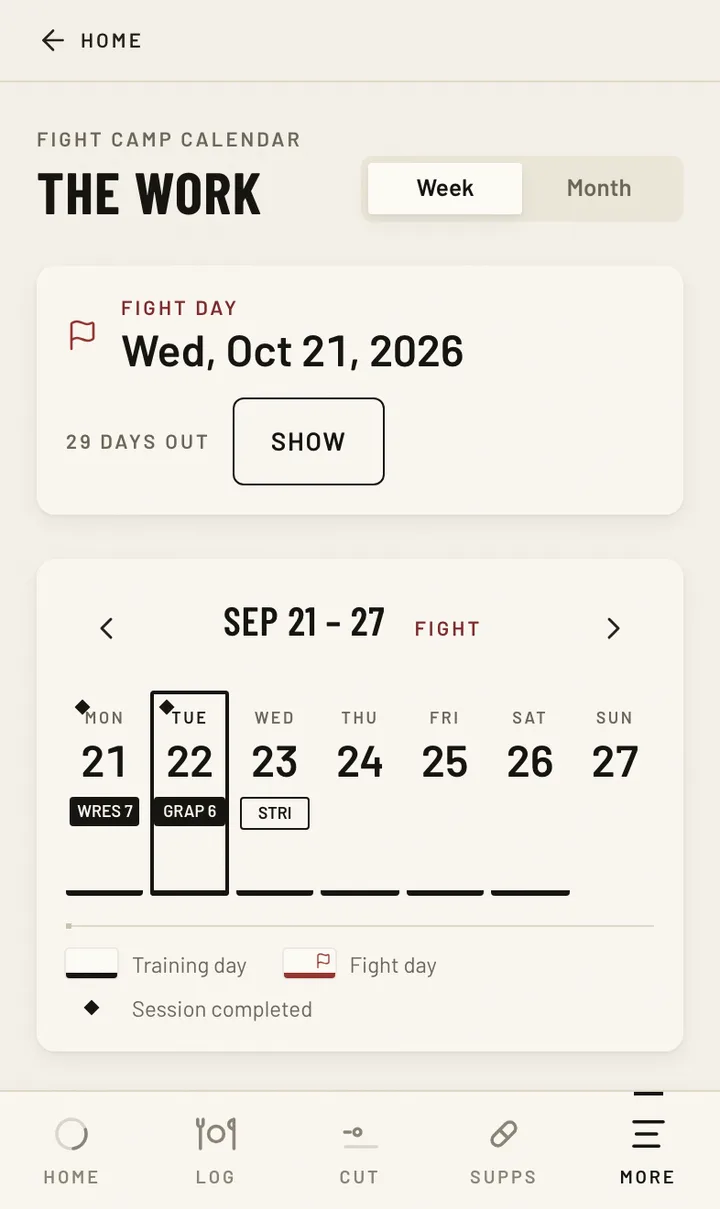
What the questionnaire literature does, and what any usable record has to do, is capture function rather than absence. Not "did you miss anything" but "was volume reduced, was participation reduced, was performance reduced, and by how much" — asked on a schedule, so that a trend exists rather than a memory. That is the whole methodological innovation of the last fifteen years, compressed into one habit.
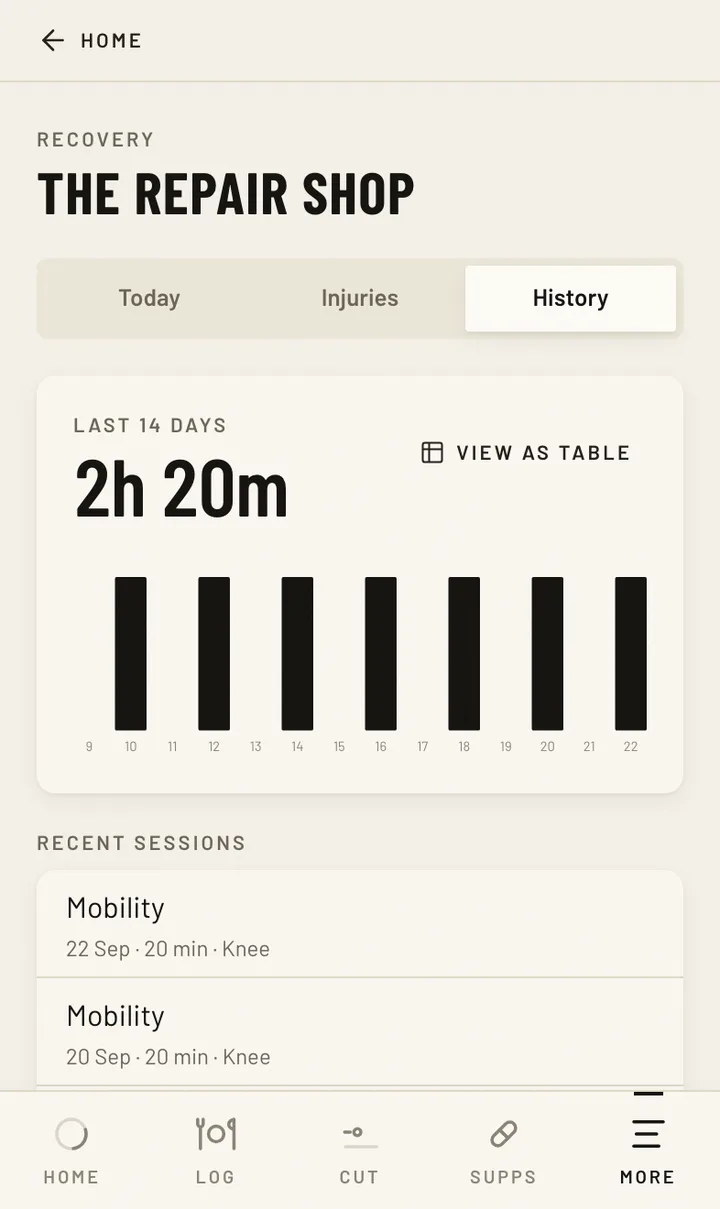
Fighter Cut logs sessions with duration and load, and keeps injury and recovery entries alongside them, so that a six-week problem has a written history by the time anyone asks about it. The app does not assess anything, does not grade a problem and does not produce a verdict, because none of those is a thing software can do. It produces a record. The value of the record is entirely in handing it to someone qualified to read it — which is also the subject of the weekly camp review, where the habit of asking the question on a schedule belongs.
14. What six weeks of pain actually calls for
The reason six weeks of shin pain feels invisible is that, for most of the history of sports injury research, it was. It did not stop anyone training, so it was not counted. The athlete kept showing up, so no clipboard recorded anything. Both nothing happened and this has hurt for six weeks are true at once, and the second one is the one the surveillance was built to miss.
That explains why the pain is not on anyone's list. It does not explain what the pain is, and this article cannot. Pain that has persisted for six weeks in a bone or a tendon — especially during a camp with a weight cut in it, where low energy availability has an established association with bone problems — is a question for a clinician who can examine and if necessary image the area. Nothing here substitutes for that, and nothing here is a reason to defer it.
What the evidence supports is narrow and worth stating exactly. Progressive loading under guidance outperformed the alternative in one trial in one condition, by an amount poorly pinned, for reasons nobody has identified — and most participants could not adhere to it. Overuse problems are common enough, in non-combat cohorts measured weekly, to account for roughly half the burden of everything that goes wrong. Bone stress injury has an association with low energy availability that a weight-class athlete should treat as relevant to them. Everything beyond that is either folklore or an extrapolation from a sport that is not this one.
The thing not to do is the thing this article's subject makes easy: treat "it hasn't stopped me" as information about severity. It is information about the definition, not about the tissue. And if part of what keeps a problem unreported is the cost of reporting it, that is its own subject — why fighters hide injuries is about that, and it is a bigger factor in most gyms than anything measured above.
What we could not verify
- Any overuse-surveillance figure from a combat sport. There is no combat-sport OSTRC study at all. Every prevalence, burden and count figure in this article comes from skiing, floorball, handball, road cycling, volleyball, Norwegian Olympic-preparation athletes, a mixed elite Persian-speaking cohort, elite track and field, or collegiate distance running. Combat-sport surveillance is acute and fight-night-only. The method transfers; the numbers do not.
- Any percentage for how many overuse injuries standard surveillance misses. 419 questionnaire-reported problems and 40 registered time-loss injuries are not the same unit and do not divide into a miss rate. The two counts are given above; the arithmetic is the reader's, and the authors' own phrase — "a small percentage" — is as far as the source goes.
- Anything at all about shin conditioning. No study of it was located. No measurement of the tibia under striking exists in anything retrieved. The nerve-death claim, the desensitisation claim, the hides-new-injury claim, the micro-fractures-heal-harder claim, the roller and bottle claims, and the banana-tree mechanism are all unsourced beyond gyms and vendors, and they contradict each other. The blog-sourced rebuttals are refused on the same grounds as the claims.
- Any figure for how long bone takes to adapt to striking, or how many kicks it takes. None exists in anything retrieved. A search for a bone-remodelling-cycle figure was abandoned rather than filled from memory.
- The ten per cent rule and the acute-to-chronic workload ratio's bands. Neither appears in any source reviewed, and the methodological literature states there is no evidence supporting that ratio for training recommendations at all. The specific numbers are deliberately not printed, including as myths.
- The sleep-hours threshold and odds ratio from the 2014 adolescent sleep study. The retrieved abstract truncates mid-sentence at exactly that finding. The circulating figures are widely quoted and were not verified here, so the finding is reported qualitatively only. The same applies to the DXA Z-score cut-off in the bone stress injury and energy availability study, whose abstract truncates at the same kind of point.
- Any pooled effect size for sleep and injury. The relevant meta-analysis exists as a conference record with no retrievable text, no DOI and no PMID.
- The REDs clinical assessment tool's thresholds and categories. The 2023 consensus full text is paywalled and was not retrieved; only the abstract was. A further scoring tool dated January 2026 appeared in search snippets and was not confirmed at source, so it is not described here. The currency of the 2023 statement was checked on 22 September 2026 by search, not against the IOC's own index, which did not load.
- Anything specific to the elbow. The tracked areas in this literature are knee, lower back and shoulder. Nothing retrieved is elbow-specific, in any sport.
- A mechanism for why loading helps a tendon. The mediation analysis actively removed the five most plausible candidates; every indirect effect's confidence interval contained zero.
- Sex differences, in either direction. Bone stress injury and low energy availability differ between sexes by pathway, not by a coefficient — menstrual function, hormonal status and peak bone mass accrual are not scalars applied to a male baseline. No female figure here may be derived from a male one or vice versa. Where only one sex was studied, this article says which. The bone stress injury and energy availability study is female-only and clinic-referred. The martial-arts bone density study found an effect in boys and none in girls. The lumbar review could not analyse sex at all. The tendinopathy trial was 76% male. There is no female combat-sport overuse cohort in anything retrieved.
- Adults. Two of the most quotable sources here — the sleep study and the martial-arts bone density study — are cohorts of children. Nothing licenses extending them to an adult professional, and the lumbar review's own finding that prevalence rises with age within adolescence shows how much age matters even inside one of those cohorts.
- Recreational and amateur fighters. The combat-sport sources are predominantly national-level competitors, or a survey in which professionals were 30 of 419 respondents. Someone training four nights a week around a job appears in no cohort reviewed here.
- Anything about you. This article describes a category of evidence. It does not diagnose, it does not assess, and it does not override a physician, a coach or gym medical staff.
Questions fighters ask
Does shin conditioning work?
Nobody knows, because nobody has measured it. A search of the biomedical literature for "shin conditioning" returns no study of shin conditioning at all, and no DXA, pQCT or MRI study of Muay Thai shins appears in anything retrieved. Every source asserting a mechanism — nerve death, desensitisation, micro-fractures healing harder — is a gym blog, a school's marketing page or a vendor, and they contradict each other about which mechanism it is. That disagreement among confident sources is the most informative thing available. Practitioners report something real; what that something is has not been established.
Why has my shin hurt for six weeks?
This article cannot tell you, and no article can. Pain that has persisted for six weeks in a bone or a tendon is a question for a clinician who can examine and if necessary image the area, and that is especially true during a camp with a weight cut in it, where low energy availability has an established association with bone problems. What the evidence does explain is why it feels invisible: a problem that does not stop you training produces no gap in any record, so it was never counted by the surveillance that defines injury. That is a fact about the definition, not about your tissue.
What is an overuse injury, exactly?
It is a problem that arrives without a single identifiable incident, develops gradually, fluctuates, and characteristically does not stop the athlete training. That last property is what makes it invisible to time-loss surveillance, where an injury is defined as an event causing missed training or competition. The methodological response has been to define these problems by function instead — whether training volume, participation or performance have been reduced, and by how much — and to report prevalence rather than incidence.
How many overuse problems does standard injury tracking miss?
There is no answerable percentage, and the widely quoted ones are invented. What exists is a parallel comparison: in 313 athletes across cross-country skiing, floorball, handball, road cycling and volleyball, tracked for thirteen weeks in three body areas, a weekly questionnaire recorded 419 overuse problems and standard time-loss registration recorded 40 overuse injuries in the same athletes over the same weeks. Those are two different units counted by two different instruments and they do not divide into a miss rate. The authors' own summary is that standard surveillance captures "a small percentage."
Are these numbers from fighters?
No, and that matters more than any individual figure. No prospective weekly overuse-symptom surveillance in MMA, boxing, Muay Thai, BJJ, wrestling, judo or kickboxing was found in a search to September 2026. The surveillance that combat sports do have is acute and fight-night: a 2025 study of 663 Muay Thai athletes had a ringside doctor examine each fighter immediately before and after their bout, which is a method structurally incapable of seeing a six-week shin. The method described in this article transfers; the numbers do not.
How common are overuse problems in athletes who are tracked weekly?
In the parallel-comparison cohort of 313 athletes across five non-combat sports, an average of 39% of athletes per week reported an overuse problem in the knee, lower back or shoulder, and 13% per week reported a substantial one — meaning moderate or severe reduction in performance or participation, or time loss. Those figures cover three body areas only, in sports that are not combat sports, over thirteen weeks of weekly email self-report. They describe what a method can see rather than what fighters experience.
Do overuse injuries actually matter, or are they just noise?
In one Olympic-preparation cohort they were roughly half of everything. Among 142 Norwegian athletes preparing for the 2012 Games, tracked for forty weeks with complaints classified by team medical personnel, overuse injuries represented 49% of the total burden of health problems measured as cumulative severity score, against 36% for illness and 13% for acute injuries. A separate 2026 cohort of 207 elite athletes reported a different split by raw counts — acute 59.5%, overuse 28.3%, illness 12.1% — which is a different metric in a different population, not a contradiction to be averaged away.
Do micro-fractures in the shin heal back stronger?
Nothing retrieved supports that as a description of a human tibia under repeated striking, and the phrasing sits awkwardly against the evidence that does exist. In the bone stress injury literature, accumulated bone microdamage is the injury rather than the adaptation. The nearest measured evidence on bone and martial arts is a nine-month study in 79 adolescents practising judo, kung fu and karate, which found a spine bone density effect in boys, no effect at all in girls, and involved no striking, no Muay Thai and no tibial measurement.
Is a bone stress injury an overuse injury?
It is usually classified as one, and it is the most serious item in the category. In a four-season collegiate cross-country dataset covering 1,220 athlete-seasons and 168 bone stress injuries, they were 20% of all injuries reported, at 0.14 per athlete-season — 0.16 in female and 0.10 in male athletes — with the lower leg and foot the most common sites. Those are distance runners, not fighters, and the rate does not transfer. What is transferable is that 72.6% were classified as both overuse and time-loss, meaning more than a quarter did not stop the athlete training.
Does cutting weight make overuse injuries more likely?
The one combat-sport source on this junction is a 2025 scoping review of 17 studies in wrestling, judo, taekwondo and MMA, which concluded that rapid weight loss consistently impairs recovery, increases muscle damage and fatigue, and increases injury risk, with sleep-quality effects less pronounced. Separately, bone stress injury at high-risk sites has an established association with surrogates of low energy availability in a cross-sectional study of 127 female athletes who had presented to a clinic. Neither establishes a safe rate of loss, and none is described as safe here, because no source reviewed establishes one.
What about the ten per cent rule for increasing training load?
It appears in none of the evidence reviewed here and its origin was not established. The related acute-to-chronic workload ratio has been examined directly: a 2020 methodological critique concluded there is no evidence supporting its use in training-load-management systems or for training recommendations aimed at reducing injury risk, and that manipulating it to change injury rates remains a conjecture and an overinterpretation of the available data. The specific bands that circulate with it are not printed in this article, because printing a number teaches it.
Does rehab loading actually work for tendon pain?
Better than the comparator, in one trial, by an amount that is hard to pin. In 76 patients with ultrasound-confirmed patellar tendinopathy, mean age 24 and 76% male, with a median two years of symptoms and 82% having failed prior treatment, progressive tendon loading beat eccentric therapy by 9 points on the VISA-P scale at 24 weeks, 95% CI 1 to 16. Adherence was 40% and 49% in the two arms. A 2025 mediation analysis found the benefit was not explained by strength, dorsiflexion, jumping, tendon thickness or neovascularisation. What it supports is doing something progressive under guidance, not any story about why.
Does sleep affect injury risk?
The most-cited study found that hours of sleep per night and grade in school were the best independent predictors of injury in multivariate analysis — but the cohort was 112 adolescents from one combined middle and high school, mean age 15, studied by self-report survey cross-referenced against retrospective school injury records, at level of evidence III. The specific hours threshold and odds ratio that circulate from it are not reproduced here, because the retrieved abstract truncates at exactly that sentence and printing them would mean quoting from memory rather than from a source.
What can I actually do about a problem that has been there for weeks?
Two things, and only one of them is in your hands. The first is to take it to a clinician who can examine and if necessary image it — which is the whole answer for what the problem is, and nothing in this article changes that. The second is to have a record for them to read: what was trained, for how long and how hard, week over week, and how much the problem reduced volume, participation or performance. That is the functional measurement the questionnaire literature spent fifteen years working out, and it is the difference between a history and a recollection.
Why is there so little research on this in combat sports?
Because the field's organising question has been "what happens in the fight." The available surveillance reflects that: ringside examinations before and after bouts, competition injury registries, and retrospective self-report surveys. Those are appropriate instruments for acute, competition-day trauma and they have produced real findings. None of them is capable of detecting a gradual problem in a training camp, which is why the question most fighters actually have — about something that has hurt for weeks without stopping them — has no direct answer in the combat-sport literature.
Sources
Sourced to
- Development and validation of a new method for the registration of overuse injuries in sports injury epidemiology: the Oslo Sports Trauma Research Centre (OSTRC) overuse injury questionnaire — Clarsen B, Myklebust G, Bahr R, British Journal of Sports Medicine, 2013. DOI 10.1136/bjsports-2012-091524, PMID 23038786
- No injuries, but plenty of pain? On the methodology for recording overuse symptoms in sports — Bahr R, British Journal of Sports Medicine, 2009. DOI 10.1136/bjsm.2009.066936, PMID 19945978
- The Oslo Sports Trauma Research Center questionnaire on health problems: a new approach to prospective monitoring of illness and injury in elite athletes — Clarsen B, Rønsen O, Myklebust G, Flørenes TW, Bahr R, British Journal of Sports Medicine, 2014. DOI 10.1136/bjsports-2012-092087, PMID 23429267
- Improved reporting of overuse injuries and health problems in sport: an update of the Oslo Sport Trauma Research Center questionnaires — Clarsen B, Bahr R, Myklebust G et al., British Journal of Sports Medicine, 2020;54(7):390–396. DOI 10.1136/bjsports-2019-101337, PMID 32060142
- Persian translation, cross-cultural adaptation, reliability, and validity of the updated Oslo sports trauma research centre questionnaire on health problems — Alimoradi M, Kabak S, Kara T, Barut Y, Daneshmandi H, Alghosi M, BMC Sports Science, Medicine and Rehabilitation, 2026;18. DOI 10.1186/s13102-026-01647-3, PMID 41807951
- Is tendon pathology a continuum? A pathology model to explain the clinical presentation of load-induced tendinopathy — Cook JL, Purdam CR, British Journal of Sports Medicine, 2009. DOI 10.1136/bjsm.2008.051193, PMID 18812414
- Effectiveness of progressive tendon-loading exercise therapy in patients with patellar tendinopathy: a randomised clinical trial — Breda SJ, Oei EHG, Zwerver J, Visser E, Waarsing E, Krestin GP, de Vos RJ, British Journal of Sports Medicine, 2021. DOI 10.1136/bjsports-2020-103403, PMID 33219115
- Do physical or imaging changes explain the effectiveness of progressive tendon loading exercises? A causal mediation analysis of athletes with patellar tendinopathy — Deng J, Runhaar J, Breda SJ, Oei EHG, Eygendaal D, de Vos RJ, Journal of Science and Medicine in Sport, 2025. DOI 10.1016/j.jsams.2024.12.006, PMID 39718487
- Investigating Achilles and patellar tendinopathy prevalence in elite athletics — Janssen I, van der Worp H, Hensing S, Zwerver J, Research in Sports Medicine, 2018. DOI 10.1080/15438627.2017.1393748, PMID 29064298
- Patellar tendinopathy: an overview of prevalence, risk factors, screening, diagnosis, treatment and prevention — Theodorou A, Komnos G, Hantes M, Archives of Orthopaedic and Trauma Surgery, 2023. DOI 10.1007/s00402-023-04998-5, PMID 37542006
- 2023 International Olympic Committee's (IOC) consensus statement on Relative Energy Deficiency in Sport (REDs) — Mountjoy M, Ackerman KE, Bailey DM et al., British Journal of Sports Medicine, 2023;57(17):1073–1097. DOI 10.1136/bjsports-2023-106994, PMID 37752011 (abstract only; full text paywalled and not retrieved)
- Low energy availability surrogates associated with lower bone mineral density and bone stress injury site — Holtzman B, Popp KL, Tenforde AS, Parziale AL, Taylor K, Ackerman KE, PM&R, 2022. DOI 10.1002/pmrj.12821, PMID 35460534
- Epidemiology of Bone-Stress Injuries and Health Care Use in Pac-12 Cross-Country Athletes — Wayner RA, Brown Crowell CN, Bovbjerg V, Fredericson M, Soucy M, Choe S, Simon JE, Journal of Athletic Training, 2024. DOI 10.4085/1062-6050-0089.23, PMID 37459389
- Prevalence and Incidence of Lumbar Bone Stress Injuries in Adolescent Athletes: A Systematic Review — Weber L, Kurtz P, Risch L, Cassel M, Sportverletzung Sportschaden, 2026. DOI 10.1055/a-2623-3380, PMID 41125101
- Acute:Chronic Workload Ratio: Conceptual Issues and Fundamental Pitfalls — Impellizzeri FM, Tenan MS, Kempton T, Novak A, Coutts AJ, International Journal of Sports Physiology and Performance, 2020. DOI 10.1123/ijspp.2019-0864, PMID 32502973
- Training load and structure-specific load: applications for sport injury causality and data analyses — Nielsen RO, Bertelsen ML, Møller M et al., British Journal of Sports Medicine, 2018. DOI 10.1136/bjsports-2017-097838, PMID 28739835 (record retrieved; no abstract text available)
- Chronic lack of sleep is associated with increased sports injuries in adolescent athletes — Milewski MD, Skaggs DL, Bishop GA, Pace JL, Ibrahim DA, Wren TA, Barzdukas A, Journal of Pediatric Orthopaedics, 2014. DOI 10.1097/bpo.0000000000000151, PMID 25028798 (abstract truncates at the threshold sentence; no figure taken)
- Sleep and Injury in the Young Athlete — Dwivedi S, Boduch A, Gao B, Milewski MD, Cruz AI, JBJS Reviews, 2019. DOI 10.2106/jbjs.rvw.18.00197, PMID 31490338 (record retrieved; abstract text absent, no effect size taken)
- Effects of Weight-Cutting Practices on Sleep, Recovery, and Injury in Combat Sports: A Scoping Review — Kużdżał A, Bilianskyi O, Wroński Z, Magoń G, Olaniszyn G, Hagner-Derengowska M, Michalska A, Journal of Functional Morphology and Kinesiology, 2025. DOI 10.3390/jfmk10030319, PMID 40843850
- Epidemiological analysis of athlete injuries in Muay Thai in-ring matches — Hallaçeli H, Davut S, Özbek A, Aydın E, Injury Epidemiology, 2025. DOI 10.1186/s40621-025-00569-x, PMID 40420121
- Mechanical Efficiency and Injury Risk in Leg Kicks Across Combat Sports: A Narrative Review of Stance, Hip Rotation, and Striking Surface Effects — Razm SS, Márquez-Flórez K, Caprioli L et al., Healthcare (Basel), 2026. DOI 10.3390/healthcare14040430, PMID 41753943 (narrative review; no tibial load measured)
- From Fitness to Fight: Associations between training motivation and injury prevalence in Muay Thai, K-1 and Kickboxing — Robbiani AI, Filippi A, Swiss Dental Journal, 2025. DOI 10.61872/sdj-2025-02-07, PMID 40662680 (retrospective self-report; dental journal, mouthguard-focused)
- Impact of Martial Arts (Judo, Karate, and Kung Fu) on Bone Mineral Density Gains in Adolescents of Both Genders: 9-Month Follow-Up — Ito IH, Kemper HCG, Agostinete RR et al., Pediatric Exercise Science, 2017. DOI 10.1123/pes.2017-0019, PMID 28714773
- Impact of martial arts on bone mineral density in adolescents: a cross-sectional analysis — Ito IH, Agostinete RR, Fernandes RA et al., Revista Paulista de Pediatria, 2016. DOI 10.1016/j.rpped.2015.09.001, PMID 27017002
Read next
Plan the descent, don't guess it
Fighter Cut builds a week-by-week plan from today to your weigh-in, classifies the rate you are actually losing at, and logs what you eat against it. It does not make a cut safe — nothing does. It makes the numbers visible early enough to change them.
Open Fighter Cut