Fighter Cut › Articles › Fight camp
Fight camp
Knee injuries in grappling and the leg-lock era
What the evidence says about heel hooks and knees — and why the single study everyone cites has a confidence interval sixty-four times wider at the top than at the bottom.
The number everyone repeats is twelve. Heel hooks, the headline runs, increase knee injury risk twelve-fold. It comes from a real study, published in Sports Health in 2026 by Piekarski and colleagues, and the point estimate is exactly that: a relative risk of 12.0.
The same parenthesis in the same abstract reports the confidence interval. It runs from 1.5 to 96.1.
That interval is the article. A study whose result is compatible with "about one and a half times the risk" and equally compatible with "ninety-six times the risk" has not measured the size of an effect. It has detected that there probably is one — P < 0.001, so the direction is not in doubt — and then failed to say how big. The honest sentence is that competitors exposed to the heel hook had a knee injury risk somewhere between modestly and enormously higher than those who were not. Anyone printing "12 times" without the interval is reporting a precision the study does not have.
That is not a reason to dismiss the finding. It is a reason to stop treating one small cross-sectional study as though it settled a question the sport has been arguing about for a decade. And the other side of the argument is in worse shape still: the claim that legalising leg locks made grappling safer, which circulates just as widely, has no published study behind it at all. Not a weak one. None.
One side of this question has a single small cross-sectional study with no imaging and a twelve-year gap between its arms. The other side has no published study at all. That asymmetry is not the same as the question being settled.
This article describes what the rules say and what has been measured. It does not teach a technique, does not tell anyone when to tap, and does not assess anyone's knee.
Knee injury risk, competitors exposed to the heel hook versus unexposed, among brown and black belt IBJJF competitors in 2021 (758) against a 2009 comparison arm (164). The interval spans a factor of 64 — the study cannot distinguish 1.5× from 96×
Piekarski et al., Sports Health 2026
The two knee injury incidence rates behind that ratio — exposed versus unexposed, denominator matches. Ankle injuries in the same comparison moved 19.8 vs 8.8 and were **not** statistically significant
Piekarski et al., 2026
Share attributable to the inside heel hook (20 of 247) in 881 practitioners globally; submissions were 28% of injuries overall, so roughly 2% of all injuries
Stegerhoek et al., BMJ Open Sport Exerc Med 2025
Share of injuries occurring in sparring rather than competition, in a 1140-athlete survey across 62 countries; takedowns caused 26.4% against submissions' 29.7%
Hinz et al., Orthop J Sports Med 2021
- The 12-fold figure is real and so is its imprecision. RR 12.0 with a 95% confidence interval of 1.5 to 96.1 means the study established a direction, not a magnitude. Every time the number appears in this article it appears with its interval, and it should never appear anywhere else without one.
- The study's two arms are two different championships twelve years apart. 758 brown and black belt IBJJF competitors in 2021 against 164 in 2009 — a 4.6-fold difference in cohort size, different fields, different eras of the sport. That is a confound, not a footnote, and it is the closest thing to a before-and-after that exists.
- The knee-versus-ankle split is the load-bearing part. Ankle injuries in the same comparison ran 19.8 versus 8.8 per 1000 matches and were not statistically significant. Exposure moved knees and not ankles, which is exactly what the mechanism argument predicts and is harder to explain as a general difference between two events.
- Heel hooks are not the leading cause of knee injury in this sport. In the largest practitioner cohort, the inside heel hook accounted for 20 of 247 submission injuries — 8% — and submissions were 28% of 888 detailed injuries. That is roughly 2% of injuries overall. In a separate 1140-athlete survey, takedowns (26.4%) caused nearly as many injuries as submissions (29.7%).
- The knee leads the injury tables regardless. Knee injuries were 25% of injuries in one cohort, 27.1% in another, 29.8% in a third, and 21.4% of all injuries in NCAA men's wrestling. The knee was the most injured site in grappling before anyone was allowed to heel hook.
- The rules are narrower than the discourse. The IBJJF legalised heel hooks and knee reaping for adult black and brown belt no-gi divisions only, in force 1 January 2021. ADCC bans heel hooks, toe holds and knee-twisting foot locks in both its Beginner and Intermediate tiers; they are legal at Professional. "Heel hooks are legal at every ADCC level" is false.
- No study measures injury rates before and after leg-lock legalisation within one ruleset and event series. Nothing measures a heel hook's torque, failure sequence or warning time. Both of the arguments the sport actually makes about this are unevidenced.
- Not one grappling study in this literature confirms a diagnosis with MRI or arthroscopy. Every "ACL" and "MCL" in it is a clinical or self-reported label.
- The cost, if it lands, is measured in years. Pooled across 69 studies and 7556 participants in mixed sports, 81% returned to some sport after ACL reconstruction, 65% to their preinjury level, and 55% to competitive sport.
- The people most exposed are the least studied. Women are about 7% of the largest cohort and its results are not stratified by sex. Under-18s are absent from every grappling cohort here, while the IBJJF regulates divisions from age four. And 77.6% of injuries happen in training, which nobody surveils.
What the study everyone cites actually did
The paper is Piekarski M, Kreiswirth E, Barber Foss K, Jimenez ML, Myer GD, Montalvo AM, "Knee Injury in Competitive Brazilian Jiu Jitsu Athletes: Implications for Training," Sports Health, 2026. Its stated hypothesis, in the authors' words, was that "knee and ankle injury incidence will be higher in those exposed to the heel hook relative to those not exposed to the heel hook during competition." Its conclusion: "Our findings indicate the heel hook significantly increased risk of knee injury."
Here is what the abstract says about the cohort, and it is worth being precise because almost every secondary account adds detail the abstract does not contain. The 2021 arm comprised 303 adult competitors, defined by the study as under 30 years old, plus 455 masters competitors, defined as 30 and over — 758 brown and black belt IBJJF competitors in total. The comparison arm was 164 adult brown and black belt competitors from 2009. The denominator throughout is matches.
The abstract names no championship. It does not use the word "no-gi". It describes no method of ascertaining injuries. A secondary report — a 2026 post on the grappling site bjjdoc, which is where the "12-fold" headline entered circulation — identifies the events as the 2021 Pan No-Gi and the 2009 World No-Gi, describes both as no-gi, and says injuries were recorded by onsite clinical evaluation with no imaging and no formal diagnoses. Those details are plausible, and they are consistent with how event-side data collection works, and they are second-hand. Treat them accordingly: this article uses them where they matter and flags them where it does.
The full text is paywalled. Attempts through PubMed Central, SAGE and Ovid all returned refusals on 22 September 2026. Everything in this article that comes from Piekarski is abstract-level. The per-structure breakdown, how "exposed" was operationalised, any sex split, and every other confidence interval in the paper are unread. That is the single biggest weakness in the spine of this article, and it would be dishonest not to lead with it.
Why the interval matters more than the point estimate
A relative risk of 12.0 with a 95% confidence interval of 1.5 to 96.1 is the statistical signature of a small number of events. When the unexposed group's rate is 2.2 per 1000 matches, the absolute count of knee injuries in that arm is tiny, and a ratio built on a tiny denominator swings violently. The lower bound clears 1.0, which is why P < 0.001 — the result is statistically significant. The upper bound is 96.1, which is why it is substantively uninformative about size.
This distinction gets lost constantly, and the loss is not innocent. "Heel hooks increase knee injury risk 12-fold" is a sentence a coach can use to ban leg locks in their gym, and a sentence a promoter can use in a press release, and a sentence an athlete can use to justify a decision about their own competitive career. A sentence that carried its interval — "somewhere between modestly and enormously higher" — supports none of those uses, and that is the correct outcome, because the study supports none of them either.
Compare the intervals elsewhere in this literature, which are what a better-powered estimate looks like. In 881 BJJ practitioners, injury incidence was 5.5 per 1000 hours of training (95% CI 4.9 to 6.1) — an interval you could plan around. In NCAA men's wrestling, the competition-to-practice injury rate ratio was 4.11 (95% CI 3.72 to 4.55). Those are measurements. RR 12.0 (1.5–96.1) is a detection.
The twelve-year gap between the arms
The second problem with the spine study is structural, and no amount of statistical care fixes it: its two arms are not the same event at two times. They are two different championships in 2021 and 2009, with 758 competitors in one and 164 in the other.
Twelve years is a long time in a sport that changed as fast as competitive grappling did between those dates. The field grew. The rule set moved. Training methodology, the prevalence of full-time professional competitors, the availability of instructional video, the age profile of brown and black belts, the number of matches a competitor takes in a weekend — all of it shifted. Any of those could produce a difference in knee injury rate that has nothing to do with the heel hook.
This is why the knee-versus-ankle contrast inside the 2021 arm carries more weight than the 2021-versus-2009 comparison does. Within a single event, among competitors in the same brackets on the same day, those exposed to the heel hook had knee injuries at 26.5 per 1000 matches against 2.2 in the unexposed, while ankle injuries ran 19.8 against 8.8 and did not reach statistical significance. A general "2021 was a rougher event than 2009" explanation predicts both joints moving together. They did not.
What no study has done — and this is a finding about the field, not an omission in this article — is measure injury rates before and after leg-lock legalisation within one ruleset and one event series. A search of Europe PMC on 22 September 2026 across "jiu-jitsu" combined with heel hook, leg lock and leglock returned 25 results and nothing of that design. Piekarski is the closest thing that exists, and its arms are two different championships twelve years apart.
What the mechanism argument claims, and what backs it
The sport's account of why a heel hook is different from an armbar goes roughly like this: an armbar loads a hinge joint in the direction the joint refuses to go, the athlete feels it coming, and there is a window in which to concede. A heel hook loads the knee rotationally through the foot, and the argument runs that the structures taking that load fail before the athlete gets a useful pain signal.
There is no published measurement of any part of that. No biomechanical study, no cadaveric study, no clinical study measuring warning time, pain onset, or torque-to-failure in a heel hook was located on 22 September 2026. The cadaveric posterolateral corner literature that gets cited in support of the argument measures external rotation torque in robotic rigs — 5 Nm loads, cut-and-test designs — on general knee specimens. It is not a heel-hook study and it must not be dressed up as one.
So the "no pain warning" claim can be reported as the argument people make. It cannot be reported as a finding, and it must never be reported with a number attached to it.
The mirror-image claim is in the same position. "Legalising heel hooks reduced injuries, because skilled athletes apply them under control and inexperienced athletes learn to concede early" is an argument made in gyms and podcasts with no published evidence of any design behind it. This article leans neither way, because the evidence does not permit leaning.
The one peer-reviewed piece that addresses grappling submission mechanisms directly — Hasegawa and colleagues' 2026 descriptive and illustrative review in the Hawai'i Journal of Health & Social Welfare — is explicit about why this gap exists. "Grappling submissions introduce risk of injury through a variety of specific moves, positions, and mechanisms," the authors write. "Yet grappling disciplines remain relatively niche, shrouded with confusing, non-descriptive terminology and jargon. This often results in a poor understanding of injury mechanisms, anatomic regions injured, and pathophysiologic cause of injury." It is a narrative review. It carries no incidence data at all.
The structures nobody has looked at
Here is the sharpest gap in this literature, and it sits precisely where the argument lives.
The heel-hook mechanism claim is a claim about rotational structures: the posterolateral corner, the lateral collateral ligament, the popliteus and popliteofibular complex. Those are the tissues that resist external rotation of the tibia, and they are what the discourse is about.
Not one grappling cohort in this literature names any of them as an injured structure. Not one.
What the grappling studies report instead is ACL and MCL — and in the Piekarski study, even those come via the secondary report, because the abstract names no structure at all. In 198 Brazilian BJJ fighters aged 18 to 60, the MCL accounted for 38% of knee injuries and the sprain mechanism for 86%, with 65% managed conservatively. In NCAA men's wrestling, partial or complete lateral collateral ligament tears were 6.5% of all injuries and among the most commonly reported specific diagnoses — which is the closest any grappling-adjacent surveillance comes to the lateral side, and wrestling has no heel hooks.
The general orthopaedic literature suggests this matters. Crespo and colleagues, reviewing posterolateral corner injuries in 2015, note that although these were "previously considered to be a rare condition, they have been shown to be present in almost 16% of all knee injuries and are responsible for sustained instability and failure of concomitant reconstructions if not properly recognized." That figure is from a general knee-injury population, not a grappling cohort, and it cannot be transferred to one. But it does mean the structure the sport is arguing about is a structure the wider literature considers easy to miss — and the grappling literature has not looked for it once.
How much of the injury burden heel hooks actually carry
Strip the argument back to proportions and it changes shape.
In Stegerhoek and colleagues' cross-sectional study of 881 BJJ practitioners globally — 41% Netherlands, 22% US, 6% UK, mean age 30.8 (SD 8.6), all belts, mixed gi and no-gi — submission techniques caused 28% of injuries. Within the 247 submission injuries described in detail, leg locks as a category accounted for 92, or 37%. The inside heel hook specifically accounted for 20 cases, 8% of submission injuries. Twenty-eight per cent of injuries, of which eight per cent: roughly 2% of injuries overall.
That study defines an injury as a physical complaint where "(1) BJJ practice and competition had to be ceased for a week, (2) BJJ practice or competition had to be modified for 2 weeks or (3) medical attention was sought" — a broad definition that captures a lot, which makes the 2% harder to explain away as a threshold artefact.
Set that beside Hinz and colleagues' survey of 1140 active BJJ athletes across 62 countries, with a three-year recall window and an injury defined as at least two weeks' training absence. "Most injuries occurred during sparring (77.6%) and were caused by submissions (29.7%) and takedowns (26.4%)." Takedowns are within four percentage points of submissions as a cause. Nobody writes articles about takedowns.
So "heel hooks are the leading cause of knee injury in BJJ" is not supportable. What is supportable is narrower and less quotable: in a competition population of brown and black belts, exposure to the heel hook was associated with a knee injury rate an unquantified amount higher, and across the whole practising population, the technique accounts for a small single-digit percentage of injuries.
The knee was already the problem
One thing the leg-lock argument obscures: the knee led the injury tables before legalisation and leads them in rule sets where leg locks are banned outright.
Across the studies here, the knee was 25% of 888 detailed injuries in the 881-practitioner cohort; 27.1% of injuries and the single most prevalent site in the 1140-athlete survey, where lower extremity accounted for 45.7% against the upper extremity's 30.2%; and 29.8% in the 198-fighter Brazilian cohort. In NCAA men's wrestling, over 1684 reported injuries across 190,862 athlete-exposures from 2014–15 to 2018–19, the knee was 21.4% of all injuries — in a sport with no submissions at all.
The pre-legalisation anchor is Scoggin and colleagues' assessment of eight BJJ tournaments in Hawai'i from 2005 to 2011, when heel hooks were banned throughout. The competition injury rate was 9.2 per 1000 exposures and orthopaedic injuries were 78% of cases. But the headline finding was somewhere else entirely: "The elbow was found to be the joint most commonly injured during BJJ competitions, with the arm bar being the most common mechanism."
In the banned era, the joint that led was the elbow. That is a genuinely interesting data point and it is one event series in one state over six years, so it is an anchor and not a proof.
What wrestling and judo can and cannot tell you
It is tempting to put grappling's numbers on one axis with wrestling's and judo's. Do not, because the injury definitions are incompatible and the resulting chart would be fiction.
NCAA men's wrestling, 2014–15 through 2018–19: overall 8.82 injuries per 1000 athlete-exposures, competition 26.70 (95% CI 24.54–28.86) against practice 6.49 (95% CI 6.11–6.88), an incidence rate ratio of 4.11 (95% CI 3.72–4.55). A reportable injury there "occurred due to participation in an organized intercollegiate practice or competition and required medical attention by a team AT or physician (regardless of TL)" — regardless of time loss. An athlete who sees the trainer and trains the next day counts. This is men's wrestling by design; there is no women's arm.
French judo competitions, 21 seasons from 1993 to 2014: 3511 injuries among 316,203 judokas across 421,670 fights, an overall traumatic injury incidence of 1.1%. The definition: a traumatic injury causing interruption of practice of more than one week. An athlete who sees a doctor and trains tomorrow does not count.
Those two numbers are not the same measurement and 8.82 per 1000 AE cannot be compared with 1.1%. What judo does uniquely offer is the only usable sex-difference data in this entire literature. Knee sprains ran 0.24% in women against 0.12% in men; ACL rupture 0.09% against 0.05%; and across all sprains, "the incidence rate for overall sprain injuries was significantly higher for female compared with male athletes (0.82% vs 0.53%, respectively; P < .001)." Roughly double, on both knee measures.
Judo is also the sport furthest from the leg-lock question — it bans leg locks entirely in competition. So that sex difference is real, well-powered, and about a different exposure. It should not be borrowed to estimate anything about women and heel hooks, because nothing measures that.
What the rules actually say, and when they changed
The discourse runs far ahead of the rule book, so here is the rule book.
IBJJF. Heel hooks and knee reaping became legal for adult black and brown belt no-gi divisions, in force 1 January 2021. The federation's own announcement is unambiguous: "The new rules updates, including Heel Hooks and Knee Reaping for Black and Brown Belt adult NoGi Divisions, will be valid starting on January 1st, 2021."
The current published rule book is Version 6.1, 2024, downloaded from ibjjf.com and read as text on 22 September 2026. Its technical-fouls table is organised by columns: 4–12 years; 13–15 years; 16 and 17 plus white belts from Adult to Master 7; Adult to Master 7 blue and purple; Adult to Master 7 brown and black belts except Adult No Gi; and Adult brown and black belts No Gi. Items 17 "Heel hook", 18 "Locks twisting the knees" and 19 "Knee Reaping" sit in that table. The column structure is what carries the rule: a separate Adult-No-Gi brown-and-black column exists precisely because it is the exception, and the adjacent column's header says "except Adult No Gi" in so many words.
One honest limit. The per-cell tick marks in that table are graphics and did not survive text extraction on 22 September 2026. The column headers confirm the structure and the 2021 announcement states the substantive change; the exact cell-by-cell legality for divisions other than adult brown and black no-gi was not read from the PDF and is not asserted here.
There is no 2025 or 2026 IBJJF rule book. As of 22 September 2026 the books-and-videos page lists Rule Book v6.0 (June 2024), a 2024 Rules Update Guide, and a Technical Fouls poster dated 1 January 2024. Anyone telling you "the rules changed for 2026" is wrong. The current book is the 2024 one and the substantive change dates to 2021-01-01.
ADCC. This is where the most widely circulated error lives. The ADCC Rules and Regulations text — read on 22 September 2026 from a state combat-sports-commission mirror, because adcombat.com sits behind a challenge and returned 403 to every direct fetch — lists under legal techniques for Professional: "Any Leg Lock or Ankle Lock". Heel hooks do not appear in the Professional illegal list. Toe holds do: "No finger or toe holds".
Both amateur tiers are different. The Beginner illegal list includes "No heel hooks", "No toeholds", "No kneebars", "No any foot locks that twist the knee". The Intermediate illegal list includes "No heel hooks", "No toeholds", "No any foot locks that twist the knee".
So the claim that heel hooks are legal at every ADCC level and every experience tier — which appears in web search summaries and in a number of gym blogs — is false, contradicted by the organisation's own rules text. Heel hooks at ADCC are a Professional-tier technique. A web summary claiming that the Intermediate tier permits toe holds is wrong in the same direction.
One caveat that belongs with all of the above: the ADCC document carries no version number and no date, and the copy read was a mirror. It should be treated as the ADCC rules text rather than as a dated edition. More on rule status across the sports in the rules hub.
Two brown belts, one weekend
Take two brown belts who train no-gi four sessions a week and enter the same event. One is 27 and enters an IBJJF adult brown belt no-gi bracket. The other is 34 and enters Master 2 no-gi. Same belt, same gym, one age category apart.
They face different leg-lock environments on adjacent mats on the same day, because of a birth year. The technical-fouls table carries a separate column for Adult brown and black belts No Gi, and the 2021 announcement names exactly that population as the one where heel hooks and knee reaping became legal. The Master divisions sit in the adjacent column — the one the table labels "except Adult No Gi". (That Master cell is a graphic in the PDF and was not read directly; the column headers and the announcement are what this rests on.)
Now the numbers, with a definitional trap attached. Piekarski defines adult as under 30 and masters as 30 and over. So the 27-year-old sits inside the 303-competitor adult sub-cohort and the 34-year-old sits inside the 455-competitor masters sub-cohort — and the study's published results are not broken out by that split in the abstract. Neither athlete can be handed a personal rate.
What the study does report is that in the 2021 brown and black belt field, knee injuries ran 26.5 per 1000 matches among competitors exposed to the heel hook against 2.2 among the unexposed, giving RR 12.0 with a 95% confidence interval of 1.5 to 96.1 — while ankle injuries moved from 8.8 to 19.8 and did not reach significance. And the scale of that evidence, in the same breath: 758 competitors in one arm against 164 at a different championship twelve years earlier, with injuries ascertained by onsite clinical evaluation, no imaging and no formal diagnoses according to a single secondary report.
Then widen it, because the bracket is not where most of the risk lives. In the 1140-athlete survey, 77.6% of injuries happened in sparring, and takedowns caused 26.4% against submissions' 29.7%. Across 881 practitioners, inside heel hooks were 8% of submission injuries and submissions 28% of injuries overall. Both of these athletes will spend roughly 200 training sessions this year and perhaps eight competitive matches, and almost everything that is known about grappling injury rates has the match as its denominator.
This scenario does not say which bracket to enter. That is a conversation for an athlete and their coach, and if a knee is already involved, for a clinician.
What the injury costs if it lands
Probability is the wrong frame for a question like this anyway. The reason the knee argument generates so much heat is not the odds. It is the cost.
The reference figures come from a meta-analysis of 69 articles and 7556 participants across mixed sports, not grappling: after ACL reconstruction, "81% of people returned to any sport, 65% returned to their preinjury level of sport and 55% returned to competitive level sport after surgery." Favourable predictors of return in the same analysis were symmetrical hopping performance, younger age, male sex, elite participation, and a positive psychological response.
Then the second-injury number, which is the one that gets misquoted most. A systematic review and meta-analysis of younger athletes after ACL reconstruction found a total second ACL injury rate of 15% — ipsilateral 7%, contralateral 8%. For athletes under 25, it was 21%. For athletes who returned to sport, 20%. For athletes who were under 25 and returned to sport, 23%.
That 23% belongs to athletes under 25 who went back to sport. It is not a number for a 34-year-old master's competitor, or for anyone outside that cohort, and it should not be applied to one. It is also mixed-sport data with no grappling arm.
For multiligament knee injuries — the category where the rotational structures live — the return-to-sport literature exists but the primary source was blocked by a reCAPTCHA challenge on 22 September 2026 and only an abstract snippet was reachable. No figure from it is printed in this article. That is itself informative about how thin the ground is.
These are population statistics from other sports. They describe what has happened to thousands of people. They do not describe what will happen to any individual, and nothing here is a prognosis. Knee pain, instability or a knee that gave way is a question for a clinician who can examine and image it.
What to record, and why the record is the useful part
The practical consequence of everything above is unglamorous: the sport does not know enough for anyone's decision to be made by a statistic, so the decision gets made by people — an athlete, a coach, and where a knee is actually injured, a physician — and those people work better with a written record than with a memory.
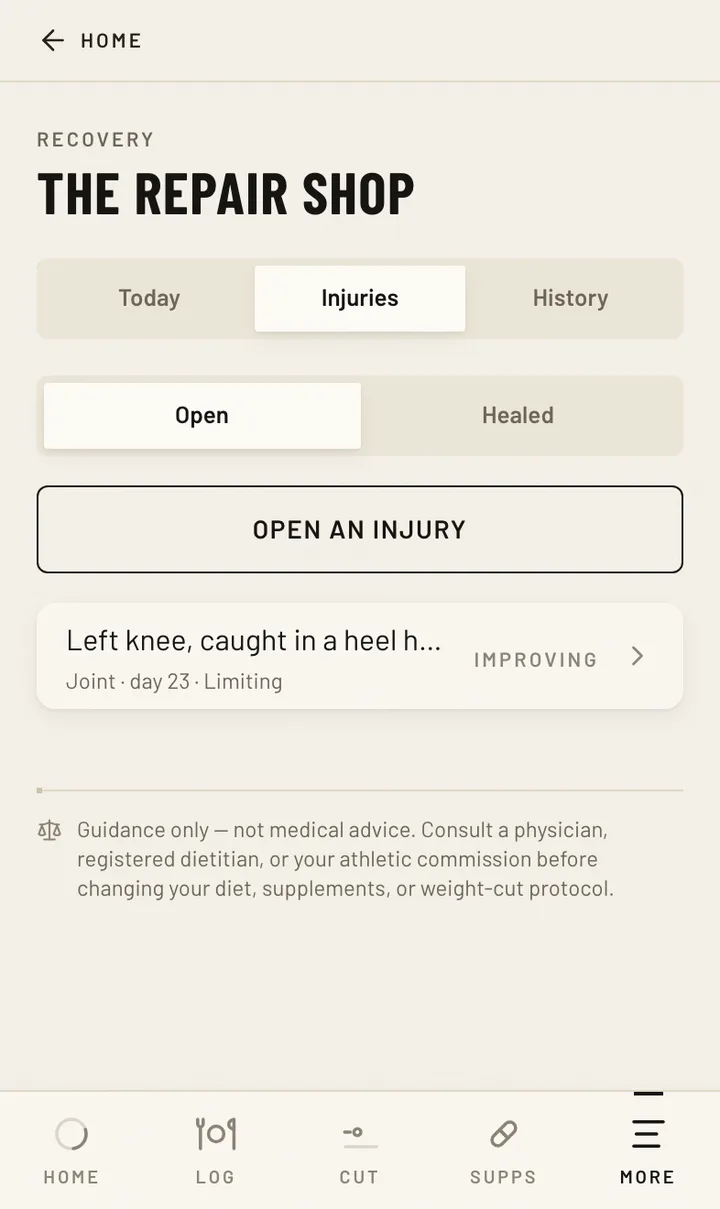
Mara Delgado is fabricated — an example, never a client. What the screen shows is the shape of the thing worth keeping: the date, the side, the mechanism in the athlete's own words, a functional status rather than a diagnosis, and a direction of travel. A clinician can work from that. "My knee has been bad for a while" is harder to work from, and it is what most athletes actually arrive with. The same logic applies to injuries that never had an incident at all, which is a different article.
Note what is absent: no grade, no tissue label, no return date. None of those is something an app or an athlete should be generating, and the literature above is a long argument for why.
The other half of the record problem is social rather than technical. Athletes systematically underreport, and the survey data here is built out of self-report and recall — three-year recall in one case — which is part of why the numbers are as soft as they are. Why fighters hide injuries is the same problem viewed from the gym floor.
What we could not verify
This is the most important section in the article, and it is long because the gaps are large.
The spine source was never read in full. Piekarski et al. 2026 is paywalled. PubMed Central returned 403, SAGE returned 403, and Ovid returned 402, all on 22 September 2026. Every figure attributed to it here comes from the published abstract. The structures injured, how "exposed" was operationalised, the sex distribution, and every confidence interval other than the one on the headline RR are unread.
The championship names, the word "no-gi", and the ascertainment method are not in that abstract. The abstract describes "brown and black belt IBJJF competitors" and gives the age-split cohort sizes. The identification of the events as the 2021 Pan No-Gi and the 2009 World No-Gi, the description of both as no-gi, and the account of injuries being recorded by onsite medical staff without imaging or formal diagnoses all come from a single secondary blog report. They are flagged wherever used and none of them is load-bearing for the numbers.
No before-and-after surveillance of leg-lock legalisation exists in any ruleset. Not IBJJF, not ADCC, not anywhere. The closest approximation is a comparison between two different championships twelve years apart.
The "no pain warning" mechanism claim has zero biomechanical backing. No study measuring warning time, pain onset, or torque-to-failure in a heel hook was found. The cadaveric posterolateral corner work that gets cited for it measures external rotation torque in robotic rigs on general knee specimens and is not about heel hooks.
The posterolateral corner is unstudied in grappling entirely. No grappling cohort in this literature names the PLC, the popliteus or the popliteofibular ligament as an injured structure. The rotational structures the whole argument concerns are missing from the evidence about the sport.
No grappling source anywhere uses imaging. Not one of the studies here confirms a diagnosis with MRI or arthroscopy. Every "ACL" and "MCL" in the grappling literature is a clinical impression or a self-reported label.
Figures we refused to print. A heel-hook-specific knee injury rate of 36.4 per 1000 matches appears in the secondary report of the Piekarski study and is not in the abstract; it is not printed here until the full text can be read. No per-attempt heel hook injury rate is printed, because none exists — every rate with a real denominator here counts matches, not attempts. Return-to-sport percentages for multiligament knee injury are not printed, because the primary was blocked. Japanese judo ACL insurance-database figures that surfaced in searching are not printed, because the primary was never fetched. And the two big gym-lore claims — "heel hooks give no pain warning" and "legalising heel hooks made grappling safer" — appear only as arguments people make, never as findings, and never with a number.
Two studies disagree about belt level and nobody has resolved it. The 881-practitioner study found a higher injury rate at lower belt levels; the 1140-athlete survey found higher belt rank a risk factor. The first study's own discussion names the conflict directly. Both are printed here, and neither is preferred.
Women are close to absent. In the largest cohort, 60 of 881 participants were women — 6.8% — and the results are not stratified by sex. The other grappling studies report no sex breakdown that could be verified, and the NCAA wrestling data is men's by design. The only usable sex-difference data in this whole literature is French judo, which found female judokas' knee sprain and ACL rates roughly double male — and judo bans leg locks.
Under-18s are absent entirely. No grappling cohort here includes anyone under 18. One study starts at 18; the largest has a mean age of 30.8. Meanwhile the IBJJF technical-fouls table regulates divisions for 4-to-12-year-olds and 13-to-15-year-olds, and there is no injury data for any of them.
Amateurs appear only in self-report recall surveys. The BJJ population is overwhelmingly amateur, and the two studies here with real denominators are competition data on medal-level fields. The studies that do reach amateurs are self-report surveys with recall windows up to three years, no imaging and no independent verification.
MMA appears in this article's scope but not in its evidence. No MMA knee or leg-lock injury data was located. The MMA submission literature that exists counts submission frequency, not injury. MMA is treated here as a sport that shares the mechanism, not as a data source.
Most of the exposure is unsurveilled. In the survey data, 77.6% of injuries happen in sparring. Every rate in this article with a solid denominator is per match.
Questions fighters ask
Are heel hooks dangerous?
The one study that measured it found competitors exposed to the heel hook had a knee injury rate of 26.5 per 1000 matches against 2.2 in the unexposed, a relative risk of 12.0 — with a 95% confidence interval running from 1.5 to 96.1. That interval spans a factor of sixty-four, so the honest answer is that the risk is somewhere between modestly and enormously higher, and the study cannot say where in that range. Ankle injuries in the same comparison were not significantly different, which is the part that makes the knee finding harder to dismiss.
Do heel hooks really increase knee injury risk twelve-fold?
That is the point estimate, and it should never be quoted alone. The full result is RR 12.0 with a 95% confidence interval of 1.5 to 96.1, P < 0.001, from brown and black belt IBJJF competitors — 758 in the 2021 arm against 164 in a comparison arm from 2009. A significant P value with an interval that wide means the study established that there is an effect without establishing how big it is.
Is it true that heel hooks give no warning before the knee is damaged?
That is the sport's central mechanical argument and there is no published evidence for it. As of September 2026, no biomechanical, cadaveric or clinical study measuring warning time, pain onset or torque-to-failure in a heel hook was found. The cadaveric posterolateral corner research that gets cited in support measures external rotation torque in robotic rigs on general knee specimens and is not a study of this technique. It is an argument, not a finding.
Did legalising heel hooks make grappling safer?
No published study of any design supports that claim, and none contradicts it either. It circulates as a coach and community argument. The only comparison that exists at all points the other way, and it compares two different championships twelve years apart, so it does not settle the question in either direction.
Are heel hooks the leading cause of knee injuries in BJJ?
No. In the largest practitioner cohort — 881 people globally — the inside heel hook accounted for 20 of 247 submission injuries, which is 8%, and submissions were 28% of 888 detailed injuries. That works out to roughly 2% of injuries overall. In a separate 1140-athlete survey, takedowns caused 26.4% of injuries against submissions' 29.7%.
When did the IBJJF legalise heel hooks?
Heel hooks and knee reaping became legal for adult black and brown belt no-gi divisions, in force 1 January 2021. The federation's announcement names exactly that population. It did not change for any other belt, age division or gi ruleset, and it has not changed since.
Did the IBJJF rules change for 2025 or 2026?
No. As of 22 September 2026 the IBJJF publishes no 2025 or 2026 rule book. The current edition is Version 6.1, 2024; the books-and-videos page lists Rule Book v6.0 (June 2024), a 2024 Rules Update Guide, and a Technical Fouls poster dated 1 January 2024. The substantive leg-lock change still dates to 1 January 2021.
Are heel hooks legal at every ADCC level?
No, and this is one of the most widely repeated errors about the ruleset. ADCC's own rules text lists "No heel hooks" in the illegal techniques for both the Beginner and the Intermediate tiers, along with "No toeholds" and "No any foot locks that twist the knee". Heel hooks are legal at Professional, where the legal techniques include "Any Leg Lock or Ankle Lock" — though toe holds are illegal even there.
Is the knee the most injured joint in grappling?
In most cohorts, yes. Knee injuries were 25% of injuries in one 881-practitioner study, 27.1% and the single most prevalent site in a 1140-athlete survey, and 29.8% in a 198-fighter Brazilian cohort. In NCAA men's wrestling, a sport with no submissions, the knee was 21.4% of all injuries. The one exception is a pre-legalisation BJJ competition series in Hawai'i from 2005 to 2011, where the elbow led and the armbar was the most common mechanism.
Are women at higher risk of knee injury in grappling?
Nobody knows, because the grappling studies do not answer it. Women were 60 of 881 participants in the largest cohort and its results are not stratified by sex; the other grappling studies report no verifiable sex breakdown; and the NCAA wrestling data is men's by design. The only usable sex-difference data in this literature is French judo, where knee sprains ran 0.24% in women against 0.12% in men and ACL rupture 0.09% against 0.05% — and judo bans leg locks, so it does not speak to this question.
What does the evidence say about teenagers and leg locks?
Nothing at all. No grappling cohort in this literature includes anyone under 18. That is a genuine void, because the IBJJF technical-fouls table regulates divisions for 4-to-12-year-olds and 13-to-15-year-olds and there is no injury surveillance for any of them.
If I tear my ACL, will I compete again?
Pooled across 69 studies and 7556 participants in mixed sports — none of them grappling — 81% returned to some sport after ACL reconstruction, 65% to their preinjury level, and 55% to competitive sport. Those are population figures about thousands of other people, not a prediction about any individual, and the answer for any specific athlete comes from the surgeon and the rehabilitation team who have examined them.
Is it true that 23% of athletes reinjure an ACL?
That figure belongs to a narrower group than it is usually quoted for. The overall second ACL injury rate in a meta-analysis of younger athletes was 15% — 7% ipsilateral, 8% contralateral. It rises to 21% for athletes under 25, 20% for athletes who return to sport, and 23% for athletes who are both under 25 and returned to sport. It should not be applied to an older competitor.
Should I stop training leg locks?
That is not a question this article answers, and it is not one a statistic can answer. The evidence establishes a direction without a magnitude, in a competition population, with no imaging, from an abstract nobody has read in full. What to train is a conversation between an athlete and their coach, and if a knee is already involved, it belongs with a clinician who can examine and image it.
Does any of this come from MMA?
No. Despite the mechanism being shared, no MMA knee or leg-lock injury data was located. The MMA submission literature that exists counts how often submissions are attempted and finished, not how often they injure anyone. Treat MMA here as a sport that shares the mechanism, not as a source of evidence about it.
Sources
Sourced to
- Knee Injury in Competitive Brazilian Jiu Jitsu Athletes: Implications for Training — Piekarski M, Kreiswirth E, Barber Foss K, Jimenez ML, Myer GD, Montalvo AM, Sports Health 2026. DOI 10.1177/19417381251400303, PMID 41549501. Abstract retrieved via Europe PMC 22 September 2026; full text paywalled and not read
- Injury prevalence among Brazilian Jiu-Jitsu practitioners globally: a cross-sectional study in 881 participants — Stegerhoek PM, Brajovic B, Kuijer PPFM, Mehrab M, BMJ Open Sport & Exercise Medicine 2025;11(1):e002322. DOI 10.1136/bmjsem-2024-002322
- Injury Patterns, Risk Factors, and Return to Sport in Brazilian Jiu Jitsu: A Cross-sectional Survey of 1140 Athletes — Hinz M, Kleim BD, Berthold DP, Geyer S, Lambert C, Imhoff AB, Mehl J, Orthopaedic Journal of Sports Medicine 2021. DOI 10.1177/23259671211062568, PMID 34988235
- Knee injuries prevalence in Brazilian jiu-jitsu: epidemiological study — Eustaquio JMJ, Rabelo AL, Debieux P, Kaleka CC, Barbosa O, Acta Ortopedica Brasileira 2021;29(6). DOI 10.1590/1413-785220212906240726, PMID 34849099
- Assessment of Injuries During Brazilian Jiu-Jitsu Competition — Scoggin JF, Brusovanik G, Izuka BH, Zandee van Rilland E, Geling O, Tokumura S, Orthopaedic Journal of Sports Medicine 2014. DOI 10.1177/2325967114522184, PMID 26535299. Eight tournaments, 2005–2011, heel hooks banned throughout
- Common grappling submissions: A descriptive, illustrative and literature review of anatomic structures at risk and pathophysiology — Hasegawa ME, Rimm JB, Ishikawa KM, Obana KK, Sy JW, Horng JC, Chan SK, Wake JL, Cage M, Scoggin JF, Crawford SN, Hawai'i Journal of Health & Social Welfare 2026. DOI 10.62547/rnvf9981, PMID 42245247. Narrative review; contains no incidence data
- Epidemiology of Injuries in NCAA Men's Wrestling: 2014–2015 Through 2018–2019 — Powell JR, Boltz AJ, Robison HJ, Morris SN, Collins CL, Chandran A, Journal of Athletic Training 2021;56(7):727–733. DOI 10.4085/1062-6050-429-20
- Epidemiology of Judo-Related Injuries in 21 Seasons of Competitions in France: A Prospective Study of Relevant Traumatic Injuries — Frey A, Lambert C, Vesselle B, Rousseau R, Dor F, Marquet LA, Toussaint JF, Crema MD, Orthopaedic Journal of Sports Medicine 2019;7(5):2325967119847470. DOI 10.1177/2325967119847470, PMC6545656
- Fifty-five per cent return to competitive sport following anterior cruciate ligament reconstruction surgery: an updated systematic review and meta-analysis — Ardern CL, Taylor NF, Feller JA, Webster KE, British Journal of Sports Medicine 2014. DOI 10.1136/bjsports-2013-093398, PMID 25157180
- Risk of Secondary Injury in Younger Athletes After Anterior Cruciate Ligament Reconstruction: A Systematic Review and Meta-analysis — Wiggins AJ, Grandhi RK, Schneider DK, Stanfield D, Webster KE, Myer GD, American Journal of Sports Medicine 2016. DOI 10.1177/0363546515621554, PMID 26772611
- Injuries to posterolateral corner of the knee: a comprehensive review from anatomy to surgical treatment — Crespo B, James EW, Metsavaht L, LaPrade RF, Revista Brasileira de Ortopedia 2015. DOI 10.1016/j.rboe.2014.12.008, PMID 26401495. General orthopaedic knee population, not a grappling cohort
- Return to Sport After Multiligament Knee Injury: A Systematic Review of the Literature — PMC11554947. Listed for completeness only: the primary was blocked by a reCAPTCHA challenge on 22 September 2026 and **no figure from it is used in this article**
- IBJJF Rule Book, Version 6.1 (2024) — International Brazilian Jiu-Jitsu Federation; PDF downloaded from the books-and-videos page and read as text 22 September 2026. No 2025 or 2026 edition is published as of that date. Per-cell tick marks in the technical-fouls table are graphics and were not extracted
- New Rules Updates — International Brazilian Jiu-Jitsu Federation; announcement of the 1 January 2021 heel hook and knee reaping change for adult black and brown belt no-gi divisions, fetched 22 September 2026
- ADCC Submission Fighting Championship Rules & Regulations — ADCC. Read as text 22 September 2026 from a state combat-sports-commission mirror, adcombat.com having returned 403 to every direct fetch. The document carries no version number and no date
- Heel Hooks Increase Knee Injury Risk 12-Fold in BJJ Competitions, New Study Finds — bjjdoc, 31 January 2026 (article located on that domain; deep link not recorded at the time of retrieval). Secondary reporting of source 1, used in this article **only** for the championship identifications, the "no-gi" description and the ascertainment method, each flagged as secondary at the point of use. No figure in this article is sourced to it
Read next
Plan the descent, don't guess it
Fighter Cut builds a week-by-week plan from today to your weigh-in, classifies the rate you are actually losing at, and logs what you eat against it. It does not make a cut safe — nothing does. It makes the numbers visible early enough to change them.
Open Fighter Cut