Fighter Cut › Articles › Fight camp
Fight camp
Hand and wrist injuries in striking
What the measured cohorts actually found, and what the wrap rules say now that the ones everyone quotes have been repealed. It will not tell you what your hand is doing.
Almost every article written about hand wraps in boxing quotes a Nevada regulation that no longer exists. NAC 467.432, the one with the forty yards of gauze and the fifteen yards of tape, and NAC 467.427, the one with the glove weights, were both repealed by Legislative Counsel Bureau File No. R089-22, section 28, effective 28 December 2022. Nevada's live rule is the Nevada Rules of Unarmed Combat, adopted 20 September 2022, and its numbers are different: thirty yards of gauze, ten yards of tape.
The reason the dead numbers keep circulating is worth stating, because it is not carelessness. The Nevada Legislature's own NAC chapter 467 page still publishes both repealed sections in full, with their pre-2022 history lines, as though they were in force. Anyone who checks a correct article against the state's official website will appear to disprove it. The repeal is verifiable only from the adopted regulation itself. We verified it there, and separately confirmed every current number against the Commission's own published rules, on 22 September 2026.
That is the regulatory half. The clinical half is less contested and more useful. The best cohort in this literature followed 98 male elite amateur boxers — the Great Britain Olympic squad — through 232.8 boxer-years between 2005 and 2012, counting anything that stopped a boxer training or competing for more than 24 hours. It recorded 172 hand and wrist injuries. The single most common diagnosis was not a fracture and not the thing people call a boxer's fracture. It was carpometacarpal instability, at 21.6% of all hand and wrist injuries, costing a mean of 54.3 days each.
What follows is what has been measured, in whom, under which definition, and what the rules say as of the date above. It is not a diagnosis and it contains nothing you can match against your own hand. That restraint is deliberate, and section 7 explains why it has to be.
Carpometacarpal instability was the most common hand or wrist diagnosis and one of the most costly, in 98 male elite amateur boxers over 232.8 boxer-years, injury defined as >24 h lost from training or competition
Loosemore et al., Hand (N Y) 2017;12(2):181–187, PMC5349401
Share of those 172 hand and wrist injuries occurring in competition versus in training — despite training accounting for roughly a thousand times more hours in the same cohort
Loosemore et al., Hand (N Y) 2017
Share of *training* injuries in the upper limb across 17 amateur boxing studies, against head and neck at a median 72% of *competition* injuries
Alevras et al., J Sci Med Sport 2022;25(12):995–1001
Nevada's in-force wrap and glove limits under NRUC 2.030 and 2.020, adopted 2022-09-20 — gauze, tape, and glove weight at or below 136 lb. The repealed NAC figures were 40 and 15
Nevada Rules of Unarmed Combat, verified 2026-09-22
- In 98 male elite amateur boxers followed over 232.8 boxer-years with a >24-hour time-loss definition, carpometacarpal instability was the most common hand or wrist diagnosis at 37 injuries (21.6%) and a mean 54.3 days lost, ahead of boxer's knuckle at 27 injuries (15.8%, mean 28.2 days) and thumb ulnar collateral ligament sprain at 25 injuries (14.6%, mean 30.8 days).
- The same cohort recorded 347 hand and wrist injuries per 1,000 hours of competition against under 0.5 per 1,000 hours of training — but 44% of the injuries still happened in training, because the training hours outnumbered the competition hours by roughly a thousand to one.
- Scapholunate instability appeared only 5 times (2.9% of the 172 injuries) and cost a mean 172.4 days, the most expensive single diagnosis per event in that cohort.
- In 1,989 general-trauma patients imaged by MRI for suspected scaphoid fracture, 256 (12.9%) had a fracture not previously detected, and of the 250 occult fractures treated in a cast, 16 (6.3%) went on to delayed or nonunion.
- Nevada's NAC 467.427 and 467.432 were repealed effective 28 December 2022 and replaced by NRUC 2.020 and 2.030; the state's own NAC web page still serves the repealed text, which is why the old 40-yard and 15-yard figures are still in circulation.
- The three regimes we read do not agree with each other: gauze is capped at 30 yards in Nevada and 20 yards under both the ABC championship guidelines and California's 4 CCR § 323, and the tape allowances differ in both length and width.
- In the one experimental primary we could obtain, 9 male collegiate boxers throwing full-power rear straights into a free-moving target across 7 glove conditions showed no significant effect of glove mass on peak impact force — the effect of added mass alone was not significant.
- No study anywhere tests a wrapping method against a hand-injury outcome. The wrap literature is biomechanics; the injury literature is clinical case series; the two do not meet.
- Women are effectively absent: the main cohort is 98 men, and the two carpometacarpal surgical series are 37 of 38 and 19 of 20 male.
1. The rule almost everyone quotes was repealed in 2022
Start here, because it is the part that is easiest to check and the part most often wrong.
Nevada regulated hand wrapping under NAC 467.432 and glove weights under NAC 467.427. Both were repealed. The instrument is Legislative Counsel Bureau File No. R089-22, section 28, which names 467.427 and 467.432 in its repeal list alongside several other sections of chapter 467, effective 28 December 2022. In their place the Nevada Athletic Commission adopted the Nevada Rules of Unarmed Combat on 20 September 2022. Wrapping is now NRUC 2.030; gloves are NRUC 2.020.
The old text allowed 40 yards of gauze, 15 yards of tape, and 1 inch of material between the fingers. The current text allows 30 yards of gauze, 10 yards of tape, and half an inch between the fingers. The rule tightened, and it tightened by a quarter on gauze and a third on tape.
Why the dead numbers persist is the interesting part. The Nevada Legislature publishes chapter 467 of the NAC on its own website, and that page still carries 467.427 and 467.432 in full, with history lines that stop before 2022. Fetch it today and it reads as live law. It is not. A regulation's repeal lives in the adopted regulation, not in a chapter page that has not been rebuilt, and the adopted file is the authority. This is not a subtlety for lawyers: it is the reason a reader who double-checks a correct article against the state's own site will conclude the article is wrong.
Status, plainly, as verified on 22 September 2026: NAC 467.427 and NAC 467.432 are repealed. NRUC 2.020 and NRUC 2.030 are in force. The numbers below are the in-force ones.
2. What the best cohort actually counted
The spine of this subject is a prospective study of the Great Britain Olympic boxing squad: 98 male boxers, mean age 24.7 years, followed from 1 January 2005 to 31 December 2012 for a total of 232.8 boxer-years. The injury definition was explicit — any musculoskeletal condition that prevented the boxer from participating in either training or competition for more than 24 hours.
That definition matters more than any single figure that follows from it. A 24-hour time-loss threshold ignores every hand that hurts on Tuesday and is fine on Wednesday, which is most of them. It also ignores every problem a boxer decides not to report. What it captures is the subset severe enough to cost a session, in a squad with a full-time medical team watching for it. Those are elite male amateurs with access nobody reading this has, and the numbers should be read as what happens when a well-resourced squad counts carefully — not as a rate anyone can apply to themselves. We have written separately about why the definition, not the sport, drives the published number.
Over those 232.8 boxer-years the squad recorded 172 hand and wrist injuries: 84 in the hand, 88 in the wrist. Seventy-eight per cent were new, 22% were recurrences. The total time lost was 7,712 days, split 40% hand and 60% wrist. The median injury cost 29.5 days (IQR 14.0–56.0) — hand injuries 16.5 days (IQR 10.0–47.3), wrist injuries 31.5 days (IQR 16.5–74.0).
Two things stand out from that paragraph before any diagnosis is named. More than one injury in five was a recurrence of something that had already happened. And the wrist, which gets almost none of the attention that knuckles get, accounted for three-fifths of the days lost.
3. Per hour, the fight. In total, the gym.
The same study measured exposure, and the result is the most misread number in this literature.
In competition the squad sustained 347 hand and wrist injuries per 1,000 hours — 183 per 1,000 hours for the hand, 165 for the wrist — across 218.8 total competition hours. In training the rate was under 0.5 per 1,000 hours: roughly 0.15–0.20 for the hand and 0.19–0.25 for the wrist. Those training figures rest on a denominator the authors constructed by estimating total training hours at somewhere between 210,000 and 280,000. It is an estimate, not a measurement, and the paper says so.
Per hour, then, competition is on the order of a thousand times more dangerous to the hands than training. And yet 56% of the injuries happened in competition and 44% in training. The reason is arithmetic: there were about a thousand times more training hours. The authors also tried to normalise for how much of training involves actually throwing punches and arrived at roughly 30 injuries per 1,000 punching hours, noting the squad spent about thirteen times longer punching in training than in competition.
The practical reading is not that training is safe. It is that the hand you damage is roughly as likely to have been damaged on a bag or a pad or in sparring as on the night. The meta-analysis of amateur boxing makes the same point from a different angle: across 17 studies, the upper limb was the most-injured region in training at a median 49% (range 40–53%), while in competition the head and neck dominated at a median 72% (range 46–100%). Training injuries were predominantly sprains and strains (median 60%); competition injuries were predominantly contusions (median 35%) and lacerations.
Head trauma is a fight-night story. Hands are a gym story.
4. Carpometacarpal instability, the diagnosis nobody has heard of
In the Olympic cohort, carpometacarpal instability was the most common hand or wrist diagnosis: 37 injuries, 21.6% of all 172, mean 54.3 days lost, 2,009 days in total. It was the only diagnosis significantly more common than the others. Fifty-four days is most of a camp.
Carpometacarpal instability is a problem of the joints at the base of the metacarpals, where the long bones of the hand meet the wrist. It is not a knuckle injury and it is not a fracture, and it is diagnosed by a hand surgeon with imaging, not by pressing on anything. That last clause is not a formality — in the surgical series described in section 12, this is a condition that reaches theatre, which tells you what kind of object it is.
What is striking about it topping the table is how little of the popular writing about boxing hands mentions it at all. The attention goes to knuckles and to the fifth metacarpal. The diagnosis that actually cost this squad the most events, and the second-most days per event, is one most fighters could not name.
5. Boxer's knuckle, and what "career-ending" means in the source
Second on the list: 27 injuries, 15.8% of the total, mean 28.2 days lost, 762 days in all. Boxer's knuckle is an injury of the extensor mechanism over a metacarpophalangeal joint — the sheet of tissue that holds the extensor tendon centred over the knuckle.
You will sometimes see this reported as 16% of boxers' hand and wrist injuries, cited to nothing in particular. That figure is almost certainly the 15.8% above, re-quoted at one remove. The number to use is the one with the cohort attached.
The phrase "career-ending" attaches to this injury in the literature, and it is worth reading the source rather than the summary. A case series of 8 professional athletes who underwent 11 repairs of the metacarpophalangeal extensor mechanism between 1989 and 1994 concluded that injuries to the extensor mechanisms of the fingers can be career-ending in professional athletes if not treated appropriately. The conditional is the point. In that series all 8 regained full range of motion and returned to professional sport at a mean of 5 months, and none needed further surgery. The long and little fingers were the most common sites.
Eight athletes is a case series. It establishes that the repair worked in those eight. It does not establish a return rate, and it was published in 2000.
6. The thumb, the wrist, and the rare expensive one
Third in the cohort was the thumb ulnar collateral ligament sprain — the injury general medicine calls skier's thumb — at 25 injuries, 14.6%, mean 30.8 days, 752 days total. Then wrist sprain at 23 injuries, 13.5%, mean 28.3 days. Then triangular fibrocartilage complex tears at 8 injuries, 4.7%, mean 42.5 days.
And then the one that distorts the whole table. Scapholunate instability occurred 5 times. That is 2.9% of the 172 injuries — rare enough that a boxer could train for years without meeting one. Its mean cost was 172.4 days, and those five injuries accounted for 862 days between them. Nearly half a year each.
That asymmetry is the argument for taking wrist pain seriously as a category, separate from knuckle pain. Hand injuries in this cohort cost a median 16.5 days. Wrist injuries cost a median 31.5 days, and the wrist supplied 60% of all days lost from 51% of the injuries. The rare wrist problems are where the months go.
None of these is something to identify in yourself. Each of them is a thing a hand specialist distinguishes from the others with an examination and, usually, imaging — and several of them present in ways that overlap.
7. The fracture that does not show on the first X-ray
This is the section that determines the shape of the rest of the article, so it is worth being blunt.
A scaphoid fracture is the classic missed wrist fracture. A multicentre UK study imaged 1,989 patients by MRI for suspected scaphoid fracture and found 256 (12.9%) with a fracture that had not previously been detected. Of the 250 occult fractures managed in a cast, 16 (6.3%) went on to delayed or nonunion: 9 nonunions (3.5%), 7 of which needed surgery, and 7 delayed unions (2.7%). Every surgically treated fracture united, with one complication. The authors' conclusion is that MRI-detected scaphoid fractures are not universally benign, with delayed or nonunion of scaphoid fractures diagnosed only after MRI seen in over 6%.
That is a general trauma population, not athletes, and the 12.9% denominator is specifically 1,989 patients who were imaged by MRI because a clinician already suspected a scaphoid fracture. It is not a rate for the general population and it is not a rate for boxers.
We went looking for a clean "what percentage of scaphoid fractures get missed" figure and refused every candidate, because the denominators are incompatible and cannot be reconciled: 9.0% across 1,685 wrist injuries of any kind, 12.9% of 1,989 clinically suspected scaphoid cases imaged by MRI, 23.87% pooled as occult prevalence in an umbrella review, and 77% in a series of 30 scaphoid nonunions diagnosed more than thirty days out. The last of these describes what missed fractures do after they are missed; it says nothing about how often fractures are missed. A bare percentage with no denominator attached is not a fact about anything. So there is no single miss rate in this article, and anyone quoting one to you should be asked what the denominator was.
What survives all that is simpler and is the only instruction in this piece. A fracture that does not show on the first X-ray is a known situation, not a rare one, and it is the reason the answer here is "get it looked at" rather than a description you can match. Persistent hand or wrist pain after training is a reason to see a clinician who can image it. This article describes what the literature has measured. It is not a diagnosis, and nothing in it should be used to delay or override medical advice.
8. The "boxer's fracture" is mostly not boxers
A fifth metacarpal neck fracture is universally called a boxer's fracture. In the general hand-trauma literature it is the most common metacarpal fracture, and it is predominantly an injury of young men in general trauma populations — people who have punched a wall, a door or another person, usually without wraps, usually without training, and usually not in a ring. We have not printed an exact percentage here because the figures available to us come from general review sources rather than a fetched primary, and this article's standard is that a number travels with its cohort or it does not travel.
The finding that does not need a percentage is a negative one. In the Olympic squad's diagnosis table, the fifth metacarpal neck fracture does not appear among the leading diagnoses at all. Elite boxers, wrapped and gloved and taught to land on the index and middle knuckles, were not breaking fifth metacarpals in numbers worth listing. The injury named after them is substantially somebody else's injury.
Two caveats. A negative in one cohort's leading-diagnosis table is not proof of absence. And an amateur throwing hooks on a bag at a commercial gym is not in that cohort — which is the recurring problem in this entire subject, and section 13 returns to it.
9. What the wrap rules actually say now
Three regimes, read in their own text on 22 September 2026.
Nevada, NRUC 2.030 (adopted 20 September 2022, in force). Bandages on each hand are restricted to soft gauze not more than 2 inches wide and 30 yards long, including the knuckle pad, held in place by surgeon's or other approved cloth tape not more than 2 inches wide and not more than 10 yards long. The knuckle pad may be folded but must not be rolled or twisted. The tape must be placed at least three-quarters of an inch away from the knuckles when the hand is clenched into a fist. Gauze or tape not more than half an inch wide may be placed between the fingers to secure the knuckle pad. The wrapping is done in the dressing room in the presence of an inspector or the Executive Director's designee and the opponents or their representatives, and either fighter may waive witnessing the other's wrapping.
The Association of Boxing Commissions championship guidelines (text fetched 2026-09-22; the ABC index page carries no current revision date, so this is dated to the copy read, not to an adoption year). Hand wraps are restricted to no more than 20 yards of soft gauze, not more than 2 inches wide, held in place by no more than 8 feet of adhesive tape not more than one and a half inches wide. The adhesive tape shall not cover any part of the knuckles when the hand is clenched. The use of water, or any other liquid or material, on the tape is strictly prohibited. Wraps are applied in the dressing room before a Commission representative and, if requested, a representative of the other boxer.
California, 4 CCR § 323 (amended 6 April 2009, in force as displayed 2026-09-22). One winding of surgeon's adhesive tape not over one and a half inches wide placed directly on the hand near the wrist; soft surgical bandage not over 2 inches wide, held in place by not more than 10 yards of adhesive tape for each hand; not more than 20 yards of bandage to complete the wrapping for each hand. Applied in the dressing room before a commission representative and both contestants.
They do not agree. Gauze: 30 yards in Nevada, 20 under the ABC guidelines, 20 in California. Tape: 10 yards at 2 inches wide in Nevada, 8 feet at one and a half inches under the ABC, 10 yards at one and a half inches in California. Knuckle clearance: three-quarters of an inch in Nevada, no tape on any part of the knuckles under the ABC. We are not printing a California knuckle-clearance figure, because the relevant sentence did not render cleanly in the text we fetched and we will not reconstruct a regulation from memory.
Glove weights follow the same pattern. Nevada, NRUC 2.020(6)–(7): boxing and kickboxing combatants at 136 pounds or less must wear 8-ounce gloves; above 136 pounds, 10 ounces — except that a combatant over 136 but not more than 148 pounds may use 8 ounces if both agree. For mixed martial arts, gloves must weigh not less than 4 and not more than 8 ounces, and all gloves must have the distal thumb attached to the glove body. The ABC guidelines set 8 ounces from Mini Flyweight through Welterweight (over 140 to 147 lb) and 10 ounces from Super Welterweight (over 147 to 154 lb) through Heavyweight, with both boxers wearing the glove required for the higher weight when they straddle a boundary. For female bouts the ABC text says glove weight shall be the same as used by male boxers, with larger gloves permitted by mutual agreement; weight classes are identical to the men's, while rounds are two minutes and capped at ten.
10. Nothing regulates what you put on your hands on a Tuesday
Every number in the section above is a competition rule. Not one of them reaches a gym.
There is no regulatory regime for training wraps anywhere in the documents we read. A commission inspector watches a wrap in a dressing room on fight night because the wrap is, among other things, a weapon-control problem — which is why the ABC text bothers to prohibit putting water or any other liquid or material on the tape. None of that machinery has anything to say about how you wrap for six rounds on the heavy bag on a Tuesday afternoon, and none of these yardages was derived from an injury study.
So a commission yardage is not a protection recipe, and reading it as one inverts what it is. Thirty yards of gauze is a ceiling written to stop a fighter building a cast inside a glove, not a floor written to protect a hand.
This is also where the surveillance stops. Nobody counts the hand that hurts after a bag session at a commercial gym unless it reaches an emergency department. Bag and pad work are not surveilled at all: no study we found separates heavy-bag from pad-holding from sparring exposure, and the Olympic squad's 30-injuries-per-1,000-punching-hours figure is the closest anyone comes — on a denominator the authors built from an estimate.
11. Glove weight: one experiment, and an unresolved question
The slogan is that heavier gloves protect the hands but cause more brain damage. It is clean, it is everywhere, and the evidence we could reach does not support stating it as a finding.
The one experimental primary we obtained in full measured this directly. Nine male collegiate boxers — varsity athletes from a Japanese university championship programme — threw full-power rear-hand straight punches into an unfixed 4.36 kg target approximating a human head, across seven glove conditions: 10, 12, 14 and 16 ounce unweighted gloves, and 10 ounce gloves with 2, 4 and 6 ounces of lead added. Mean peak impact forces were 2,090 N at 10 oz, 2,140 N at 12 oz, 1,920 N at 14 oz, 1,900 N at 16 oz, 2,050 N at 10+2, 2,100 N at 10+4 and 2,130 N at 10+6. Impact duration ran 18.5 to 28.8 milliseconds.
The analysis across unweighted gloves was significant overall, but no post-hoc pair differed, and the effect of added mass by itself was not significant. The authors' own sentence is that the effect of mass of the gloves on the impact force was not significant. The only significant pairwise difference was between the 16 oz glove and the 10 oz glove loaded to 16 oz — a comparison that holds mass constant and varies cushioning, which is what makes it informative.
Read carefully, that undercuts the simplest version of the slogan: adding mass alone did not reduce the force delivered. It does not settle the argument. It is nine athletes, one punch type, a head-surrogate target, and it measures nothing whatsoever about the hand inside the glove. A 2026 pilot study exists that looked at gloves, headgear and head acceleration, and we could not obtain it — the publisher returned an error — so no figure from it appears here, including a sex-split finding that circulated in search summaries.
The honest position is that the glove-weight question is unresolved, that the one experiment we could read found no significant effect of mass on delivered force, and that nothing in that experiment speaks to hand protection at all.
12. Wraps, cushioning, and two literatures that never meet
The biomechanics of wrapping has been studied. The injury consequences of wrapping have not.
A double-blind crossover trial in 12 elite boxers compared a silicone wrapping against gauze across five maximal punches per condition, three days apart. Delivered force was 436 ± 33 N with silicone against 372 ± 12 N with gauze (p < 0.001); force wastage was 2.0% against 3.8% (p < 0.001); and fist-to-target contact time lengthened from 35 to 50 milliseconds (p < 0.001). The authors conclude that the elastic cushion does not compromise the force delivery of the boxing glove to the hitting target. That is a performance study. No hand-injury outcome was measured. It is also a study of a cushioning product, and we were unable to read its conflict-of-interest statement, so treat any product-favourable framing in it as vendor-adjacent and unverified on that point.
Manufacturers of gloves and wraps publish protection claims — impact-absorption percentages, injury- prevention copy. None of the protection claims we encountered in this research was backed by a trial with a stated n in a named journal. Where a manufacturer's figure appears anywhere, it should carry the manufacturer's name in the same sentence, because it is marketing, not evidence.
We also chased and rejected two figures in wide circulation. "Hand wraps reduce impact force by 9–29%" has no traceable study, n or journal behind it; we looked and found no origin. And a widely shared "2025 controlled trial" reporting that 10 oz gloves produced 22% higher punch velocity and 34% more wrist deviation traces to a glove retailer's blog, with no journal, no n and no author. Neither is printable.
Which leaves the bottom line for this whole section, and it deserves to be stated flatly: no study anywhere tests a wrapping method against a hand-injury outcome. The wrap research is biomechanics; the injury research is clinical case series; the two literatures do not meet. Anyone who tells you that a particular wrapping technique reduces hand injuries is giving you an opinion, which may well be a good one, formed from experience rather than from a measured outcome.
13. What happens after surgery, in two series that disagree
Carpometacarpal instability is the most common diagnosis in the spine study and it is also the one with the most surgical follow-up, so it is where return-to-sport data exists.
The larger series: 38 boxers, 40 hands, 101 carpometacarpal joints fused, operated between 2009 and 2021, mean age 24.1 years, 37 of the 38 male. Eighty-two per cent (31 of 38) returned to the same level of boxing, at a median 8 months from surgery, range 3 to 27 months. Three patients needed revision for non-union and all eventually returned.
The smaller series: 20 combat-sport athletes treated between 2011 and 2023 for second and third carpometacarpal instability, 19 male and 1 female, mean age 24.7 years — 7 managed conservatively and 13 by arthrodesis. All returned to their pre-injury competition level, pain-free and without residual instability, at a mean follow-up of 6.7 years (range 1.8 to 11.7). Three surgical complications, all resolved.
Eighty-two per cent and one hundred per cent are different answers. They come from series of 38 and 20, with different treatment mixes and very different follow-up horizons, and they should be reported side by side rather than averaged into a number that describes neither. What they agree on is the order of magnitude of the time cost: this is a months-scale problem, not a weeks-scale one, once it reaches surgery.
Boxer's knuckle has its own return figure — the mean 5 months in that series of 8 professional athletes. Again: eight people, operated three decades ago.
14. What a record is for here, and what it is not
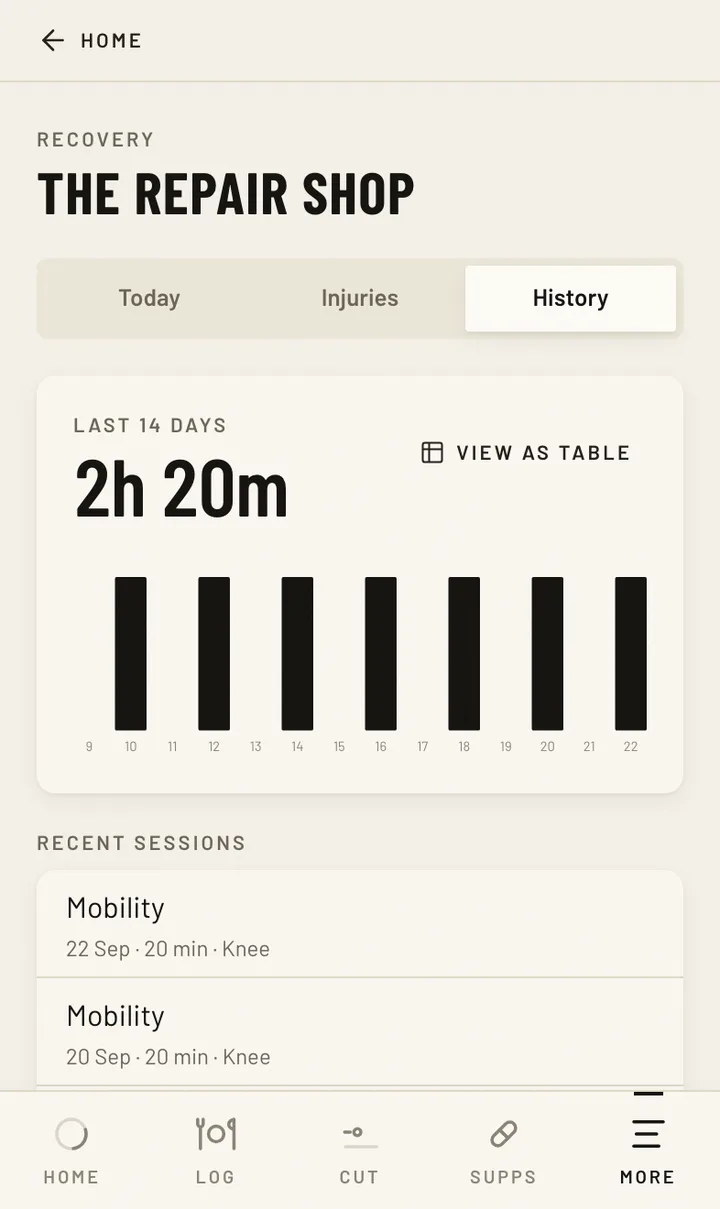
Twenty-two per cent of the hand and wrist injuries in the Olympic cohort were recurrences. That is the number that makes a written history worth keeping, because a recurrence is only recognisable as one if the first episode has a date attached to it. Fighter Cut's recovery module records what was logged and when, without thresholds or ceilings, for exactly that reason.
What a record cannot do is any of the work this article has refused to do. It cannot tell you what tissue is involved. It cannot distinguish a wrist sprain from a scapholunate problem from an occult scaphoid fracture, and neither can you, and neither can a coach — that distinction belongs to a clinician with imaging, and section 7 is the reason. A log changes the account you can give. It does not change the decision, and the decision is not yours or ours to make. The same logic applies to the injuries that accumulate without a single incident, where the date of onset is the hardest thing to recover after the fact.
The one behavioural consequence worth drawing from everything above is unglamorous. Persistent pain after impact, with a normal X-ray, is the exact situation this literature treats as unresolved rather than reassuring. One imaging appointment is cheap. A scaphoid nonunion is measured in months, and in the cohort above so is a scapholunate injury, and so is carpometacarpal instability that reaches theatre.
What we could not verify
Women are effectively absent from this entire literature. The spine study is 98 male boxers. The larger carpometacarpal series is 37 of 38 male; the smaller is 19 of 20. The US emergency-department sample is 84.4% male. There is no adequately powered female cohort on hand and wrist injury in striking sports, and the only sex-split signal we found anywhere came from a pilot study we could not obtain, which makes it unusable. Nothing here should be scaled to women by a coefficient, because no source supports one.
Adolescents are absent. We located no paediatric or junior striking cohort on hand and wrist injury at all.
Muay Thai and kickboxing have no dedicated cohort. Everything measured on this page is boxing, mixed martial arts, or general martial-arts surveillance. We have not extended boxing numbers to Muay Thai, and neither should anyone else.
No study anywhere tests a wrapping method against a hand-injury outcome. This is the single largest hole in the subject. It is not that the answer is disputed; it is that the experiment has not been done.
Bag and pad exposure is entirely unsurveilled. No study separates heavy-bag from pad work from sparring, and the only punching-time denominator that exists was constructed by the authors as an estimate.
We refused every bare scaphoid miss rate. The candidates were 9.0% (of 1,685 wrist injuries of any kind), 12.9% (of 1,989 patients imaged by MRI for clinically suspected scaphoid fracture), 23.87% (pooled occult prevalence in an umbrella review) and 77% (of a 30-case series of scaphoid nonunions diagnosed after thirty days). These are four different questions with four different denominators. Averaging them, or quoting any one of them as "the miss rate", would manufacture a fact. We print only the 12.9%, welded to the population that produced it.
Fifth metacarpal neck fracture percentages. We could not obtain a fetched primary for the commonly quoted share of metacarpal fractures, so no percentage appears in section 8.
The 2026 glove-and-headgear pilot. The publisher returned an error on every attempt. No figure from it — including its reported sex difference in glove-weight response — appears anywhere above.
California's knuckle-clearance sentence. It did not render cleanly in the § 323 text we fetched, so no California knuckle distance is printed.
Questions fighters ask
Why do my hands hurt after bag work?
There is no measured answer to that question, and it is worth knowing why. No study anywhere separates heavy-bag exposure from pad work or sparring, so nobody has counted what bag work does to hands. What is known is that in 98 male elite amateur boxers, 44% of 172 hand and wrist injuries occurred in training rather than competition, and that across 17 amateur boxing studies the upper limb was the most-injured region in training at a median 49% of injuries. Soreness that settles is not the same thing as an injury and is not what those studies counted. Pain that persists after impact is a reason to see a clinician who can image the hand, not something to identify from an article.
Do heavier gloves protect my hands?
Nobody has measured that. The experiment that would answer it — comparing glove weights against hand injury rates in a cohort — has not been done. What has been measured is force delivered to a target: in 9 male collegiate boxers throwing full-power rear straights across 7 glove conditions from 10 to 16 ounces, including gloves weighted with lead, the effect of glove mass on peak impact force was not statistically significant. That study measured a head-surrogate target, not the hand, and nine athletes is a small sample. The popular claim that heavier gloves protect hands while increasing brain injury is not something the evidence we could obtain establishes in either direction.
What is the most common hand injury in boxing?
In the best cohort available — 98 male elite amateur boxers from the Great Britain Olympic squad, followed 232.8 boxer-years, counting anything costing more than 24 hours of training or competition — it was carpometacarpal instability: 37 injuries, 21.6% of all 172 hand and wrist injuries, mean 54.3 days lost each. Boxer's knuckle was second at 27 injuries (15.8%, mean 28.2 days) and thumb ulnar collateral ligament sprain third at 25 (14.6%, mean 30.8 days). That ranking belongs to elite male amateurs with a full-time medical team, not to gym populations, which nobody has counted.
Is the "boxer's fracture" actually common in boxers?
Not in the elite cohort. A fifth metacarpal neck fracture does not appear among the leading diagnoses in the Great Britain Olympic squad's table of 172 hand and wrist injuries at all. In general hand-trauma populations it is the most common metacarpal fracture and predominantly an injury of young men punching things without wraps, gloves or training. The name attaches to boxing; the epidemiology largely does not. A negative in one cohort's leading-diagnosis list is not proof of absence, and no boxing-specific primary with a percentage was available to us.
How many yards of hand wrap does Nevada allow?
Thirty yards of soft gauze not more than 2 inches wide, including the knuckle pad, held by not more than 10 yards of approved tape not more than 2 inches wide, under NRUC 2.030, adopted 20 September 2022 and in force as verified on 22 September 2026. The 40-yard and 15-yard figures still quoted in most articles come from NAC 467.432, which was repealed effective 28 December 2022. Nevada's own NAC web page still publishes the repealed text, which is why the old numbers keep circulating. The rule also requires the tape to sit at least three-quarters of an inch from the knuckles with the hand clenched.
Do the wrap rules apply to training?
No. Every wrap regulation we read — Nevada's NRUC 2.030, the ABC championship guidelines and California's 4 CCR § 323 — governs competition, and each specifies that wrapping happens in the dressing room in front of a commission representative. Nothing in any of them reaches a gym. There is no regulatory regime for training wraps at all, and none of the published yardages was derived from an injury study. A commission limit is a ceiling written for fairness and weapon control, not a protection recipe.
What glove weight is required in professional boxing?
It depends on the jurisdiction and the weight. Under Nevada's NRUC 2.020, adopted 20 September 2022, boxing and kickboxing combatants at 136 pounds or less wear 8-ounce gloves and those above 136 pounds wear 10 ounces, except that a combatant over 136 but not more than 148 pounds may use 8 ounces if both agree. Mixed martial arts gloves must weigh not less than 4 and not more than 8 ounces. The ABC championship guidelines set 8 ounces up to Welterweight (over 140 to 147 lb) and 10 ounces from Super Welterweight (over 147 to 154 lb) upward. These are not interchangeable — check the commission you are fighting under.
Can a broken wrist not show up on an X-ray?
Yes, and the scaphoid is the classic case. In a multicentre UK study, 1,989 patients were imaged by MRI for suspected scaphoid fracture and 256 of them — 12.9% — had a fracture that had not previously been detected. That is a general trauma population, not athletes, and the denominator is patients a clinician already suspected. The reason this matters is what happened next: of the 250 occult fractures treated in a cast, 16 (6.3%) went on to delayed or nonunion. A normal first X-ray is not the end of the question, which is why persistent pain after impact belongs with someone who can image it rather than with a description you match yourself.
How long does a hand injury keep a boxer out?
In the Great Britain Olympic squad cohort, with injury defined as more than 24 hours lost, the median was 29.5 days overall (IQR 14.0–56.0) — hand injuries a median 16.5 days, wrist injuries a median 31.5 days. By diagnosis, the means were 54.3 days for carpometacarpal instability, 42.5 for a triangular fibrocartilage complex tear, 30.8 for a thumb ulnar collateral ligament sprain, 28.3 for a wrist sprain, 28.2 for boxer's knuckle and 172.4 days for scapholunate instability. Those are group averages from 98 male elite amateurs with full-time medical support. None of them is a timetable for any individual, and none is a clearance.
Why does wrist pain matter more than knuckle pain?
Because of where the days went. In the Olympic cohort, wrist injuries were 88 of the 172 hand and wrist injuries — 51% — but accounted for 60% of the 7,712 days lost, and their median cost was 31.5 days against 16.5 for hand injuries. The extreme case is scapholunate instability: 5 injuries, 2.9% of the total, and a mean 172.4 days each. Knuckles get the attention and the nickname; the wrist supplies the long absences. That is an argument for not dismissing wrist pain, not a way to tell what is wrong with a wrist.
Do hand injuries in boxing come back?
In the cohort that measured it, often enough to be the second thing you notice about the data: of 172 hand and wrist injuries in 98 male elite amateur boxers over 232.8 boxer-years, 78% were new and 22% were recurrences. That recurrence share is one reason a dated written history of an injury is practically useful — a recurrence is only identifiable as one if the first episode has a date. The figure belongs to that cohort and that >24-hour definition; no equivalent recurrence rate exists for amateur or recreational strikers.
Do fighters return to the same level after hand surgery?
The two series available disagree, and they should be read side by side rather than averaged. In 38 elite boxers who had carpometacarpal joints fused between 2009 and 2021 (37 male), 82% — 31 of 38 — returned to the same level of boxing at a median 8 months from surgery, range 3 to 27 months, with three revisions for non-union who all eventually returned. In a separate series of 20 combat-sport athletes (19 male) treated for second and third carpometacarpal instability, 7 conservatively and 13 by arthrodesis, all returned to pre-injury level, pain-free, at a mean 6.7 years of follow-up. The treatment mixes, sample sizes and follow-up horizons differ substantially.
Are there any studies on hand injuries in Muay Thai?
None that we could locate. Everything measured in this subject is boxing, mixed martial arts, or general martial-arts surveillance that does not separate hand injuries by sport. There is no dedicated Muay Thai or kickboxing cohort on hand and wrist injury, and the boxing figures should not be extended to sports with different glove rules, different round structures and a different distribution of striking tools. The absence is a real finding, not an oversight in this article.
Is there any evidence that a particular wrapping technique prevents injury?
No. No study anywhere tests a wrapping method against a hand-injury outcome. What exists is biomechanics — measurements of delivered force, force wastage and contact time, such as a double-blind crossover in 12 elite boxers comparing a silicone wrap with gauze on force delivery — and clinical case series describing which structures fail. Neither measures whether a technique reduces injuries. Coaches have strong and often well-founded opinions here, but they are drawn from experience rather than from a measured outcome, and that distinction is worth keeping visible.
What do glove manufacturers' protection claims mean?
Treat them as marketing until a trial is named. None of the protection claims we encountered during this research — impact-absorption percentages, injury-prevention copy — was supported by a trial with a stated sample size in a named journal. Two widely shared figures turned out to have no traceable origin at all: a "hand wraps reduce impact force by 9–29%" claim with no study behind it, and a supposed 2025 controlled trial of glove weights that traces to a glove retailer's blog with no author, no n and no journal. Where a manufacturer's number is quoted, the manufacturer's name belongs in the same sentence.
Sources
Sourced to
- Hand and Wrist Injuries in Elite Boxing: A Longitudinal Prospective Study (2005-2012) of the Great Britain Olympic Boxing Squad — Loosemore M, Lightfoot J, Gatt I, Hayton M, Beardsley C, Hand (N Y), 2017;12(2):181–187. PMCID PMC5349401
- Epidemiology of injuries in amateur boxing: a systematic review and meta-analysis — Alevras AJ, Fuller JT, Mitchell R, Lystad RP, Journal of Science and Medicine in Sport, 2022;25(12):995–1001. DOI 10.1016/j.jsams.2022.09.165, PMID 36195527
- Epidemiology of boxing-related upper extremity injuries in the United States — Lemme NJ, Ready L, Faria M, DeFroda SF, Gil JA, Owens BD, The Physician and Sportsmedicine, 2018;46(4). DOI 10.1080/00913847.2018.1516478, PMID 30156137
- Boxer's knuckle in the professional athlete — Hame SL, Melone CP Jr, American Journal of Sports Medicine, 2000;28(6):879–882. DOI 10.1177/03635465000280061701, PMID 11101112
- Hand Carpometacarpal Joint Instability in Elite Boxers: Injury Characteristics, Surgical Technique, and Outcomes — Matharu GS, Bodansky DMS, Gatt IT, et al., Journal of Hand Surgery (American Volume), 2024;49(5):489.e1–489.e7. DOI 10.1016/j.jhsa.2022.07.021, PMID 36307285
- Treatment of Second and Third Carpometacarpal Joint Instability in Elite Boxers — Iijima Y, Kusunose K, Journal of Hand Surgery (Asian-Pacific Volume), 2026;31(1):56–64. DOI 10.1142/s2424835526500074, PMID 41508621
- The rate of nonunion in the MRI-detected occult scaphoid fracture — Dean BJF, Riley N, Little C, Sheehan W, Gidwani S, Brewster M, Dhiman P, Costa ML, The Bone & Joint Journal, 2024;106-B(4):387–393. DOI 10.1302/0301-620X.106B4.BJJ-2023-1171.R1, PMID 38555933
- Which clinical features best predict occult scaphoid fractures? A systematic review — Coventry L, et al., Emergency Medicine Journal, 2023. PMID 37169546
- An Umbrella Review and Updated Meta-Analysis of Imaging Modalities in Occult Scaphoid and Hip and Femoral Fractures — Jorisal, et al., Journal of Clinical Medicine, 2024. PMID 38999335
- Ultrasound for diagnosing radiographically occult scaphoid fracture — Kwee RM, Kwee TC, Skeletal Radiology, 2018. PMID 29619506
- Streamlining Definitive Care for Occult Scaphoid Fractures — Liu Peterson, et al., Military Medicine, 2020. PMID 32400856
- Nevada Rules of Unarmed Combat, NRUC 2.020 (gloves) and NRUC 2.030 (bandages), adopted 9/20/2022 — Nevada Athletic Commission, adopted 2022-09-20, text verified 2026-09-22
- Legislative Counsel Bureau File No. R089-22A — the adopted regulation repealing NAC 467.427 and 467.432, effective 28 December 2022 — Nevada Legislative Counsel Bureau, effective 2022-12-28, verified 2026-09-22
- NAC 467.432 as it stood on 30 January 2019 (superseded) — Nevada Athletic Commission, superseded text, retained for comparison
- Regulatory Guidelines and Rules for All World and Regional Championship Bouts — Association of Boxing Commissions; copy hosted by the BC Athletic Commission, read 2026-09-22, no current revision date shown on the ABC index page
- Cal. Code Regs. tit. 4, § 323 (Bandages) — California Code of Regulations via Cornell LII; amendment filed and operative 2009-04-06 (Register 2009, No. 15), in force as displayed 2026-09-22
- Influences of the mass of boxing gloves on the impact force of a rear hand straight punch — Nakano G, Iino Y, Kojima T, International Society of Biomechanics in Sports conference proceedings, University of Tokyo
- Enhanced boxing punch impact with silicone cushioning — Punthipayanon S, Kwanboonchan S, Rachanavy P, Kuo CH, Frontiers in Sports and Active Living, 2024;6:1358224. DOI 10.3389/fspor.2024.1358224, PMID 39176237
- Return to Play After Hook of Hamate Fracture: A Systematic Review and Meta-Analysis — PMCID PMC11571494; 20 studies, 823 patients, grip-dominant sports, not a boxing cohort
Read next
Plan the descent, don't guess it
Fighter Cut builds a week-by-week plan from today to your weigh-in, classifies the rate you are actually losing at, and logs what you eat against it. It does not make a cut safe — nothing does. It makes the numbers visible early enough to change them.
Open Fighter Cut