Fighter Cut › Articles › Fight camp
Fight camp
Painkillers in fight camp
What the evidence supports about taking anti-inflammatories through a hard camp and a dehydrating cut — and the large, honest hole in the middle of it, because nobody has ever run the study that would answer the question you are asking.
This article contains no doses. How much of anything you should take is a question for a physician or a pharmacist, and it depends on things only they can check — your kidneys, your liver, your blood pressure, what else you are taking, and what is actually wrong with the joint that hurts.
That is not a disclaimer bolted onto the front. It is the finding. The reader who arrives here is usually asking one version of one question: I take ibuprofen most days in camp, is that a problem? The honest answer is that nobody has measured it. There is no study of anti-inflammatories in a fight camp, none in a weight cut, and none in any combat sport at all. What exists instead is three separate bodies of evidence that do not overlap — what dehydration and hard training do to kidney function, what anti-inflammatories do to kidney blood flow during exercise, and what a rapid weight cut does to a wrestler's blood chemistry — and a mechanism that connects them on paper.
Connecting them on paper is a legitimate thing to do. Presenting the connection as though it had been measured is not. This page does the first and refuses the second, and it says which is which every time.
What follows: how common this is in the athletes who have been counted, why the kidney is the organ that puts this question inside a weight-class sport specifically, what the one randomised trial found and why it settles less than it appears to, the gut and the liver, the genuinely unresolved argument about healing and adaptation, where the anti-doping rules sit, and the one thing a fighter can actually do about any of it before they next see a clinician.
Of 6,155 athletes at Tokyo 2020 and Beijing 2022, declared pain-and-inflammation medication on doping-control and medical forms; oral NSAIDs were the most-used class at 25.6%. No equivalent figure exists for any combat sport
Vernec, Burke et al., Sports Med Open 2024, PMC11258109
The only randomised trial of ibuprofen versus placebo for acute kidney injury in a dehydrating endurance event: 52% of the ibuprofen arm versus 34% of placebo, n=89. The interval crosses 1 — the trial did not reach statistical significance
Lipman et al., Emerg Med J 2017, PMID 28679502
Trials that have combined anti-inflammatories with a weight cut. The renal argument in this article is a mechanistic inference across three non-overlapping evidence bases, not a measured effect
Gap identified across the literature reviewed here
Ibuprofen, naproxen, aspirin, diclofenac and paracetamol return zero hits in a full-text search of the WADA 2026 Prohibited List, in or out of competition. Tramadol is prohibited in-competition under S7
WADA, Prohibited List 2026 International Standard, in force 1 January 2026
- Permitted is not the same as harmless. Nothing in this article about kidneys, gut, liver or adaptation is an anti-doping question — all of it applies to drugs that are entirely legal in sport, sold without a prescription, and bought by the athlete themselves in most of the surveys that have looked.
- No study has measured painkiller use in MMA, boxing, Muay Thai, BJJ, judo or kickboxing. Every prevalence number on this page comes from Olympic multi-sport, US collegiate, amateur football or endurance populations, and none of them is a fighter figure. They are the nearest available evidence, not a measurement of this sport.
- The renal concern is a convergence, not a trial result. Hard, prolonged, dehydrating exercise moves kidney function markers in healthy men. A rapid cut moves them further in wrestlers. Anti-inflammatories remove a vasodilatory reserve the kidney leans on during exercise. Those are three separate findings from three separate populations, and no one has put them together in a study.
- The single randomised trial in this space did not reach significance. Lipman's ultramarathon trial reported more acute kidney injury in the ibuprofen arm, at an odds ratio of 2.1 with a confidence interval from 0.9 to 5.1. Anyone quoting that result without the interval is quoting it wrongly, including in our favour.
- Paracetamol is a different drug with a different problem, and its problem overlaps a weight-class athlete more directly than the kidney story does: hepatotoxicity has been reported at recommended dosage in the setting of recent fasting and severe malnutrition, in patients rather than athletes. That is a reason to raise energy restriction with a clinician, never a threshold anyone can work out for themselves.
- Whether anti-inflammatories interfere with healing and adaptation is unresolved, in both directions. Two meta-analyses of overlapping fracture literature reach opposite conclusions. Three randomised trials on muscle adaptation point three different ways, one of them the other way entirely.
- The population most likely to be taking these drugs is the population least represented in the evidence. Women used more in every prevalence cohort here. The renal and gut studies were 34 men, 12 men and 9 men.
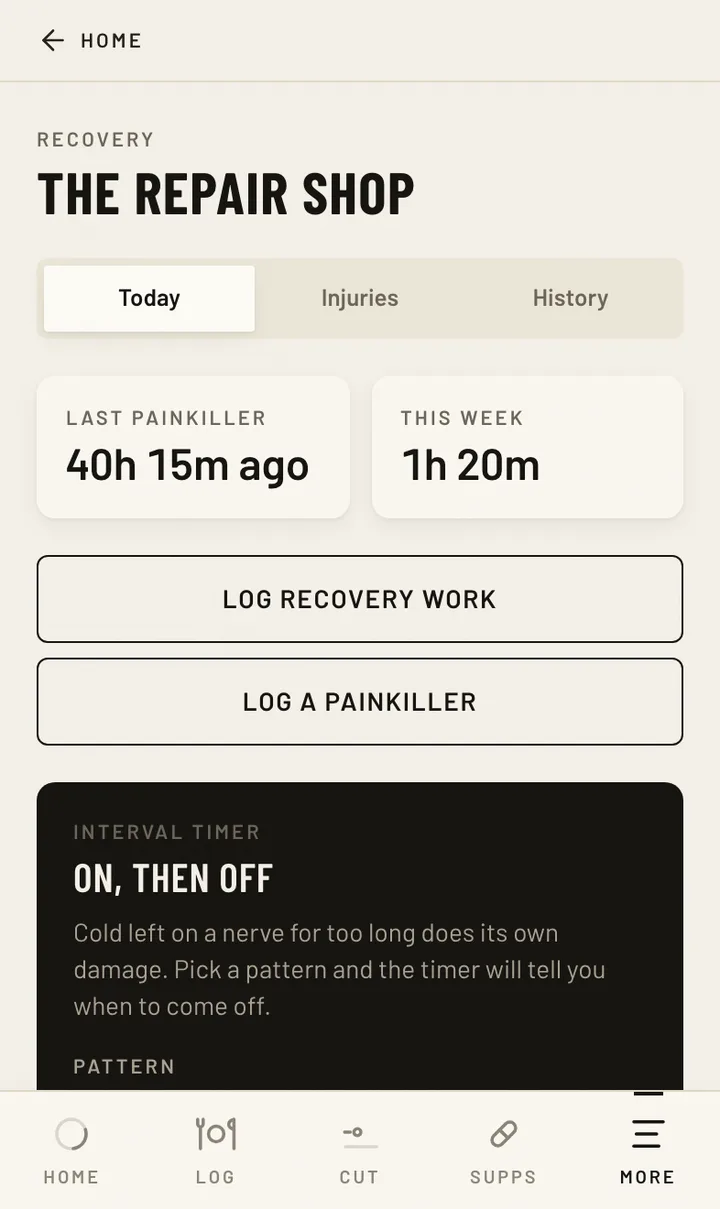
- The app's recovery module records what was taken and when. It has no dose ceiling and no interval, by design: a log is a record, not a recommendation. Its purpose is to replace an estimate with a dated list before a clinical conversation, not to tell anyone when to stop.
- Nothing here is a reason to stop, start, or change anything a clinician has told you. If the answer to your question is a number, the number comes from them.
How many athletes are doing this, and which athletes were counted
Start with what has actually been measured, because the size of this behaviour is the reason the question is worth 5,000 words.
The largest and cleanest dataset comes from Olympic doping-control and medical declarations. Across 6,155 athletes at Tokyo 2020 and Beijing 2022, 36.7% declared pain-and-inflammation medication use — 39.4% (1,771 of 4,492) at Tokyo, 29.3% (487 of 1,663) at Beijing. Anti-inflammatories as a class accounted for 27%, oral NSAIDs specifically for 25.6%, and other oral non-opioid analgesics for 9.8%. Female athletes declared more than male: 44.1% against 30.0% overall, and 33.4% against 26.0% for NSAIDs alone.
Note what that dataset is before you carry it anywhere. It is a declaration made on a form, at a Games, by athletes who knew it would be read by an anti-doping organisation. It is not a diary, it is not a prescription record, and the window it covers is a competition period, not a training block.
The US collegiate picture is more granular and smaller. Among 230 female and 83 male NCAA athletes at three institutions surveyed in August and September 2019, 28% of women and 20% of men reported currently taking NSAIDs. The finding worth sitting with is the next one: among athletes reporting no current pain, 21% of women and 15% of men were taking them anyway. And 70% of female and 61% of male athletes self-purchased — there is no prescriber in that transaction, and therefore no record of it anywhere.
A one-season prospective study of 316 amateur footballers, 185 women and 131 men, collected 2,439 weekly reports and found weekly analgesic use of 27.6% (95% CI 23.8–32.1) in women against 11.2% (8.4–14.8) in men, on near-identical weekly pain — 40.7% against 37.2%. The same sex gradient, in a population reporting week by week rather than recalling at a Games.
A UK survey of 129 amateur endurance athletes found 68% had used NSAIDs in the previous twelve months — 84.4% of triathletes, 70.9% of runners, 52.5% of cyclists, with ibuprofen the most common single drug. The figure that matters for this article is a different one: only 26% of that use was advised by a doctor or pharmacist. Three-quarters of it was self-directed.
A meta-analysis pooling 49 studies and 44,381 youth athletes reported NSAID point prevalence of 48% (95% CI 23–73) and in-season prevalence of 92% (95% CI 88–95). Those intervals are enormous and the authors say why: most of the included studies were of poor methodological quality. The number is real as a signal that this is near-universal in youth sport and useless as a precise estimate of anything.
And then the gap. No measured NSAID or analgesic prevalence figure exists for MMA, boxing, Muay Thai, BJJ, judo or kickboxing. Not a low one, not a high one — none. Anyone who tells you what percentage of fighters are taking anti-inflammatories in camp is extrapolating from one of the cohorts above, and every one of those cohorts differs from a fight camp in the two variables that matter most here: chronic blunt trauma, and a deliberate dehydration at the end.
Why the kidney is where this question lands in a weight-class sport
In any other sport, the case against habitual anti-inflammatories is mostly about the gut, the stomach and cardiovascular risk over years. In a sport where you dehydrate on purpose, the kidney moves to the front, and the reason is mechanical rather than mysterious.
Renal prostaglandins — PGE2 and PGI2 in particular — are vasodilators in the kidney. Most of the time they are not doing much work, because nothing is squeezing the renal vasculature hard. They become load-bearing precisely when vasoconstrictor tone rises, which is what intense exercise produces: blood is redistributed to working muscle and skin, sympathetic drive is high, and the kidney's own vasodilatory signalling is what keeps perfusion and filtration from falling further than they otherwise would.
Anti-inflammatories work by inhibiting prostaglandin synthesis. That is not a side effect; it is the mechanism of action, and it is not selective about which prostaglandins in which tissue matter to you today.
Dehydration adds a third input. Volume and sodium depletion activate the renin–angiotensin–aldosterone system, which is itself vasoconstrictive, and reduces the circulating volume the kidney has to work with in the first place.
Put the three together on paper and you get the argument: remove the vasodilatory compensation at the moment when two vasoconstrictor signals are near maximal, and renal blood flow and glomerular filtration fall further than either stress would produce alone. That is a coherent physiological statement, and the observation underneath it — that ibuprofen use was associated with significantly greater reductions in glomerular filtration rate during exercise in a sodium- and volume-depleted condition — comes from a review published by a sports-drink manufacturer's science institute. It is vendor-published. We use it as mechanism framing and not as the load-bearing citation, and we are telling you that rather than hiding the provenance in a reference list.
What the mechanism does not tell you is magnitude, threshold or who it happens to. For that you need trials, and the trials are where this gets thin.
What dehydrating exercise alone does, with no drug involved
The cleanest evidence separates the exercise from the drug entirely.
In a controlled trial of 34 healthy men, mean age 23, cycling at 80% of maximum heart rate, estimated glomerular filtration rate by cystatin C was unchanged after a 30-minute bout — 118 ± 11 versus 116 ± 12 mL/min/1.73 m², P = 0.12, with a mean body-mass loss of 0.6 ± 0.3%. The same men, cycling until they had lost 3% of body mass — around 150 minutes, mean loss 2.9 ± 0.7% — showed eGFR significantly lower at 103 ± 16 mL/min/1.73 m², P < 0.001. Urinary NGAL, a marker of subclinical kidney stress, rose after both bouts and more after the prolonged one; urinary KIM-1 trended higher after the prolonged bout without reaching significance.
Two things follow, and only two. The exercise that moves kidney markers is the prolonged, dehydrating kind, not the short hard kind — a technical round on the bag is not the thing this study is describing. And these are subclinical markers in healthy young men, not clinical kidney injury. No drug was given in that study at all. It tells you what the dehydration leg of the argument looks like by itself, which is exactly why it is useful and exactly why it cannot be stretched.
The population closest to a fighter comes from wrestling. Twelve male Greco-Roman wrestlers completed a crossover in which the same high-intensity, sport-specific training block was performed with and without a rapid weight loss of roughly 5% of body mass over three days. The weight-loss condition raised blood urea nitrogen (p = 0.002), uric acid (p < 0.001) and serum creatinine (p = 0.006) compared with the identical training alone; cystatin C was slightly elevated after both. The authors' own summary is that high-intensity specific training combined with rapid weight loss significantly affects the increase in kidney function markers compared with identical training without rapid weight loss.
Read the conditions attached to that. Twelve men. Greco-Roman wrestlers, not mixed martial artists. A three-day descent, which is the fight-week shape rather than the whole camp. And — this is the part that gets dropped when the study is cited in a blog post — no anti-inflammatory was administered or measured in it. It is a study about cutting weight, full stop.
That three-day, roughly 5% descent is what the study protocol did. It is not a recommendation, not a ceiling, and not a number anyone should read as acceptable; the markers moved at it, which is the finding. If you want the separate question of what the literature does and does not establish about the size and pace of a descent, that has its own published answer and it is not a number this page is qualified to endorse either.
The one trial that tested the drug, and why it settles less than it looks like
There is exactly one randomised controlled trial of an anti-inflammatory against placebo for acute kidney injury in a dehydrating endurance setting, and it is worth describing in full because it is almost always described wrongly.
Eighty-nine runners — 42 ibuprofen, 47 placebo — were studied during a 50-mile stage of seven-day, 155-mile ultramarathons held in China, Chile, Ecuador and Sri Lanka. Acute kidney injury was defined by RIFLE criteria. Overall AKI incidence across both arms was 44%. In the ibuprofen arm it was 52%; in the placebo arm, 34%.
An 18-point difference sounds decisive. It is not, and the trial's own statistics say so: the 95% confidence interval on that difference ran from −4% to +41%, and the odds ratio was 2.1 with a 95% confidence interval of 0.9 to 5.1. The interval crosses 1. The trial did not reach statistical significance.
This is the point where a health article usually picks a side. The number is consistent with a substantial harm; it is also consistent with no effect; and with n = 89 it could not have resolved between them. That is a finding about the state of the evidence, not a verdict on the drug. Any sentence of the form "ibuprofen more than doubles kidney injury risk" takes the point estimate, drops the interval, and reports an inconclusive trial as a conclusive one. We will not print it, and you should discount any page that does — in either direction, because "the trial found nothing" is the same misreading with the sign flipped.
Note also what the population is not. Ultramarathon runners over 50 miles in the heat are dehydrated by attrition over many hours. A fighter is dehydrated deliberately, faster, and usually while also energy-restricted. Those are not the same exposure, and the trial does not speak to the second one.
Saying the renal argument honestly
Here is the whole case, assembled, with every seam visible.
Leg one: prolonged, dehydrating exercise depresses kidney filtration markers in healthy men, and short exercise does not. Measured, no drug.
Leg two: a rapid weight cut layered on top of hard training raises kidney function markers above what the same training produces alone, in twelve male wrestlers. Measured, no drug.
Leg three: anti-inflammatories inhibit the renal prostaglandins that maintain perfusion when vasoconstrictor tone is high, and the single trial testing that during dehydrating exercise reported more acute kidney injury in the drug arm without reaching statistical significance. Partly mechanistic, partly a trial that did not resolve.
No trial has tested anti-inflammatories in a dehydrating weight cut. The convergence of those three legs is a mechanistic inference across three separate evidence bases, in three separate populations, none of which was a fighter. It is a good inference. It is the kind of inference clinicians make every day and act on. It is not a measurement, and this article will not dress it as one.
What that honestly supports is a conversation, not a rule. It supports a fighter being able to tell a physician: here is the drug, here is how many days, and here is where in the camp the dehydration sat. It does not support this page telling anyone what to do in fight week, because the study that would justify that sentence has never been run.
The gut, and what a camp diet does to it
The gastrointestinal leg is better measured than the renal one and less discussed.
In a four-arm randomised crossover in nine healthy trained men — ibuprofen plus cycling, cycling alone, ibuprofen at rest, rest alone — intestinal fatty-acid-binding protein, a marker of small-intestinal injury, rose with cycling and with ibuprofen, and was highest after cycling with ibuprofen. Small-intestinal permeability increased, again most after the combined condition. The authors' conclusion is unusually blunt for a physiology paper: NSAID consumption by athletes is not harmless and should be discouraged.
Nine men. Cycling. Healthy, and not cutting weight. The signal is that the gut effect is exercise-potentiated — the drug and the training do more together than either alone — which is the same shape as the renal argument and rests on better data.
The interaction with a fight camp's diet is where the evidence runs out, and it is worth being explicit about that because it would be easy to write a confident paragraph here. No study on this page tested anti-inflammatories against an energy-restricted diet. What can be said is reasoning, marked as reasoning: a camp diet reduces total food volume, changes meal timing and often compresses fluid intake in the final week, and the measured GI injury signal above is potentiated by the exercise that is also happening. Whether those interact, and how much, is unmeasured. If you want the broader picture of what sustained energy restriction does in combat sport, that sits in its own evidence base and the overlap with this one is an open question rather than an answered one.
Paracetamol is a different drug, and its risk profile overlaps a weight cut more directly
Paracetamol — acetaminophen — is not an anti-inflammatory in the relevant sense and the renal mechanism above does not transfer to it. In the sodium-depleted exercise condition where ibuprofen was associated with falling filtration, acetaminophen showed no significant association with GFR. If the kidney were the only consideration, it would be the less complicated of the two.
It is not the only consideration. Hepatotoxicity has been reported at recommended dosage following a period of fasting, in some cases without other identifiable risk factors, and the pattern is described in that literature as dose-related rather than purely idiosyncratic in the setting of recent fasting and severe malnutrition. The proposed mechanism is straightforward enough to state without a number attached: the liver detoxifies paracetamol's reactive metabolite using glutathione, glutathione is synthesised from three amino acids, and protein or amino-acid deficiency can deplete it. Fasting additionally shifts hepatic metabolism away from the conjugation pathways toward formation of that reactive metabolite. The fasting-to-glutathione link is largely rodent-supported; the clinical reports are case reports and case series, in patients, not athletes.
This is the most transferable finding on this page for a fighter, and the reason is uncomfortable. The described risk-modifying profile includes older age, lower body weight and malnutrition. An athlete in the back half of a camp is deliberately energy-restricted, deliberately at the bottom of their body-weight range, and often eating little on the days when they are most likely to reach for something for a headache. That is an overlap with a clinically described risk profile, not a measured risk in athletes — nobody has studied paracetamol in energy-restricted competitors.
What to do with it is therefore not a number and cannot be. It is a sentence to say out loud at an appointment: I am in a calorie deficit, I have lost body mass deliberately, and I take this. A pharmacist can answer that question in two minutes with your details in front of them. This page cannot answer it at all, and any page that gives you a threshold for it is inventing one.
Healing and adaptation: genuinely unresolved, and we are not going to resolve it
The claim a fighter hears most often is that anti-inflammatories interfere with healing and blunt training adaptation. The claim a fighter hears second most often is that this was overblown. Both camps cite real studies, and the evidence does not currently settle it.
Bone. A 2024 systematic review and meta-analysis of 20 studies and 523,240 patients, covering literature to July 2023, produced a pooled adjusted odds ratio for non-union or delayed union of 1.11 (95% CI 0.99–1.23) — no significant difference. A 2023 systematic review and meta-analysis of 12 articles, covering literature from January 1990 to June 2023, produced a cumulative odds ratio for adverse bone healing after post-fracture NSAID exposure of 2.10 (95% CI 1.41–3.15). Two meta-analyses drawing on overlapping literature, reaching opposite conclusions. Both are observational-heavy — these are fracture patients, not athletes, and nobody randomises people with broken bones to a drug that might impair union. Presenting either one alone would be picking the answer you wanted.
Tendon. A randomised trial in early-phase human Achilles tendinopathy found that clinical symptoms improved with physical rehabilitation and that adding short-term anti-inflammatory treatment did not augment the improvement, with recovery occurring without measurable structural change. A review of the mixed human and animal literature found that non-selective COX inhibitors showed no negative effect on healing of labrum, tendons and ligaments in the majority of studies, while COX-2-selective inhibitors showed negative impact in the majority of reported studies, including one of the two human studies — a drug-class split that almost never survives into the version of this argument you hear in a gym. The same review states the limitation of the whole field plainly: there has never been a large, prospective, randomised, double-blinded study of the effects of NSAIDs on healing after fractures or tendon ruptures.
Muscle adaptation. Three randomised trials, three directions. One found that ibuprofen, dosed heavily and continuously through eight weeks of supervised knee-extensor resistance training in healthy adults aged 18–35, attenuated gains in quadriceps muscle volume on MRI and in strength — against an active acetylsalicylic acid comparator rather than a placebo, which limits what the contrast means. A second found only a limited effect on the mechanisms regulating hypertrophy at the doses people take without advice, in young adults doing resistance training. A third, in trained men, found that NSAID ingestion augmented training-induced hypertrophy and differentially affected muscle mRNA expression, while not changing strength gains.
The widely repeated "ibuprofen blocks your gains" rests mostly on the first of those three. It was a heavy, continuous dosing protocol run against an aspirin comparator in untrained young adults, and the trial in trained men points the other way. That is not a reason to dismiss it; it is a reason not to state the conclusion as established, in either direction.
Taking it before it hurts. One position worth separating out, because it is the pattern a lot of camp use actually follows: taking something in anticipation of soreness rather than in response to pain. A review of prophylactic NSAID use by athletes concludes that there is no scientific evidence supporting it before events or hard sessions. That is a statement about absence of demonstrated benefit, which is a different and weaker claim than demonstrated harm — but if the reason you are taking something most days is that tomorrow's session is going to hurt, the benefit side of that trade has not been shown to exist.
Topical is not a loophole, and the number you have seen is not real
The reasonable next question is whether a gel sidesteps the systemic argument. Partly, and less cleanly than the internet says.
In a randomised three-way crossover in 40 healthy volunteers, systemic exposure measured as AUC over 24 hours was 3,890 ± 1,710 ng·h/mL for oral diclofenac against 233 ± 128 and 807 ± 478 ng·h/mL for the topical arms — roughly 5- to 17-fold lower for the topical gel. Oral diclofenac inhibited platelet aggregation and both COX-1 and COX-2; the topical did not inhibit platelet aggregation and inhibited COX-1 and COX-2 less. In the same trial, the oral arm produced gastrointestinal adverse events while the topical produced application-site reactions.
Three conditions travel with that. Those volunteers were healthy, hydrated and at rest — not dehydrated athletes mid-camp, which is the exact population the renal question is about. Lower systemic exposure is not zero systemic exposure. And a range of 5- to 17-fold is a range, driven by which topical formulation and which application, not a single conversion factor.
Which brings us to a figure you have certainly seen: that topical delivers 3–8% of the oral systemic dose, or that peak concentration is about a hundred times lower. We chased both. They appear only in unattributed search-summary text with no retrievable primary study behind them, and we are not printing them. The grounded figures are the AUC numbers above, with their n of 40 and their healthy-volunteer conditions attached.
The anti-doping question, answered, and then set aside
This is the shortest section in the article and the only one with a clean answer.
The 2026 WADA Prohibited List came into effect on 1 January 2026. A full-text search of the official International Standard for ibuprofen, naproxen, aspirin, acetylsalicylic, diclofenac, paracetamol and acetaminophen returns zero hits. None of them is prohibited, in competition or out, under any class.
Tramadol is prohibited in-competition under S7 Narcotics, added effective 1 January 2024, and is a Specified Substance. WADA justified the addition on dependence, addiction and overdose risk together with evidence of performance enhancement in certain activities. The complete S7 list in the 2026 Standard is thirteen substances: buprenorphine, dextromoramide, diamorphine (heroin, also designated a Substance of Abuse), fentanyl and its derivatives, hydromorphone, methadone, morphine, nicomorphine, oxycodone, oxymorphone, pentazocine, pethidine and tramadol.
Codeine, dihydrocodeine, hydrocodone and tapentadol do not appear on the 2026 Prohibited List. They are sometimes described as prohibited in-competition by pages summarising anti-doping material, which appears to conflate the Prohibited List with the Monitoring Program. Those are different documents with different consequences: the Monitoring Program exists so that WADA can detect patterns of use or misuse, and athletes may still use substances on it without risk of an anti-doping rule violation. Tramadol and fentanyl are additionally monitored out-of-competition under the 2026 program; we have not read the Monitoring Program document directly and flag that claim as triangulated rather than verified. If you need a ruling on a specific medication in your jurisdiction, the check is a live one against the current List and your own anti-doping organisation, not a blog post — the same discipline that applies to anything else you put in your body during camp.
And then set it aside, because it answers a different question than the one this article is about. Permitted is not the same as harmless. Everything above concerning kidneys, gut, liver and adaptation applies to drugs that are entirely legal in sport, unrestricted in competition, and available without a prescription. Passing a drug test is not evidence that a drug is doing nothing to you.
Ten weeks of camp, written down
There is one thing a fighter can do about all of this before they next talk to a clinician, and it is not a decision about the drug. It is producing the only number they can honestly produce.
Not milligrams. Days.
Take the sentence the reader arrived with — I take ibuprofen most days in camp. Over a ten-week camp, "most days" is somewhere around fifty separate days of use. Almost nobody knows that number about themselves, and the reason is structural rather than careless: the drug was self-purchased (70% of female and 61% of male collegiate athletes in the NCAA survey), taken without professional advice (only 26% of amateur endurance use was advised by a doctor or pharmacist), and written down nowhere at all. There is no prescription record to reconstruct it from. There is no pharmacy history. There is a box in a gym bag.
Now overlay the camp's own shape on the same calendar: the weeks where volume is highest, the days in the final week where fluid comes down, and weigh-in day itself.
The payoff is the overlap, not a calculation. The exercise that moved kidney markers in healthy men was the prolonged, dehydrating kind — the short bout left filtration unchanged at P = 0.12 while the bout taken to roughly 3% body-mass loss dropped it at P < 0.001. Adding a rapid cut to hard training raised kidney markers in wrestlers above what the same training produced alone. The mechanism says an anti-inflammatory is the worst thing to add to precisely that state. And nobody has tested all three together, which this page has now said four times because it is the most important sentence on it.
So the scenario ends where it should. The fighter has a dated list of days and a marked-up camp calendar, and a sentence to take to a physician or pharmacist: here is what I actually took, and here is when I was dehydrated — is this a problem for me?
That is a question only a clinician can answer. Making a fighter able to ask it well is the entire job of this article. It is also, incidentally, the same problem as telling a coach you are hurt — a thing that is hard to say because it was never written down, and much easier to say once it was.
Why a contemporaneous record and not recall? A validation study linking self-reported medication to national prescribing records in 10,244 people found recall accuracy varying sharply by drug class, with kappa values of 0.95 for cholesterol-lowering drugs, 0.90 for antihypertensives, 0.85 for antidepressants, 0.84 for aspirin, 0.78 for HRT, 0.73 for oral contraceptives and 0.42 for mood stabilisers — with evidence of both under- and over-reporting, and history of the indicated illness the strongest predictor of accurate recall.
Be careful with what that does and does not show, because it is easy to over-claim. It is a general-population study, over a six-month recall window, of prescribed medicines with a paper trail behind them. It does not show that athletes systematically under-report anti-inflammatories; no study on this page measures that. If anything the inference runs the unflattering way: the classes it validated best are the ones least like an over-the-counter drug bought by the athlete themselves and taken irregularly across ten weeks. Retrospective recall of that is the weakest possible input to a clinical conversation. A dated record replaces an estimate with a record, and that is the whole of the argument.
What we could not verify
Twelve things were checked and refused. Naming them is more useful than quietly leaving them out.
No combat-sports prevalence data exists at all. We searched for measured analgesic or NSAID use in MMA, boxing, Muay Thai, BJJ, judo and kickboxing populations and found none. Every figure in this article comes from Olympic multi-sport, NCAA, amateur football, amateur endurance or youth cohorts. We have not transferred any of them onto combat sport as if it had been measured there, and neither should anyone else.
Women are absent from the harm evidence. They were the higher-using group in all three prevalence cohorts with a sex breakdown — 44.1% against 30.0% at the Olympics, 28% against 20% in the NCAA survey, 27.6% against 11.2% weekly in amateur football. The renal and gastrointestinal studies cited here were 34 men, 12 men and 9 men. The population most likely to be taking these drugs is the population least represented in the data about what they do. We cannot scale the findings across that gap and we have not tried.
"Topical delivers 3–8% of oral systemic absorption." Widely repeated, including in otherwise careful places. It surfaced for us only in search-summary text with no traceable primary source. Refused, and replaced by the measured AUC comparison with its own conditions attached.
"Peak concentration after topical is about 100 times lower than oral." Same problem, same refusal.
"Ibuprofen more than doubles your risk of kidney injury." The point estimate exists; the interval runs from 0.9 to 5.1 and the trial did not reach significance. Refused as stated.
"NSAIDs delay bone healing," and its mirror image. Two meta-analyses of overlapping literature disagree. Only the disagreement is printable.
"Ibuprofen blocks muscle growth." Three randomised trials, three directions, including one in trained men pointing the opposite way. Not established.
A blog-shaped sentence about the dehydration–NSAID stack, describing the combination as stacking risk highest because filtration falls at the moment the kidney is asked to clear myoglobin from a low-fluid system, surfaced repeatedly in search results with no primary behind it. It may well be someone's summary of the same mechanism this article describes. We have not quoted it or lightly reworded it; the mechanism here is written from the underlying physiology and the trials named.
Athlete-specific under-reporting rates for anti-inflammatories. Material attributing under-reporting on doping-control forms to the stress of the control process and to athletes concealing products was retrievable only as search summary. No primary. Refused.
The WADA Monitoring Program, as a document. We verified the Prohibited List against the official 2026 International Standard text. The Monitoring Program is a separate document and we did not read it. The out-of-competition monitoring of tramadol and fentanyl, and the 2026 additions, remain triangulated from national anti-doping and International Testing Agency material rather than read from the source. Likewise the claim that M1.4, non-diagnostic carbon monoxide use, is the only permitted-to-prohibited change for 2026.
Several abstracts could not be fetched directly — publisher 403 responses on multiple journals, a CAPTCHA on one PMC record, and a PDF that would not extract to text. Where a claim rests on one of those, we have said so in the text rather than presenting abstract-level retrieval as full-text verification.
Any dose–response relationship for any of this in an athletic population. "Most days in camp" — the reader's own exposure — has never been studied as an exposure. There is no published curve, no threshold and no ceiling to report, which is one of the reasons this article contains none.
Questions fighters ask
Is it bad to take ibuprofen every day in camp?
Nobody has measured it, and that is the honest answer rather than an evasion. There is no study of daily anti-inflammatory use in a fight camp, in a weight cut, or in any combat sport. What is known is mechanistic and adjacent: anti-inflammatories inhibit the renal prostaglandins that help maintain kidney perfusion when vasoconstrictor tone is high, prolonged dehydrating exercise depresses kidney filtration markers on its own, and a rapid cut raises kidney markers further in wrestlers. Those are three separate findings in three separate populations, none of them fighters, and no trial has combined them. Daily use over ten weeks is a pattern worth raising with a physician or pharmacist, who can check the things that decide the answer for you specifically. This page cannot, and will not give you a frequency.
How much ibuprofen is safe for an athlete?
That is a question for a pharmacist or a physician and there is no version of it this article will answer. The amount depends on your kidney function, your liver, your blood pressure, what else you take, your body mass and what is actually wrong with you — none of which a web page has access to. A pharmacist will answer it across a counter in a couple of minutes for free. What this article can tell you is which information to bring: how many days you have taken it, where in the camp those days sat, and whether you were dehydrating at the time.
Does ibuprofen damage your kidneys during a weight cut?
No trial has ever tested that combination, which is the most important sentence in this whole article. The argument that it might is a mechanistic inference built from three non-overlapping evidence bases: anti-inflammatories remove renal vasodilatory compensation during exercise, dehydrating exercise depresses filtration markers by itself in healthy men, and a rapid weight cut raises kidney function markers in wrestlers above the same training without a cut. The single randomised trial of ibuprofen against placebo for kidney injury in a dehydrating endurance event reported 52% versus 34%, odds ratio 2.1, 95% confidence interval 0.9 to 5.1 — it did not reach statistical significance. The inference is reasonable and unproven, and anyone stating it as a measured fact is overreaching.
Is ibuprofen banned by WADA?
No. A full-text search of the official 2026 WADA Prohibited List International Standard, in force since 1 January 2026, returns zero hits for ibuprofen, naproxen, aspirin, acetylsalicylic acid, diclofenac, paracetamol and acetaminophen. None of them is prohibited in or out of competition under any class. That is a clean answer to the doping question and no answer at all to the health question: permitted is not the same as harmless, and everything documented about kidneys, gut, liver and adaptation applies to drugs that are fully legal in sport.
Is tramadol banned in MMA?
Tramadol is prohibited in-competition under section S7, Narcotics, of the WADA Prohibited List, added effective 1 January 2024, and it is classified as a Specified Substance. WADA justified the addition on the grounds of physical dependence, opiate addiction and overdose risk, together with studies indicating performance enhancement in certain activities. The complete S7 class in the 2026 Standard contains thirteen substances. Whether it applies to you specifically depends on which anti-doping organisation tests your competition, so verify against the current List and your own governing body rather than against any article.
Is codeine prohibited in competition?
Codeine does not appear on the WADA 2026 Prohibited List — a full-text search of the official International Standard finds it in no section, including S7 Narcotics. The same is true of dihydrocodeine, hydrocodone and tapentadol. They are sometimes described as prohibited by pages that have conflated the Prohibited List with the Monitoring Program, which is a separate document with a different purpose: substances on it are monitored to detect patterns of use, and athletes may use them without risk of an anti-doping rule violation. Not prohibited is not the same as advisable, and any opioid question belongs with a prescriber.
Do NSAIDs stop muscle growth?
Not established, and the evidence points three ways. One randomised trial dosing ibuprofen heavily and continuously through eight weeks of supervised resistance training in healthy untrained adults found attenuated gains in quadriceps volume and strength — but its comparator was an active aspirin arm rather than a placebo. A second trial found only a limited effect on the mechanisms regulating hypertrophy at the amounts people take without advice. A third, in trained men, found NSAID ingestion actually augmented training-induced hypertrophy while not changing strength gains. The claim you usually hear rests on the first study alone and drops its conditions.
Do anti-inflammatories slow bone healing after a fracture?
The two most recent meta-analyses disagree, and picking one would be choosing an answer rather than reporting the evidence. A 2024 review of 20 studies and 523,240 patients found a pooled adjusted odds ratio for non-union or delayed union of 1.11, 95% CI 0.99–1.23 — no significant difference. A 2023 review of 12 articles found a cumulative odds ratio for adverse bone healing after post-fracture exposure of 2.10, 95% CI 1.41–3.15. Both draw on overlapping, observational-heavy literature in fracture patients rather than athletes. If you have a fracture, this is a decision for the clinician managing it, who has the imaging and the history.
Is paracetamol safer than ibuprofen for a fighter?
They are different drugs with different problems, and "safer" depends on which problem you have. The kidney mechanism in this article is specific to anti-inflammatories and does not transfer to paracetamol, which showed no significant association with filtration in the sodium-depleted exercise condition where ibuprofen did. But paracetamol carries a hepatic risk profile that overlaps an energy-restricted athlete unusually closely: hepatotoxicity has been reported at recommended dosage after a period of fasting, in the setting of fasting and severe malnutrition, in patients rather than athletes. Neither drug is the obvious default, and which one suits you is a pharmacist's answer, not an internet one.
Does being in a calorie deficit change how paracetamol affects you?
The clinical literature describes hepatotoxicity at recommended dosage following a period of fasting, with a proposed mechanism that is coherent: the liver uses glutathione to neutralise paracetamol's reactive metabolite, glutathione is synthesised from three amino acids so protein deficiency can deplete it, and fasting shifts hepatic metabolism toward forming more of that metabolite. The fasting-to-glutathione link is largely rodent-supported and the clinical evidence is case reports and series in patients. Nobody has studied it in energy-restricted athletes. It is a strong reason to tell a clinician you are in a deficit and have deliberately lost body mass, and not a threshold anyone can calculate.
Are topical gels a way around the kidney risk?
They reduce systemic exposure substantially without eliminating it, and the evidence has conditions. In a three-way crossover in 40 healthy volunteers, 24-hour systemic exposure was 3,890 ± 1,710 ng·h/mL for oral diclofenac against 233 ± 128 and 807 ± 478 ng·h/mL for topical arms — roughly 5- to 17-fold lower. Topical did not inhibit platelet aggregation where oral did. But those volunteers were healthy, hydrated and at rest, not dehydrated athletes in fight week, and lower exposure is not zero exposure. The widely quoted "3–8% of oral" figure has no traceable primary source and is not used here.
How many fighters take painkillers in camp?
Unknown. No study has measured analgesic or anti-inflammatory use in MMA, boxing, Muay Thai, BJJ, judo or kickboxing. The nearest measured figures come from other populations: 36.7% of 6,155 Olympic athletes declared pain-and-inflammation medication, 28% of female and 20% of male NCAA athletes reported currently taking NSAIDs, and 68% of a UK amateur endurance sample had used them in the previous year. Those are real numbers about other sports. Anyone quoting a fighter percentage is extrapolating, and combat sport differs from all of those cohorts in exactly the ways that would matter — chronic blunt trauma and a deliberate dehydration.
Should I take something before a hard session so I am not sore?
A review of prophylactic NSAID use by athletes concludes there is no scientific evidence supporting it before events or hard sessions. That is a statement about the absence of demonstrated benefit rather than proof of harm, but it matters for the common camp pattern of taking something in anticipation of soreness rather than in response to pain, because the upside of that trade has not been shown to exist while the questions about kidney, gut and adaptation apply the same way. If soreness is severe enough that you are pre-medicating for it most sessions, that is worth raising with your coach and a clinician as a training-load question, not only a medication one.
Does the app tell me when I have taken too many?
No, deliberately. The recovery module records what was taken and when, and it contains no dose ceiling and no interval anywhere. A log is a record, not a recommendation, and a limit would be medical advice this app is not qualified to give — the amount that is appropriate for you depends on your kidney function, your liver, your other medications and your body, which software does not have access to and a clinician does. What the log is for is producing a dated list you can put in front of a physician or pharmacist, instead of an estimate made from memory about ten weeks of an over-the-counter drug you bought yourself.
Should I stop taking what my doctor prescribed after reading this?
No. Nothing in this article is a reason to stop, start, or change anything a clinician has told you, and it is not capable of being one — a physician who prescribed something for you did so knowing your history, your kidney and liver function, and what is actually wrong. If this article has raised a question, the correct use of it is to bring the question to them, ideally with a record of what you have taken and when. The one thing that never follows from a web page is overriding the person who examined you.
Sources
Sourced to
- Prohibited List 2026 — World Anti-Doping Code International Standard — World Anti-Doping Agency, official International Standard in force 1 January 2026, full text as published by NADA Austria, accessed 22 September 2026
- The Prohibited List — World Anti-Doping Agency, 2026 List, accessed 22 September 2026
- The Prohibited List — athlete hub — International Testing Agency, explainer on the List and the Monitoring Program, accessed 22 September 2026
- 2026 WADA Prohibited List advisory — U.S. Anti-Doping Agency, 2026 changes summary, accessed 22 September 2026
- The Essential and Optimal Analgesic and Anti-Inflammatory Medicines for Athletes at the Olympic Games — Vernec, Burke et al., Sports Medicine – Open, 2024, PMC11258109
- Prevalence, frequency, adverse events, and reasons for analgesic use in youth athletes: a systematic review and meta-analysis of 44,381 athletes — Pedersen et al., Journal of Science and Medicine in Sport 2022;25(10):810-819, PMID 36100523
- Epidemiological profile of pain and non-steroidal anti-inflammatory drug use in collegiate athletes in the United States — cross-sectional survey of NCAA athletes at three institutions, 2019, PMC7437034
- One in three reports pain in a given week: a one-season prospective study of amateur female and male football players — prospective cohort, 316 players, 2,439 weekly reports, PMC12766771
- Amateur endurance athletes' use of non-steroidal anti-inflammatory drugs: a cross-sectional survey — Küster et al., International Journal of Pharmacy Practice 2019;27(1):105-107, PMID 30019790
- Ibuprofen versus placebo effect on acute kidney injury in ultramarathons: a randomised controlled trial — Lipman GS et al., Emergency Medicine Journal 2017;34(10):637-642, doi 10.1136/emermed-2016-206353, PMID 28679502
- Impact of acute versus prolonged exercise and dehydration on kidney function and injury — controlled trial, 34 healthy men, cystatin C and urinary injury markers, PMC5995308
- Rapid weight loss can increase the risk of acute kidney injury in wrestlers — Trivic et al., BMJ Open Sport & Exercise Medicine 2023, crossover in 12 male Greco-Roman wrestlers, PMC10314685
- Anti-inflammatory drugs, kidney function and exercise — Gatorade Sports Science Institute, Sports Science Exchange #67 — vendor-published review, used here for mechanism framing only
- Aggravation of exercise-induced intestinal injury by ibuprofen in athletes — van Wijck K et al., Medicine & Science in Sports & Exercise 2012;44(12):2257-62, PMID 22776871
- Do NSAIDs affect bone healing rate, delay union, or cause non-union: an updated systematic review and meta-analysis — 20 studies, 523,240 patients, literature to July 2023, PMC11420001
- The Association of NSAID Use and Risk of Adverse Fracture Healing: A Systematic Review and Meta-analysis — SurgiColl, 2023, 12 articles, literature January 1990 to June 2023
- High doses of anti-inflammatory drugs compromise muscle strength and hypertrophic adaptations to resistance training in young adults — Lilja M et al., Acta Physiologica 2018;222(2), PMID 28834248
- Limited effect of over-the-counter doses of ibuprofen on mechanisms regulating muscle hypertrophy during resistance training in young adults — Journal of Applied Physiology, 2023, randomised trial in young adults
- NSAID ingestion augments training-induced muscle hypertrophy and differentially affects muscle mRNA expression in trained men — Mallinson et al., The Journal of Physiology, randomised trial in trained men
- No additive clinical or physiological effects of short-term anti-inflammatory treatment to physical rehabilitation in early human Achilles tendinopathy: a randomized controlled trial — Malmgaard-Clausen et al., American Journal of Sports Medicine, 2021, doi 10.1177/0363546521991903
- NSAID therapy effects on healing of bone, tendon, and the enthesis — review of human and animal literature, including the COX-2-selective split, PMC3764618
- Systemic bioavailability of topical diclofenac sodium gel versus oral diclofenac sodium in healthy volunteers — Kienzler JL, Gold M, Nollevaux F, Journal of Clinical Pharmacology 2010, randomised three-way crossover, n=40, doi 10.1177/0091270009336234
- Paracetamol-induced hepatotoxicity at recommended dosage — Kurtovic J, Riordan SM, Journal of Internal Medicine 2003, case series with accompanying commentary, doi 10.1046/j.1365-2796.2003.01097.x
- Self-reported medication use validated through record linkage to national prescribing data — Hafferty, Fernandez et al., Generation Scotland: Scottish Family Health Study, n=10,244, PMC5808931
- Prophylactic use of NSAIDs by athletes: a risk/benefit assessment — Warden SJ, The Physician and Sportsmedicine 2010;38(1):132-8, PMID 20424410
Read next
Plan the descent, don't guess it
Fighter Cut builds a week-by-week plan from today to your weigh-in, classifies the rate you are actually losing at, and logs what you eat against it. It does not make a cut safe — nothing does. It makes the numbers visible early enough to change them.
Open Fighter Cut