Fighter Cut › Articles › Fight camp
Fight camp
Telling your coach you are hurt
The measured behaviour is well documented in adjacent sports. What disclosure costs a fighter — a bout, a purse, a spot — has never been measured, and this article will not pretend otherwise.
The question almost every fighter is actually asking is: if I say my knee is bad, do I lose the fight? And the honest answer is that nobody has measured it. There is no study anywhere in the sports-medicine literature that tracks fighters who disclosed an injury and fighters who did not, and reports what happened to their bouts, their purses or their places on a roster. The reader's literal question has no measured answer.
That absence is the most important fact on this page, so it goes first rather than last. Everything that follows is built around it, because the alternative — assembling a confident answer out of numbers borrowed from college football and small surveys of striking gyms — would be exactly the kind of false precision this subject attracts.
What is measured is the behaviour. Of 797 former US collegiate athletes surveyed, 214 recalled at least one concussion they identified themselves; 71 of those 214, or 33.2%, said they had not disclosed at least one of them. In a cohort of college football players, 47% of suspected concussions were reported to a medical professional against 80% of other injuries — same athletes, both figures. And in the only survey here whose subjects are actually fight-sport athletes and coaches, 68.5% of coaches confirmed that a health-care professional is likely absent from training altogether.
This article describes why fighters hide injuries. It is not telling anyone to. That distinction is not a disclaimer bolted on at the end: in Nevada, the prefight medical questionnaire is attested under penalty of perjury, which means that at the weigh-in table the choice is not between disclosing and staying quiet. It is between an accurate statement and a false sworn one. There is no version of this article that treats concealment as a strategy.
What follows is the measured record, the incentive structure it sits inside, the regulatory facts that are actually in force as of the date they were checked, and the one thing about all of this that is inside a fighter's own control.
No study tracks what disclosing an injury costs a fighter — not a bout, not a purse, not a roster spot. The reader's actual question is unanswered in the literature
Absence across all sources consulted for this article, 2026-09-22
Of the 214 former US collegiate athletes who recalled a self-identified concussion — not of all 797 surveyed, and not a diagnosis — reported not disclosing at least one
Kerr et al., Am J Sports Med 2016;44(1):220–225, PMID 26582799
Suspected concussions reported to a medical professional versus other injuries reported, in the same college football players, men only, the athlete's own suspicion of concussion
Baugh et al., Harvard-hosted accepted manuscript, read 2026-09-22
Of coaches across MMA, boxing, kickboxing and Muay Thai — 35 coaches beside 70 athletes, 15 of them women — confirmed the likely absence of health-care professionals during training
Follmer, Varga & Zehr, Phys Sportsmed 2020;48(4):417–423, PMID 32067547
- No study measures what disclosure costs a fighter. Nothing located for this article tracks whether telling a coach, a physician or a commission cost an athlete a bout, a purse or a place. The question is real and the answer is absent, and pretending otherwise would be the dishonest part of writing this.
- No measured non-disclosure rate exists for professional combat sports either. The numbers below come from college football and from small surveys in adjacent striking sports. None of them is a fighter number, and none should be quoted as one.
- Under-reporting concentrates on concussion specifically. In the college football cohort, 47% of suspected concussions reached a medical professional against 80% of other injuries — a within-person gap, in the same athletes, on the athlete's own suspicion.
- The reasons athletes give are ordinary and situational. Among the 71 non-disclosers in the collegiate survey, the most common motivations were not wanting to leave the game or practice (78.9%) and not wanting to let the team down (71.8%), alongside not knowing it was a concussion and not thinking it serious enough (70.4% each).
- Reporting fell as injuries accumulated, and no athlete in that cohort ever reported a fifth concussion to medical personnel, despite many suspecting more — an association the authors note sits at roughly the clinical threshold for discussing curtailed participation.
- In combat sports the structural problem is different: there is often no clinician in the room at all. Across 70 athletes and 35 coaches in four striking sports, 68.5% of coaches confirmed health-care staff are likely absent from training, and athletes named self-diagnosis (79%) and the coach's diagnosis (43.3%) as the methods most used.
- At the Nevada weigh-in the prefight questionnaire is sworn. Under NRUC 3.040(1), adopted 2022-09-20, each unarmed combatant completes a prefight medical questionnaire and attests under penalty of perjury to its accuracy. Concealment at that table is a false sworn statement, and nothing here is advice to make one.
- Medical suspensions are portable, not local. Where a commission places one, other commissions recognise it — so a suspension is not a thing a fighter can outrun by crossing a state line, whatever the room says.
- Women, adolescents and grappling sports are effectively absent from this literature. The combat-sports survey includes 15 women; the football cohort is male-only; nothing here covers youth boxing, junior judo, BJJ or wrestling. Every combat-sport finding on this page is a striking-sport finding.
1. The question that has no answer
Start with the shape of the missing evidence, because knowing precisely what is absent is more useful than a substitute number.
To answer "will disclosing cost me the fight," a study would need to follow a defined group of fighters through a camp, record which of them disclosed an injury and to whom, and then record the outcomes: bout kept or lost, purse paid or not, gym place retained or not, next booking offered or not. It would need a comparison group who did not disclose. It would need to handle the obvious confounder that the fighters who disclose are, on average, the more injured ones, so any raw difference in outcomes would partly be the injury speaking rather than the disclosure.
No such study was located. Not a weak one, not an underpowered one in one promotion — none. The closest the literature comes is a description of what fighters do: self-diagnose, or ask a coach. That tells you something about the environment and nothing about consequences.
This matters more than a normal evidence gap because of what fills the vacuum. Gym lore fills it. A story about someone who told a coach about a rib and never got booked again fills it, and so does the opposite story. Neither is data, and both feel like data to the person weighing them at eleven at night four weeks out. An article that offered a reassuring number here would be doing the same thing as the gym lore, with better typography.
So the honest structure is this: describe the incentive environment precisely, report the behaviour that has actually been measured in populations near enough to be informative, mark exactly how far each of those populations is from a fighter, state the regulatory facts that are in force, and stop. No cost estimate. No "in most cases it works out." Those sentences do not exist in any source.
2. What non-disclosure actually looks like when someone counts it
The best-characterised measurement of athletes hiding injuries comes from a 2016 survey in the American Journal of Sports Medicine. Kerr and colleagues surveyed 797 former US collegiate athletes across mixed sports and both sexes, asking them to recall concussions they had self-identified — not concussions a clinician diagnosed, but ones the athlete themselves believed they had sustained, across high school, college or professional play.
Of the 797, 214 (26.9%) recalled at least one such concussion. Of those 214 — and this denominator matters enormously — 71, or 33.2%, reported not disclosing at least one of them.
The abstract puts it plainly: "A total of 214 respondents (26.9%) reported sustaining at least 1 SISRC. Of these, 71 (33.2%) reported not disclosing at least 1 SISRC."
Read that denominator carefully, because the figure is quoted in the wrong form constantly. It is not 33.2% of all athletes. It is not 33.2% of concussions. It is the share of people who remember having had one and say they kept at least one of them quiet. Change the denominator and the number means something else entirely.
The variation within the cohort is more informative than the headline. Among former football athletes — men, a collision sport — non-disclosure ran to 68.3%. Among female athletes in low-contact or non-contact sports it was 11.1%. In a multivariate model controlling for sex, contact level and the year the athlete began collegiate sport, men were more likely to have concealed, with an adjusted prevalence ratio of 2.11 (95% CI 1.13–3.96); excluding football entirely barely moved it, at 2.11 (1.12–3.94).
A six-fold spread between the highest and lowest subgroups of the same survey is the point. Non-disclosure is not a stable personal trait that some athletes have. It tracks the structure of the sport the athlete is standing in.
3. The gap is specific to concussion
A separate cohort makes the sharper version of the same observation, and it does it within the same people rather than between subgroups.
Baugh and colleagues studied college football players across four teams — two with winning records at the top of their conference, two with losing records at the bottom — with demographics available for around 294 athletes, all men. They asked about suspected concussions and about other injuries, using the athlete's own suspicion as the unit.
The result: 47% of suspected concussions were reported to a medical professional, against 80% of non-concussion injuries. The abstract states it directly: "We find that athletes are much less likely to report a concussion to a medical professional than they are to report another injury (47% vs. 80%), but no association between reporting and a measure of athletes' ability to switch from fast, reactive thinking to reasoned, deliberative thinking."
Because both figures come from the same athletes, the 33-point gap is not two populations behaving differently. It is one population treating two kinds of injury differently.
Broken down by athlete rather than by injury, the distribution is starker still. For concussions: 56% of the cohort — 165 men — reported none of theirs, 23% reported some, 20% reported all. For non-concussion injuries: 23% reported none, 26% some, 51% all. The modal college football player in that study reported zero of his suspected concussions and all of his other injuries.
The second half of the abstract sentence deserves as much attention as the first. The authors found no association between reporting and a cognitive-reflection measure of deliberative thinking, and note that 51% of the cohort scored zero on the three-item test. Whatever produces the gap, the data do not support describing it as a calm cost-benefit calculation that a more thoughtful athlete would get right.
4. Reporting fell as injuries accumulated
The same cohort produced the finding that is hardest to look at.
Fitting reporting probability against the sequence of suspected concussions, the authors found the proportion reported declining across successive events: 0.53, 0.48, 0, then 0.32, with a likelihood-ratio statistic of 10.3 against the 95% chi-squared quantile — a statistically significant decline. Athletes with more than four suspected concussions, 22 men or about 11% of the sample, were excluded from that particular model. Expressed as a regression estimate, an athlete one standard deviation above average in career injuries reported 17% fewer concussions to medical personnel, and 10% fewer injuries in the parallel injury model.
And the ceiling: no athlete in the cohort reported more than four concussions to medical personnel, despite many suspecting more than four.
The authors observe that four is a figure that recurs in clinical discussions about whether an athlete should continue in a collision sport. The reporting ceiling and the participation threshold sit in the same place. That is an association in a single cohort of college football players and not a demonstrated mechanism, and it should be read as one. It is still the most legible picture in this literature of what happens when the consequence of reporting becomes large enough to see.
For a fighter reading this, the transferable part is not the number. It is the direction: in the one population where anyone has looked, the athletes with most to lose reported least, and they stopped reporting exactly where reporting started to threaten the career.
5. In a fight gym, there is often nobody to tell
Everything above happens inside NCAA sport, where an athletic trainer is a salaried presence and a reporting pathway exists whether or not it is used. Combat sports are structurally different, and the difference is documented.
Follmer, Varga and Zehr surveyed 70 athletes and 35 coaches across MMA, boxing, kickboxing and Muay Thai — 55 male athletes and 15 female, 52 amateur and 18 professional. It is the only source consulted here whose cohort is actually fight-sport athletes and their coaches, and it is small enough that every percentage below rests on very few people.
Their finding: "The likely absence of health-care professionals during training was confirmed by 68.5% of coaches, and athletes declared that self-diagnosis (79%) and coaches' diagnosis (43.3%) were the most used method of suspected concussion assessment."
That reframes the whole question. The collegiate literature asks whether an athlete will disclose to the clinician who is standing there. In a fight gym the ordinary case — not the unlucky one — is that there is no clinician standing there. The realistic options at the end of a hard Tuesday are the fighter's own judgement and the coach's.
Two further numbers from the same 35 coaches, and the n has to travel with them because it is doing all the work: 5.7% correctly recognised the level of traumatic brain injury a concussion represents, which at n = 35 is about two people, and 68.8% were unfamiliar with any sideline assessment tool. Only 14.3% said they often sought out concussion knowledge.
That is not an indictment of coaches. It is a description of a role nobody trained them for and nobody pays them to hold. A coach is being asked to make an assessment that, in the sport next door, is made by a licensed professional with a protocol.
Two more findings from the same cohort, both fragile. Return to full practice within a week of a concussion diagnosis was reported by 55.5% of the professionals (n = 18), 54.5% of the women (of 15 overall) and 50% of the under-66.2 kg group (n = 25). And athletes who were aware of the severity level a concussion represents did fewer sparring sessions per week — 1.27 ± 1.1 against 3.17 ± 2.81 — at p = .05 with d = .89, and were more likely to report concussive episodes. That is an association at a borderline p-value in a very small sample. It does not show that education caused either behaviour. If it points anywhere, it points at the amount of hard sparring a camp is carrying as a variable worth looking at alongside disclosure rather than downstream of it.
6. The Muay Thai number everyone quotes, and what it actually asked
A 2018 study in Injury Epidemiology is the most-cited combat-sports source on this topic, and the way it is cited is a small case study in how figures decay.
Lystad and Strotmeyer surveyed 193 adult competitive Muay Thai athletes registered with the Thai Boxing Association Sanctioning Authority, the largest amateur Muay Thai sanctioning body in North America, drawn from a frame of 1,309 adults of whom 743 were recently active. The instrument was RoCKAS-ST, 55 items, delivered anonymously. Mean concussion knowledge was 19.5 out of 25 (SD 2.3); mean attitudes 62.7 out of 75 (SD 7.4). And 134 athletes — 69.4% — were classified as likely to report concussion symptoms. No significant predictors of knowledge, attitudes or reporting intention were found.
Here is the part that never travels with the 69.4%. That classification rests on a single questionnaire item, scored by the athlete's disagreement with one sentence:
"I would continue playing a sport while also having a headache that resulted from a minor concussion"
So 69.4% is the share who disagreed with continuing to train through a concussion headache. It measures intention, on one item, at one moment, in an anonymous survey. It does not measure behaviour, and it does not measure disclosure to anyone.
Non-disclosure rates are extremely sensitive to how the question is phrased — which is the whole reason the wording above is printed here rather than summarised. A single-item intention measure and a retrospective "did you tell anyone" measure are not the same quantity and should never be put in the same sentence as if they were.
7. The incentive structure, stated without editorialising
The behaviour above sits inside an economic arrangement, and describing that arrangement accurately is different from excusing what it produces.
Professional MMA pay is generally structured as show money plus a win bonus. A fighter who withdraws before the bout generally receives neither, with discretionary exceptions in some late-cancellation situations. That description comes from MMA trade press and no promotional contract was examined for this article, so it is offered as a structure and not as a figure. No number belongs here, and no claim about what any named promotion does or does not pay an injured fighter appears on this page, because none was verifiable.
The structural point survives without numbers: the purse exists only if the bout happens. Whatever else is true, an injury that stops the bout stops the payment, and that is visible to every fighter without anyone needing to research it.
Two Nevada regulations make the conditionality concrete rather than atmospheric, and both were checked against the repeal list of LCB File No. R089-22 and are in force.
Under NAC 467.522, failing to make the agreed weight forfeits 25% of the purse — or a lesser amount set by the Executive Director with Commission approval — and the forfeited amount is paid to the opponent. There is no forfeit within one pound, or if the weight is made within the hour after the weigh-in. Under NAC 467.137(1), a combatant "must be paid in full according to his or her bout agreement and no part of his or her remuneration may be withheld except by order of the Commission," with narrow exceptions for advances and for withholding pending disciplinary action.
Put together: the purse is protected once earned, and it is already conditional on facts about the fighter's body. A reader who feels that their physical state is financially load-bearing is reading the arrangement correctly. Note what the insurance does and does not cover, too. NAC 467.149 requires the promoter to provide primary insurance of $50,000 or more per licensed contestant, with no deductible payable by the contestant, for injuries sustained while engaged in a contest or exhibition — and $25,000 for non-licensed combatants in amateur contests. That is the bout. It is not the knee that went in week three of camp.
8. The documented way out of a bout is medical
The regulations also describe, quite precisely, what a legitimate withdrawal looks like — and it runs through a physician.
NAC 467.132, verified in force, reads:
"An unarmed combatant who fails to appear in a contest or exhibition in which he or she signed a bout agreement to appear, without a written excuse determined to be valid by the Commission or a certificate from a physician designated by the Commission in advance in case of physical disability, is subject to disciplinary action."
A fighter who does file such a certificate must, once restored to the eligible list, fulfil the agreement against the same opponent or a suitable substitute within a reasonable time, unless released by mutual agreement.
Two things follow, neither of them advice. First, the route out that the regulator recognises is documented and medical, and the physician has to be one the Commission designates — not the gym's friend, not a text message. Second, the obligation does not evaporate; it is carried forward.
This is worth knowing for the same reason it is worth knowing where the exits are on an aircraft. It is not a recommendation to use one. Whether a fighter should withdraw from a bout is a question for a physician who has examined them, and this article does not answer it, narrow it, or hint at it.
9. The weigh-in is a sworn statement, and the rule you will look up is out of date
Here is the fact that sets the ethical floor for this entire subject.
In Nevada, at the weigh-in, a physician designated by the Commission examines each unarmed combatant, and as part of that examination the combatant completes a prefight medical questionnaire and attests under penalty of perjury to its accuracy. The current text, NRUC 3.040(1), adopted 2022-09-20, reads:
"A physician designated by the Commission, the Executive Director, or a designee of either, shall give each unarmed combatant a thorough physical examination at the time of his or her weighing in before a contest or exhibition, or on the day of the competition if approved by the Commission, the Executive Director, or a designee of either. As part of the examination, each unarmed combatant shall complete a prefight medical questionnaire and attest under penalty of perjury to the accuracy of the information provided by him or her on the questionnaire."
NRUC 3.040(2) carries the duty to report treatment, infusions or admissions occurring after the weigh-in.
So at the weigh-in table the choice is not between disclosing and staying quiet. The prefight medical questionnaire is attested under penalty of perjury. The choice is between an accurate statement and a false sworn one. That is why nothing in this article describes concealment as effective, understandable-and- therefore-reasonable, or as something a fighter can simply decide to do.
Now the part a fighter needs to know before they go looking for this rule themselves, because it is the kind of trap that produces confident wrong answers.
The public text of the Nevada Administrative Code that a fighter would find first is out of date. The Nevada Legislature's own chapter page for NAC 467 still serves several sections as live text with pre-2022 history lines, including NAC 467.528 — the old home of the prefight-questionnaire provision — which was repealed by LCB File No. R089-22, effective 28 December 2022, alongside 467.427, 467.432 and 467.642. The substance moved into the Nevada Rules of Unarmed Combat, where NRUC 1.020 states that if a provision of NAC chapter 467 conflicts with a rule in the NRUC, the NRUC controls.
The same trap catches NAC 467.562, on suspension for medical reasons. The wording on that page is the superseded pre-2022 text. As amended by R089-22 §16, effective 28 December 2022, subsection 1 reads:
"A licensee, unarmed combatant or person associated with unarmed combat who is determined by a physician to be unfit to compete, officiate or otherwise participate in a contest or exhibition must be suspended until it is shown that he or she is fit for further competition, officiating or participation."
The substance is unchanged and is worth reading twice: the suspension is open-ended and condition-based. It runs until fitness is shown, and there is no day count in it. NAC 467.642, on ringside physician duties, was also repealed by the same file; those duties now live in the NRUC.
The practical lesson is small and useful. If a fighter or a coach checks a Nevada rule on the state's NAC page and builds an argument on it, the argument may rest on a regulation that stopped existing in 2022. The adopted-regulation file and the NRUC are the documents that control. All of the above was verified 2026-09-22.
10. A suspension is portable, and the 30/60 numbers are narrower than they look
A belief that circulates in gyms is that a medical suspension is a local inconvenience — that the next card in the next state does not know about it. The model regulatory text says the opposite.
The Association of Boxing Commissions' regulatory guidelines state: "All medical and administrative suspensions placed on contestants by other athletic commissions will be recognized by the supervising Commission."
The suspension schedule in the same document is the source of the widely-quoted pair: a TKO from head blows carries a minimum 30-day medical suspension, a KO a minimum 60 days, with a mandatory seven-day rest after any event, and — in the document's own words — "At the discretion of the physician, longer suspension periods may be issued for either the TKO or KO." The decision to issue or extend a suspension is the physician's and is final.
Now the scope limit, which is routinely dropped and which changes who the numbers apply to. The document's title block reads Regulatory Guidelines and Rules for All World and Regional Championship Bouts, and its first line states that the guidelines "govern all championship professional boxing competitions" held in the United States, Puerto Rico, the Virgin Islands, the District of Columbia and any Indian reservation.
That is championship professional boxing. It is not amateur MMA, not Muay Thai, not a four-round club card. An amateur reader who takes 30/60 as the rule that applies to them has over-scoped a championship-boxing guideline by two sports and a competitive tier. The copy read for this article is hosted by the BC Athletic Commission on a 2024 path and its version date could not be confirmed; it was read 2026-09-22.
For MMA specifically, the ABC's amateur unified rules are now listed as legacy or archived and marked "Recommendations Only" as of 2026-09-22, so they are not a source of a suspension rule either. None of this tells a reader what applies to their own bout. The commission sanctioning the card does, and it is the one to ask.
And whatever day count appears anywhere in this section: a day count is not clearance. Every number above is an administrative minimum in a particular jurisdiction for a particular class of bout. None of them is a medical permission to train, spar or compete, and none of them substitutes for a physician's assessment.
11. The coach sets the room, and education moves intention
If the assessment in a fight gym usually comes down to the athlete and the coach, the coach's posture is not an incidental detail.
A survey of 997 NCAA Division I, II and III contact and collision sport coaches found that coaches' attitudes and beliefs about concussion were the strongest predictors of how much they communicated about concussion safety. Knowledge had only a small effect, and it ran almost entirely through attitudes. A substantial part of the variance was attributable to the sex of the coach and the sex of the team coached. The outcome measured was the coach's own self-reported communication, not anything about what athletes then did — so this supports "the coach sets the room's posture" and nothing stronger.
On the intervention side, the best available evidence is a randomised controlled trial of a peer concussion-education programme covering 1,614 male and female NCAA athletes across 60 teams at 10 institutions, with eight athletic trainers interviewed. The intervention group showed greater increases immediately after the programme and at one month in knowledge (F = 51.3, p < .0001), in intention to report for oneself (F = 82.3, p < .0001) and for teammates (F = 53.9, p < .0001), in subjective norms and in perceived behavioural control. Participants also discussed concussion more often with a teammate (F = 13.96, p < .0001) or with athletic staff (F = 6.62, p < .001).
The limits have to travel with that result. The outcomes are knowledge, attitudes, norms, intention and discussion frequency — at one month, in NCAA team sport. It is not a measured reduction in concealment, and it is not in combat sports. No study establishes that any disclosure programme reduces concealment in MMA, boxing, Muay Thai or grappling. If someone tells you a gym-education programme demonstrably cuts hidden injuries in fighters, ask which trial.
12. Who the doctor works for is a documented problem — but not for fighters
There is a substantial bioethics literature on the conflict a team physician sits in, and it is worth knowing about mostly for how badly it fits a fighter's situation.
A clinical review of conflicts of interest in sports medicine finds they concentrate in two areas: confidentiality and clinical decision-making. Its own sentence — ungrammatical as published, so paraphrased here — is that confidentiality is challenged by the team physician's dual responsibilities to the player-patient and to the team. A bioethics review makes the same point about team-employed physicians: they "have obligations to act in the club's best interest while caring for the individual athlete. As such, they must balance issues like protecting versus sharing health information." That review, focused on American professional football, also notes the field's lack of evidence-based standards and the financial interests of multiple parties; one of its authors disclosed consultancy for the NFLPA.
All of that describes team medicine, where a physician draws a salary from the club whose athlete they are treating. The combat-sports structure is not that. The commission physician is neither the fighter's own clinician nor the promoter's employee; the fighter's own GP or physiotherapist, if they have one, sits entirely outside the apparatus; and the gym typically employs nobody clinical at all, which is the finding from §5.
What that asymmetry means for a fighter's confidentiality is undocumented in the sources consulted here. It is a gap in the literature and it is reported as one. This article does not claim that a fighter has a confidential clinical route independent of promoter and gym, and it does not claim they lack one. Nobody has written that paper.
13. What a dated record changes, and what it does not
There is one thing in this entire structure that sits inside a fighter's own control, and it is smaller than anyone would like: whether an accurate, dated account of their own body exists when someone finally asks for it.
Consider a constructed case — no real person, no client, and Fighter Cut has no coached roster to draw one from. An amateur Muay Thai fighter, eight weeks out from a sanctioned card, takes a hard right hand in Tuesday sparring, sits out the last round, and has a headache that evening. There is no clinician in the gym, which is the ordinary case rather than the unlucky one. The assessment available is self-diagnosis or the coach's read.
Eight weeks later, at a weigh-in physical, or in front of a physician they have met once, the difference between "I think I got rocked somewhere in camp, maybe twice" and a dated line reading Tuesday — headache and light sensitivity, sat out final round, resolved Thursday is the difference between a recollection and a contemporaneous record.
Memory of one's own medical events drifts, and it drifts in both directions. In a study of 751 adults with a mean age of 74, self-reported GP visits over twelve months were compared against insurer claims: 14% net under-reporting overall, but +35% over-reporting for the 0–6 month window and −36% under-reporting for the 7–12 month window. That is a post-rehabilitation Australian cohort and has nothing to do with sport, and the percentages should not be transplanted onto athletes. It is cited only for the general property: recollection of one's own medical history is not a stable object.
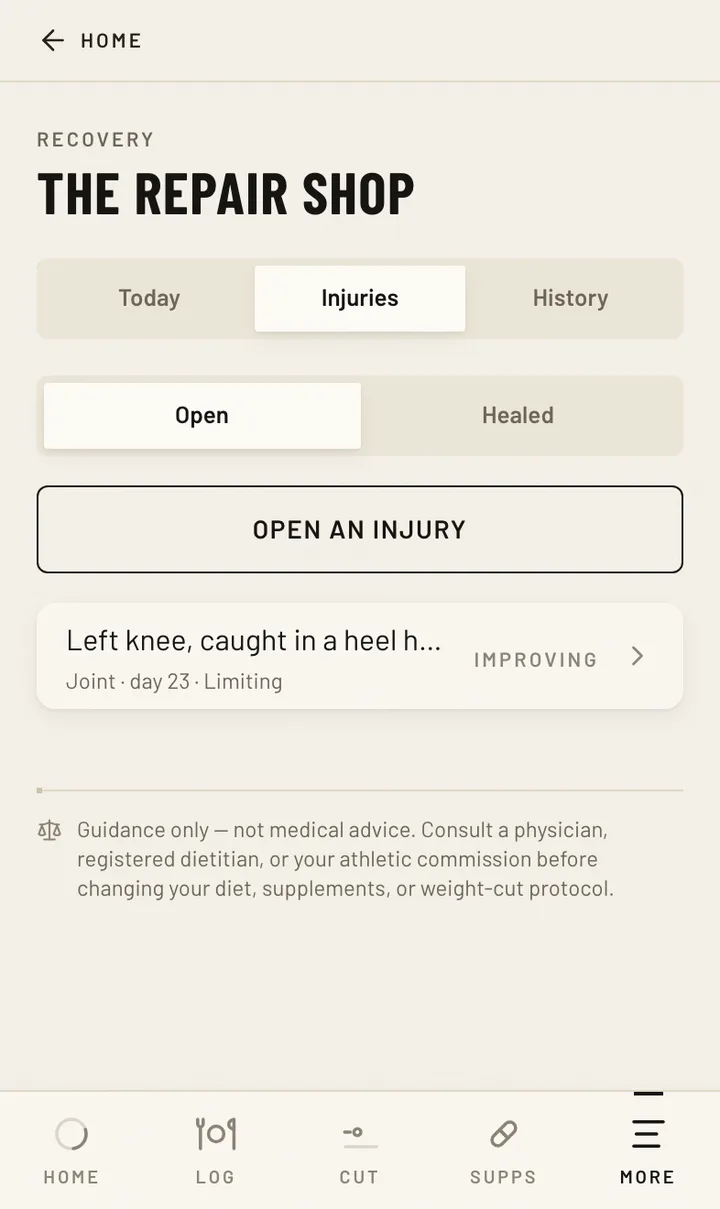
What a record changes is the account, not the decision. The decision belongs to a physician. Writing an injury down does not make it less serious, does not clear anyone to train, and — this is the honest limit — there is no evidence anywhere that keeping a written injury record improves a clinical outcome. The recall literature supports one property and one only: fidelity of the account.
Nor is it leverage, and it is not something to keep from anyone. It is a record to bring. A fighter who records a knee on the day it goes and shows that record to a doctor is doing the opposite of concealment, which is the only reason it belongs in an article on this subject at all. The same logic runs through training around an injury: the value of the record is that it makes the conversation specific. The log stays on the athlete's phone; what she does with it is hers to decide.
Nothing here is advice to withhold anything from a doctor, a coach or a commission, or to train against medical instruction.
14. What this adds up to
The reader's fear is about a real structure. The purse exists only if the bout happens; the withdrawal route runs through a Commission-designated physician and carries the bout obligation forward; the weigh-in binds the fighter to a sworn account of their own medical facts; and a medical suspension, where one is placed, travels between commissions rather than staying put.
The behaviour that structure produces has been measured in adjacent sports and the measurements are consistent: 47% of suspected concussions reported against 80% of other injuries in the same men; 56% of a football cohort reporting none of theirs; reporting falling as injuries accumulated; and not one athlete in that cohort ever reporting a fifth. The reasons athletes gave for concealing are the reader's own reasons, stated in the reader's own terms — not wanting to leave the session, not wanting to let the team down.
And the thing the reader actually wants to know — what it costs to say it out loud — is not in any of it. That is not a hedge. It is the state of the evidence on 2026-09-22, and it is why this piece describes the incentive structure instead of pricing it. Anyone who gives you a number for that cost is giving you a feeling. What can be said is what is inside a fighter's control, which is the quality of the account they can give when a physician asks — and, separately, that the people who decide are a physician and a commission, not this article and not the room.
What we could not verify
- "Over 20% of Muay Thai athletes concealed symptoms" and "21% returned to play the same day as a suspected concussion." Both circulate attributed to the 2018 Lystad and Strotmeyer study. The full text of that paper was retrieved and neither figure appears in it. Its outcomes are a knowledge score of 19.5/25, an attitudes score of 62.7/75, and the single-item 69.4% reporting-intention measure quoted in §6. These two figures are ungroundable and are not printed here as fact.
- "About half of all concussions go unreported." The football paper says only "perhaps as many as half in some populations," citing others — a literature-review hedge, not a measurement. Where this article wants a number it uses 47%, with its cohort attached.
- "50% of collegiate athletes did not report a suspected concussion," and "over 30% non-disclosure among collegiate athletes." Both appear as aggregate claims with no traceable cohort or definition. The 33.2% in §2 has a specific denominator — those who recalled a self-identified concussion — and is not the same quantity.
- "The UFC pays fighters 16–17% of revenue." This is a plaintiffs' economic expert's model from antitrust litigation that settled with no liability finding, and the docket and expert report were not obtained. It is not printed as a fact about fighter pay, and no figure about any promotion's pay appears on this page.
- Whether any named promotion pays an injured fighter who withdraws. No promotional contract was examined. Only the general structure — show money plus win bonus — is described, attributed to trade press.
- Any claim that a disclosure or education programme reduces concealment in combat sports. No such study was found. The RCT in §11 measured knowledge, attitudes, norms, intention and discussion frequency at one month, in NCAA athletes.
- Any claim that a written injury record improves a clinical outcome. The recall study cited in §13 is about elderly rehabilitation patients and measures accuracy of recall, not outcomes and not athletes. The record's demonstrable property is fidelity of the account.
- The final publication record of the football reporting study. What was read is the Harvard-hosted accepted manuscript; the typeset volume, pages and DOI were not confirmed, and it is cited accordingly.
- The version date of the ABC guidelines. The copy read is hosted by the BC Athletic Commission on a 2024 path. The title and scope lines are quoted verbatim; the version date is unconfirmed.
- Women, adolescents and grappling sports. The combat-sports survey includes 15 women in total; the football cohort is male-only; the collegiate survey's female data comes from a low- and non-contact-sport subgroup that is not a combat-sport analogue. Adolescents are absent from every source here — nothing on youth boxing, youth wrestling or junior judo. And BJJ, wrestling and judo have no dedicated source at all: every combat-sport finding on this page comes from striking sports and should not be carried into a grappling room without saying so.
- What disclosure costs a fighter. No source tracks it. This is stated three times in this article deliberately, because it is the question the page exists to answer and the answer is that nobody knows.
Questions fighters ask
Will I lose the fight if I tell my coach I am hurt?
Nobody has measured this. No study anywhere tracks fighters who disclosed an injury against fighters who did not and reports what happened to their bouts, their purses or their roster spots, so any confident answer — in either direction — is somebody's impression rather than evidence. What is documented is the structure the fear sits in: the purse generally exists only if the bout happens, and the recognised route out of a bout runs through a physician the commission designates. What is not documented is the consequence of speaking up. The decision about whether you can compete belongs to a physician who has examined you, not to this page.
How many athletes actually hide concussions?
The best-characterised figure is 33.2%, and its denominator matters. In a survey of 797 former US collegiate athletes, 214 recalled at least one concussion they had identified themselves; of those 214, 71 — 33.2% — reported not disclosing at least one. That is not 33.2% of all athletes and not 33.2% of concussions, and the concussions were self-identified rather than diagnosed. Within the same survey the range across subgroups was wide: 68.3% among former football athletes, all men, and 11.1% among female athletes in low- and non-contact sports.
Is there a non-disclosure figure for MMA, boxing or Muay Thai specifically?
No. No measured non-disclosure rate exists for professional combat sports. Nothing located for this article reports what share of fighters concealed an injury from a coach, a physician or a commission. The closest combat-sports data is a survey of 70 athletes and 35 coaches across four striking sports, which found that 79% of athletes named self-diagnosis as a method of assessing a suspected concussion and 43.3% named the coach's diagnosis. That describes how assessment happens, not how often something is hidden.
Why do athletes say they kept quiet?
Because they did not want to stop and did not want to let people down. Among the 71 non-disclosers in the 797-athlete collegiate survey, the most commonly reported motivations were: did not want to leave the game or practice (78.9%), did not want to let the team down (71.8%), did not know it was a concussion (70.4%), and did not think it was serious enough (70.4%). Respondents could select more than one, which is why the percentages sum past 100. Those are what athletes said about themselves, recalled retrospectively — not motives inferred by anyone.
Do fighters hide concussions more than other injuries?
In the one cohort where both were measured in the same people, yes, by a wide margin — though the cohort is college football players rather than fighters. Those athletes reported 47% of their suspected concussions to a medical professional against 80% of their non-concussion injuries. By athlete rather than by injury: 56% reported none of their suspected concussions and 20% reported all of them, while for other injuries 23% reported none and 51% reported all. The gap is within-person, so it is one population treating two kinds of injury differently.
Does reporting get less likely the more injuries you have had?
In that same football cohort it did. Fitted reporting proportions declined across successive suspected concussions — 0.53, 0.48, 0, 0.32 — a statistically significant decline, and an athlete one standard deviation above average in career injuries reported 17% fewer concussions to medical personnel. The finding that stops you is that no athlete in the cohort reported more than four concussions to medical staff, despite many suspecting more. The authors note four is a common threshold for clinical discussions about curtailing participation. That is an association in one cohort of men, not a demonstrated mechanism.
Is it true that most fight gyms have no medical staff?
That is what the coaches themselves report. Across a survey of 70 athletes and 35 coaches in MMA, boxing, kickboxing and Muay Thai, 68.5% of coaches confirmed the likely absence of health-care professionals during training. The same survey found 68.8% of those 35 coaches were unfamiliar with any sideline assessment tool, and 5.7% — about two people at that sample size — correctly recognised the level of traumatic brain injury a concussion represents. The sample is small and every percentage should be read with its n attached.
What does the "69.4% of Muay Thai athletes would report" figure actually mean?
It is one questionnaire item, and it measures intention rather than behaviour. In a survey of 193 adult competitive Muay Thai athletes registered with a North American amateur sanctioning body, 134 (69.4%) were classified as likely to report concussion symptoms on the basis of their disagreement with a single sentence: "I would continue playing a sport while also having a headache that resulted from a minor concussion." It does not measure whether anyone told anyone anything. Non-disclosure figures are very sensitive to the wording of the question asked, which is why the wording is printed rather than summarised.
What happens legally if I do not mention an injury at the weigh-in?
In Nevada, you would be making a false sworn statement. Under NRUC 3.040(1), adopted 2022-09-20, a physician designated by the Commission examines each unarmed combatant at the weigh-in, and as part of that examination the combatant completes a prefight medical questionnaire and attests under penalty of perjury to its accuracy. Subsection 2 carries a duty to report treatment or admissions occurring after the weigh-in. So the choice at that table is not between disclosing and staying quiet; it is between an accurate statement and a false sworn one. Nothing in this article advises the latter.
Why does the Nevada rule I found online say something different?
Because the state's public NAC chapter page is out of date. The Nevada Legislature's NAC 467 page still serves several sections as live text with pre-2022 history lines, including NAC 467.528 and NAC 467.642, both of which were repealed by LCB File No. R089-22 effective 28 December 2022, and it shows NAC 467.562 in its superseded pre-2022 wording. The prefight-questionnaire provision now lives in the Nevada Rules of Unarmed Combat at NRUC 3.040, and NRUC 1.020 states the NRUC controls where the two conflict. Check the adopted regulation file and the NRUC, not the chapter page.
Is there a mandatory 30 or 60 day suspension after a stoppage?
Those numbers exist, but they are narrower than they are usually quoted. The 30-day minimum after a TKO from head blows and 60-day minimum after a KO come from the Association of Boxing Commissions' regulatory guidelines — a document whose own first line says it governs championship professional boxing competitions. It is not a rule for amateur MMA, Muay Thai or a club card. The same document sets a mandatory seven-day rest after any event and leaves longer suspensions to the physician, whose decision is final. Whatever applies to your bout comes from the commission sanctioning it, and a day count is never a medical clearance.
Can I just take a fight in another state if I am suspended?
The model regulatory text says no. The ABC guidelines state that "all medical and administrative suspensions placed on contestants by other athletic commissions will be recognized by the supervising Commission," which is the mechanism that makes a suspension portable rather than local. In Nevada, NAC 467.562 as amended in 2022 provides that a person a physician determines unfit must be suspended until it is shown that they are fit to compete, officiate or participate — an open-ended, condition-based suspension with no day count in it. That is a question for the commissions involved, not for a gym.
Does keeping an injury log make me less likely to get hurt?
No, and nothing here claims it does. There is no evidence that a written injury record improves any clinical outcome — the study cited for record-keeping in this article measured how accurately people recall their own medical visits, in elderly rehabilitation patients, not athletes and not outcomes. The one demonstrable property of a dated record is fidelity of the account: eight weeks later, "I got rocked sometime in camp" and a dated line describing what happened and what it stopped you doing are not the same object. It changes what you can tell a doctor, not what the doctor decides.
Does coach education fix this?
It moves the things that have been measured, which are not the same as concealment. A randomised controlled trial of a peer concussion-education programme in 1,614 NCAA athletes across 60 teams found greater increases in knowledge, in intention to report for oneself and for teammates, in subjective norms and perceived behavioural control, and in how often participants discussed concussion with a teammate or athletic staff — at one month. It did not measure a reduction in hidden injuries, and it was not conducted in combat sports. Separately, a survey of 997 NCAA contact-sport coaches found coaches' attitudes, more than their knowledge, predicted how much they communicated about concussion safety.
Who is missing from all of this research?
Almost everyone a combat-sports reader might be. The only combat-sports cohort here includes 15 women in total; the football cohort is male-only; the collegiate survey's female data comes from low- and non-contact sports, which is not a fight-sport comparison. Adolescents are absent entirely — nothing on youth boxing, youth wrestling or junior judo. And BJJ, wrestling and judo have no dedicated source at all, so every combat-sport finding on this page is a striking-sport finding and should not be carried into a grappling room without that caveat. Broader context on what the surveillance literature does and does not cover is in what actually gets injured in MMA and in what to track in a fight camp.
Sources
Sourced to
- Motivations Associated With Nondisclosure of Self-Reported Concussions in Former Collegiate Athletes — Kerr ZY, Register-Mihalik JK, Kroshus E, Baugh CM, Marshall SW, American Journal of Sports Medicine, 2016;44(1):220–225. DOI 10.1177/0363546515612082, PMID 26582799, PMCID PMC4722948
- College football players less likely to report concussions and other injuries with increased injury accumulation — Baugh CM, Meehan WP III, Kroshus E, McGuire TG, Hatfield LA, Journal of Neurotrauma; accepted author manuscript hosted by the Harvard Football Players Health Study, read 2026-09-22. Typeset volume, pages and DOI not confirmed
- Concussion knowledge, attitudes and reporting intention among adult competitive Muay Thai kickboxing athletes: a cross-sectional study — Lystad RP, Strotmeyer SJ, Injury Epidemiology, 2018;5:25. DOI 10.1186/s40621-018-0155-x, PMID 29888376, PMCID PMC5994390
- Understanding concussion knowledge and behavior among mixed martial arts, boxing, kickboxing, and Muay Thai athletes and coaches — Follmer B, Varga AA, Zehr EP, The Physician and Sportsmedicine, 2020;48(4):417–423. DOI 10.1080/00913847.2020.1729668, PMID 32067547
- Randomized Controlled Trial of a Novel Peer Concussion-Education Program for Collegiate Athletes — Kneavel ME, Ernst W, McCarthy KS, Journal of Athletic Training, 2020;55(5):456–468. DOI 10.4085/1062-6050-0182.19, PMID 32298143, PMCID PMC7249285
- Determinants of Coach Communication About Concussion Safety in US Collegiate Sport — Kroshus E, Baugh CM, Hawrilenko MJ, Daneshvar DH, Annals of Behavioral Medicine, 2015;49(4):532–541. DOI 10.1007/s12160-014-9683-y, PMID 25712480
- Conflicts of Interest in Sports Medicine — Tucker AM, Clinics in Sports Medicine, 2016;35(2):217–226. DOI 10.1016/j.csm.2015.10.010, PMID 26832972
- Sports medicine and ethics — Testoni D, Hornik CP, Smith PB, Benjamin DK Jr, McKinney RE Jr, American Journal of Bioethics, 2013;13(10):4–12. DOI 10.1080/15265161.2013.828114, PMID 24024796, PMCID PMC3899648. Author conflict disclosed: NFLPA consultancy
- Sideline Ethical Dilemmas — Krajca-Radcliffe J, Cummings NM, Journal of Bone and Joint Surgery (American), 2014;96(15):e132. DOI 10.2106/JBJS.N.00151, PMID 25100785
- Empirical evidence of recall bias for primary health care visits — Brusco NK, Watts JJ, BMC Health Services Research, 2015;15:381. DOI 10.1186/s12913-015-1039-1, PMID 26373712, PMCID PMC4572632
- Nevada Rules of Unarmed Combat (NRUC), official final text — Nevada State Athletic Commission, adopted 2022-09-20. NRUC 3.040 (weigh-in examination and sworn prefight questionnaire) and NRUC 1.020 (NRUC controls over NAC chapter 467 on conflict), read 2026-09-22
- LCB File No. R089-22A — adopted regulation of the Nevada State Athletic Commission — Nevada Legislative Counsel Bureau, effective 28 December 2022. §16 amends NAC 467.562; §28 repeals NAC 467.427, 467.432, 467.528 and 467.642. Read 2026-09-22
- Nevada Administrative Code Chapter 467 — Unarmed Combat — Nevada Legislature. Sections 467.132, 467.137, 467.149 and 467.522 cross-checked against the R089-22 repeal list and in force, read 2026-09-22. Note: this page still serves repealed sections as live text and is not, on its own, verification
- Regulatory Guidelines and Rules for All World and Regional Championship Bouts — Association of Boxing Commissions; by its own first line the document governs championship professional boxing only. Copy hosted by the BC Athletic Commission on a 2024 path, version date unconfirmed, read 2026-09-22
Read next
Plan the descent, don't guess it
Fighter Cut builds a week-by-week plan from today to your weigh-in, classifies the rate you are actually losing at, and logs what you eat against it. It does not make a cut safe — nothing does. It makes the numbers visible early enough to change them.
Open Fighter Cut