Fighter Cut › Articles › Weight cut & fight week
Weight cut & fight week
What an injury does to a weight cut
The measured direction of travel for requirements is upward, not downward. What this article cannot give you is a way to keep cutting on an injury, because no source describes one.
An athlete gets hurt in week six of an eight-week camp. The knee, usually. Training volume collapses overnight, and the first thought is almost always the same one: the food has to come down, because the work that was burning it is gone.
That intuition is the subject of this article, and the measured direction of travel for requirements is the opposite one. The clinical literature on injury describes energy expenditure going up, not down. It describes protein requirements going up. It describes muscle disappearing from an immobilised limb inside five days, and the limb responding less to the protein that is eaten. And the sports-nutrition position stand that governs combat-sport weight descent names, in its own sentence, the exact situation an athlete lands in when an injury eats two weeks of an eight-week camp.
None of that is a way to keep cutting. No one has followed a cohort of combat athletes who were injured mid-camp and continued to cut. Every number below is assembled from adjacent literatures — clinical immobilisation, critical care, general sports nutrition, the REDs consensus. There is no protocol for cutting weight on an injury because no source describes one. What the sources do describe, in unusual detail, is what changes in the body and who is legally entitled to decide what happens next. That is what this page is.
The range by which energy expenditure may rise, "depending on the type and severity of the injury" — a clinical stress-factor band spanning minor injury to major trauma, applicable to no single athlete's knee
Tipton KD, Sports Med 2015;45(Suppl 1):S93–S104. DOI 10.1007/s40279-015-0398-4
Quadriceps cross-sectional area and strength lost after 5 days, in 24 healthy young men (23 ± 1 y) in a one-legged full leg cast — not athletes, no women, no adolescents
Wall BT et al., Acta Physiol 2014;210(3):600–611. DOI 10.1111/apha.12190
The ISSN combat-sports position stand's protein recommendation during injury recovery, against its own camp floor of 1.2–2.0 g/kg/day. The floor moves up with injury, not down
Ricci AA, Evans C, Stull C, et al., J Int Soc Sports Nutr 2025;22(1):2467909. PMID 40059405
The position stand's own description of the deficit window that "may put athletes at a greater risk for low energy availability" — the window an injury in week six creates
Ricci AA, Evans C, Stull C, et al., J Int Soc Sports Nutr 2025
- The intuition is that training fell, so food should fall. The measured direction of travel for requirements is the opposite one. Tipton's review of exercise-induced injury reports energy expenditure "increased by 15 % up to 50 %, depending on the type and severity of the injury" — a clinical range across all injury types, not a figure for one athlete.
- Smith-Ryan and colleagues describe the same stress factor as raising metabolic demand "from about 20% for minor injuries and surgeries to 100% for more severe bodily insults such as burns." The 100% end of that range is burns. It has nothing to do with a fight camp and must never travel without the word.
- Muscle goes fast, and strength goes faster than mass. In 24 healthy young men in a one-legged full leg cast, quadriceps cross-sectional area fell 3.5 ± 0.5% at five days and 8.4 ± 2.8% at fourteen, while strength fell 9.0 ± 2.3% and 22.9 ± 2.6%. The five-day leg lean mass change (1.4 ± 0.7%) did not reach significance at P = 0.07.
- The immobilised limb also becomes anabolically resistant. In 12 healthy young men, five days of casting cut postabsorptive myofibrillar protein synthesis by 41 ± 13% and postprandial rates by 53 ± 4%. The protein that is eaten does less than it did.
- Under an energy deficit, protein is burned as fuel rather than used for repair. The position stand says so directly. Restricting harder attacks the two things repair needs, in that order — the energy first, then the protein.
- Protein floors diverge across sources — 2–2.5 g/kg/day in Tipton, at least 1.6 and closer to 2.0–3.0 g/kg/day in Smith-Ryan, 1.3–2.5 g/kg/day in the ISSN stand, and 2.0–2.5 g/kg/day in critical care patients, which is a hospital population and not a combat athlete. They agree only on direction. The single defensible sentence is Tipton's: "care should be taken not to reduce the absolute amount of protein intake when energy intake is reduced."
- REDs is diagnosed by a physician with expertise in it, using information from a multidisciplinary team. A fighter cannot self-diagnose it, and this article does not help them try.
- In Nevada — and the text differs in every jurisdiction — a combatant found unfit by the examining physician "shall not participate." There is no athlete-side override in the rule. The ABC's Unified Rules of MMA contain no pre-fight injury-withdrawal procedure at all; that machinery lives in state regulation.
1. What an injury actually changes
Three things move at once, and only one of them moves in the direction the athlete expects.
The first is training volume, which falls. That is the visible one, and it is the one the athlete reasons from.
The second is energy requirement, which the clinical literature describes as rising. Tipton's 2015 review in Sports Medicine puts it plainly: "Energy expenditure may be increased by 15 % up to 50 %, depending on the type and severity of the injury." That band is a clinical stress-factor range spanning everything from a minor procedure to major trauma, and Tipton sources it second-hand to Frankenfield's work on injury stress factors rather than measuring it. It is not applicable to any one athlete's injury, and it is not a number to eat by. It establishes a direction and nothing more.
Smith-Ryan and colleagues, writing in the Journal of Athletic Training in 2020, describe the same mechanism with the endpoints attached: "This stress factor can increase metabolic energy demands from about 20% for minor injuries and surgeries to 100% for more severe bodily insults such as burns." The 100% is burns. Detaching that figure from the word "burns" is the single worst error available in this subject, and it is a common one.
The third thing that moves is the mechanical cost of getting around. Tipton again: "If an athlete must use crutches, the energy expenditure for ambulation is increased two- to threefold." That is the energy cost of the act of crutching, not of the athlete's day — nobody crutches for eight hours. Tipton's own inference from it is deliberately modest: intake "may not need to be dramatically reduced." That is the whole of what the crutch figure supports. It is not an argument for eating more, and it is certainly not a licence.
2. The eight-week runway, and why week six is the problem
Here is the part most articles miss. The injury did not create the risk. It collapsed the runway the plan already depended on.
The ISSN position stand describes a combat-sport weight descent built on a long window. Athletes are advised to sit, off camp, at a body mass "ranging 12% to 15% above the weight division requirement," and the stand's weekly rate is given in kilograms rather than percentages: combat athletes "are commonly recommended to aim for weight loss of 0.5–1 kg of body mass each week with the resulting energy deficit being based largely on total daily energy needs." Eight weeks of that arithmetic is the runway. The stand's framing throughout is professional MMA, where weigh-ins fall roughly 24 to 36 hours before the bout — a point that matters for every percentage in this article, because at a same-day weigh-in, common in amateur boxing, BJJ and Muay Thai, none of the acute figures describe anything at all.
Now read the stand's own risk sentence:
Combat athletes exceeding 12–15% body mass will require more significant energy restriction, and if completed over a shorter duration than 8 weeks, the caloric deficit needed to achieve the desired changes in body mass may put athletes at a greater risk for low energy availability.
An injury in week six is precisely "a shorter duration than 8 weeks." Whatever remained of the descent now has to happen in a compressed window, under a body whose requirements the injury literature says have gone up, in an athlete who has lost the training that was doing most of the work. The position stand names this exact case as an elevated low-energy-availability risk, in a sentence written before anyone got hurt. That is the strongest thing anyone can honestly say about the situation, and it is a warning, not a plan.
3. What the immobilised limb is doing
The numbers here are precise, and their population is narrow enough that the precision is almost misleading. Both studies are Wall and colleagues from Maastricht, and both used healthy young men in one-legged full leg casts. Not athletes. No women. No adolescents.
In the 2014 study in Acta Physiologica, "twenty-four healthy, young (23 ± 1 year) males were subjected to either 5 (n = 12) or 14 (n = 12) days of one-legged knee immobilization using a full leg cast." Quadriceps cross-sectional area fell 3.5 ± 0.5% at five days and 8.4 ± 2.8% at fourteen. Leg lean mass fell 1.4 ± 0.7% and 3.1 ± 0.7% — and the five-day result carried P = 0.07, which is to say it did not reach statistical significance and should not be quoted as a measured loss. Strength fell 9.0 ± 2.3% and 22.9 ± 2.6%.
Read those two rows against each other. Strength falls roughly three times faster than mass. At five days the leg had lost about three and a half per cent of its cross-section and nine per cent of what it could do. For a fighter that ratio is the whole story: the mirror and the scale will under-report what has happened to the leg, and the first hard session back will not.
The authors' conclusion is the sentence to keep: "even short periods of muscle disuse can cause substantial loss of skeletal muscle mass and strength and are accompanied by an early catabolic molecular signalling response."
Both reviews also carry a faster figure — that muscle tissue is lost "after as little as 36 hours of inactivity, with global gene expression alterations after 48 hours." That 36-hour number is a metabolic and gene-expression measurement rather than a measured loss of mass, and neither review's underlying primary study was read for this article. It belongs here with that qualification attached or not at all.
4. Anabolic resistance, or why the protein does less
The 2016 companion study explains the mechanism, and it is the least intuitive finding on this page.
In 12 healthy young men, aged 22 ± 1, five days of one-legged casting reduced postabsorptive myofibrillar protein synthesis rates by 41 ± 13% and postprandial rates by 53 ± 4%. Quadriceps cross-sectional area fell 3.9 ± 0.6%, consistent with the earlier cohort. The authors conclude that five days of disuse "substantially lowers postabsorptive myofibrillar protein synthesis rates and induces anabolic resistance to protein ingestion."
Anabolic resistance means the limb's response to eating is blunted. The same meal that would previously have driven a rise in muscle protein synthesis drives roughly half of one. So the athlete is losing tissue faster than usual while the primary tool for defending it has become less effective — and this is before anything has been subtracted from the plate.
That is the context in which any conversation about restricting further has to happen. It is also why Tipton's review treats protein as a floor problem rather than a target problem, and why the position stand's hierarchy puts energy first.
5. Why restriction is the wrong lever
Two independent reviews say the same thing without hedging.
Tipton: "Negative energy balance will interfere with wound healing and exacerbate muscle loss."
Smith-Ryan: a negative energy balance "is likely to exacerbate the problem by slowing wound healing and increasing the loss of muscle."
The position stand adds the reason it compounds. "When the energy intake is insufficient, the body will start to further break down lean mass to use as energy." And, on the protein specifically: "when energy intake is insufficient, protein may be required to contribute to energy demands."
That second sentence is the one that closes the loop. Under an energy deficit, protein is burned as fuel rather than used for repair. Eating more protein does not rescue an energy-deficient athlete, because the protein is being spent as currency rather than as building material. Restricting harder therefore attacks the two things repair needs, in that order: the energy first, and then the protein that was supposed to substitute for it.
There is a third-order effect too. Tipton reports that muscle protein synthesis and its associated intracellular signalling proteins are "downregulated by ~20–30 % during even a moderate energy deficit." The review does not define "moderate" numerically, so that figure cannot be attached to any calorie number. But layered onto a limb that has already lost half its postprandial synthetic response, the direction is unambiguous.
The position stand's own hierarchy is explicit about what comes first: "the top priority that should be addressed is ensuring energy balance is maintained." Ahead of protein. Ahead of supplements. Ahead, by implication, of the number on the bout agreement.
6. Where the protein floors actually sit
Five sources give five overlapping ranges, from five different contexts, and they disagree. Reporting that disagreement honestly is more useful than picking a favourite, because in an article read by someone who is injured and behind on weight, a grams-per-kilo number stops being a finding and becomes an instruction.
Tipton, on immobilisation: higher protein intakes "seem to be warranted." The hedge is his. The range he attaches is 2–2.5 g/kg/day, and it describes immobilisation, not weight-making.
Smith-Ryan, on injury recovery in athletes: at least 1.6 g/kg/d and closer to 2.0 to 3.0 g/kg/d, "with an emphasis on consuming about 3 grams of leucine per serving."
The ISSN combat-sports stand, on injury: "the authors recommend 1.3–2.5 g/kg/day of protein to promote healing and maintain lean body mass during injury recovery." It separately notes that intakes as high as 2.3 g/kg/day "can minimize muscle loss during energy deficits in active individuals," and that 2.0–2.5 g/kg/day supports recovery "in critical care patients" — a hospital population that has no business being read as a combat-athlete figure.
Notice what the bottom of the ISSN injury range does. 1.3 g/kg/day is below Smith-Ryan's floor of 1.6 and well below Tipton's 2.0. The sources are not converging on a number; they are converging on a direction.
And that direction is the argument. The same position stand sets the macronutrient floors for a longitudinal weight descent at "carbohydrates 3.0–4.0 g/kg, protein 1.2–2.0 g/kg, and fat 0.5 to 1.0 g/kg/day." Its camp floor for protein is 1.2–2.0. Its injury recommendation is 1.3–2.5. In its own document, the protein floor moves up when an athlete gets hurt. Its explanation is one line: "Due to protein's role in tissue repair and lean mass maintenance, protein requirements will therefore be even greater during injury."
The single sentence in this whole section that survives being extracted from its context is Tipton's, and it is a floor rather than a target: "At the very least, care should be taken not to reduce the absolute amount of protein intake when energy intake is reduced."
7. A worked scenario, framed as one
Mara Delgado is invented. She is not a client, a case study or a composite of one — Fighter Cut has no coached roster. She exists to walk a decision, and the decision ends at a physician rather than at a number.
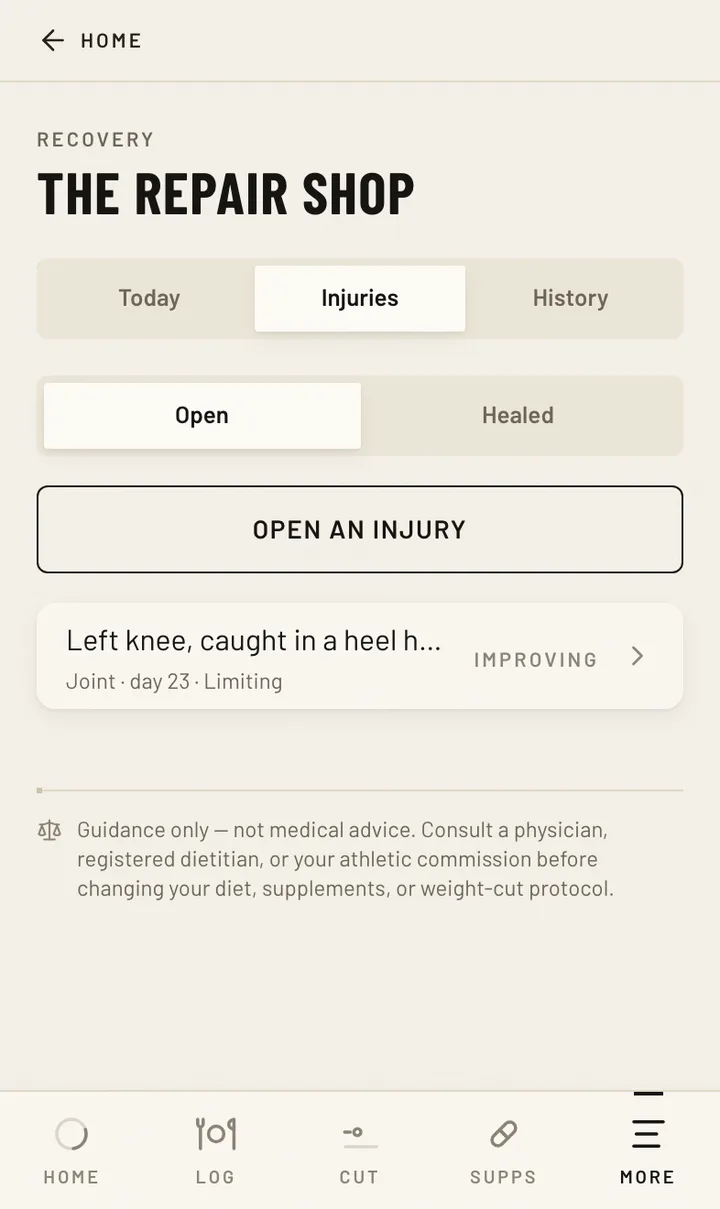
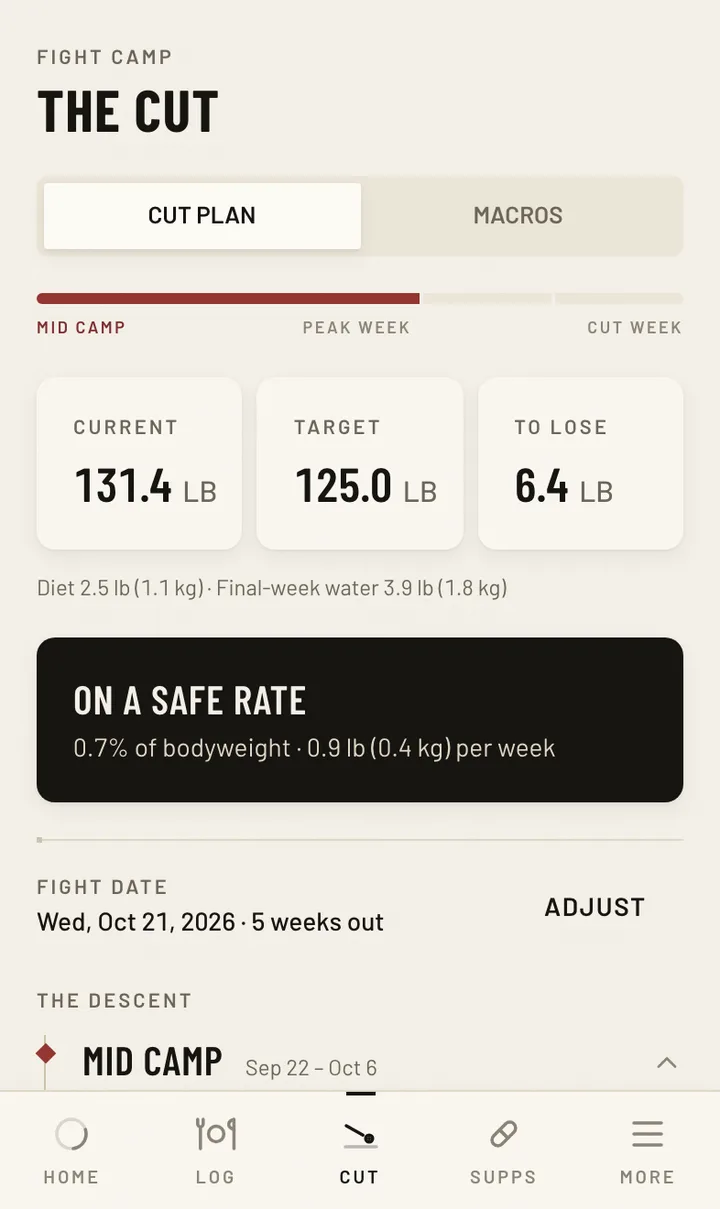
The scenario: a flyweight, four weeks out, with 6.4 lb still to lose, split in the plan between a gradual dietary descent and the final-week water manipulation. On day 24 of camp she injures her left knee. In the app the injury is logged as open and marked Limiting, which is a record of what happened, not a verdict on what to do next.
Here is what the literature says has changed, in order.
Her requirements have not fallen with her training. The clinical stress-factor literature describes requirements rising by some amount inside a 15%–50% band whose width is entirely a function of injury type and severity, and nothing in that band identifies where a specific knee sits.
Her runway is gone. Four weeks is inside the "shorter duration than 8 weeks" the position stand names as the low-energy-availability risk case, and the plan she has been executing assumed the longer window.
Her leg is changing faster than her scale will show. If the knee is immobilised at all, the cohort data says the strength loss will outrun the mass loss by roughly three to one over the first five days.
Her protein is doing less work than it was, and would be doing still less if the energy came down.
What the scenario does not produce is a revised target, a deficit, a timeline or a daily intake. No fetched source supports computing one, and the arithmetic that would produce it is exactly the arithmetic the position stand flags as the risk. What it produces is a phone call to a physician and, if there is a bout agreement, to her commission — because at this point the decision is no longer only hers, and the rules already assume that.
8. Where this goes if it is ignored
Two published case studies show the far end. Both are n = 1. Both are male. Both were instrumented and supervised by academic teams, which is precisely why the data exists at all.
Langan-Evans and colleagues followed a male combat-sport athlete through a descent in which body mass fell 13.5%, from 72.5 to 62.7 kg, over eight weeks. Seven of those weeks at a mean energy availability of 20 kcal/kg fat-free mass per day (range 7–31) produced 6.5 kg of body mass and 4.4 kg of fat mass without Triad or REDs consequences. The consequences presented later, when mean daily energy availability sat consistently below 10 kcal/kg FFM/day: testosterone under 5 nmol/L and resting metabolic rate down 257 kcal/day.
Kasper and colleagues documented an elite male MMA athlete whose body mass fell 18.1%, from 80.2 to 65.7 kg. The paper records RED-S indices — resting metabolic rate down 331 kcal, testosterone below 3 nmol/L, hypercholesterolaemia above 6 mmol/L — and then the acute endpoint. Severe dehydration reducing body mass by 9.3% in the final 24 hours before the weigh-in "induced hypernatremia (plasma sodium: 148 mmol/L) and acute kidney injury (serum creatinine: 177 μmol/L)." The authors describe their own paper as "a call for action to governing bodies to safeguard the welfare of mixed martial arts athletes."
That last case closes a loop worth naming. This article is about what an injury does to a cut. Kasper's paper is about a cut that was the injury — an acute kidney injury produced by the weight-making itself, in an athlete who was healthy when the camp started. The two directions meet in the same place, and it is a hospital.
Neither case is a template, a comparison or a threshold. Each is one man, measured.
There is a third route to the same ward, and it is the ordinary one. An injured fighter in a deficit is usually also taking something for the pain, and the convergence of anti-inflammatories, dehydration and hard training is the subject of what painkillers cost a fighter in camp — where the honest finding is that nobody has ever studied the three together.
9. Low energy availability is the mechanism, and a physician makes the call
The framework underneath most of this is the 2023 IOC consensus statement on Relative Energy Deficiency in Sport, which defines REDs as "a syndrome of impaired physiological and/or psychological functioning experienced by female and male athletes that is caused by exposure to problematic (prolonged and/or severe) low energy availability."
Energy availability is defined as dietary energy intake minus exercise energy expenditure, divided by fat-free mass, per day. The consensus prints descriptive bands around that formula — 45 kcal/kg FFM/day and above for mass gain and growth, around 45 for weight maintenance and body function, 30–45 as reduced availability for body mass and fat loss, and 30 or below as the level causing health implications. Those are the document's own descriptions of where athletes sit, not targets to occupy, and the consensus is candid about how soft the threshold is: "While a universal cut-off of 30 kcal/kg FFM/day as a threshold of LEA leading to some REDs outcomes in females is debated, such a cut-off or range at which males experience REDs-related symptoms is even less understood, but appears to be lower (eg, ~9 to 25 kcal/kg FFM/day)."
Most fighters reading this are male. For them the honest headline is not the 30. It is that the number is not established. A fuller treatment of what the consensus does and does not settle is in low energy availability in combat sports.
The consensus is equally clear about who does the assessing. "A diagnosis of REDs results from the clinical assessment by a physician with expertise in REDs, using information collected from a multidisciplinary team" — sports medicine physician, sports dietitian, sports physiologist, sports psychologist or psychiatrist — with severity and risk stratified as green, yellow, orange or red. A fighter cannot self-diagnose that, and this article does not help them try. What it can note is that the consensus lists bone stress injuries, impaired bone strength and lowered bone mineral density among the health outcomes of problematic low energy availability — which means an under-fuelled athlete is, on the consensus's own account, a more injurable one. Holtzman and colleagues found, in 127 female athletes aged 15–30 exercising at least four hours a week, that high-risk bone stress injury sites were associated with surrogates of low energy availability (p = .032) and with a DXA Z-score below −1 (p = .035). That cohort is female, young, and not combat athletes; it points at the mechanism, it does not measure fighters.
10. What the rules actually say about withdrawing
The commission machinery is where an injured athlete's assumptions are usually most wrong, and it is also the one part of this subject with written, checkable text. Everything below is Nevada, verified against the Nevada Administrative Code on 7 September 2026. Every jurisdiction writes its own, and none of these numbers should be assumed to apply anywhere else.
Reporting is mandatory and immediate. NAC 467.555(1): "When an unarmed combatant is unable to take part in a contest or exhibition for which he or she has entered into a bout agreement because of an injury or illness, he or she shall immediately report the fact to the Commission and shall submit to an examination by a physician designated by the Commission." Not the athlete's own physician — one the commission designates.
Someone pays for that examination, and it may be the athlete. NAC 467.555(2): "The fee for the physician's examination must be paid by the promoter if he or she has requested the examination. Otherwise, the fee must be paid by the unarmed combatant."
An unfit finding ends participation. NAC 467.545(1) is the answer to "can I just show up and see how it feels on the day": if the examining physician determines the combatant unfit for competition, "the unarmed combatant shall not participate in the contest or exhibition," and the physician reports immediately to the promoter and the commission's representative. There is no athlete-side override in the rule text.
And the finding persists. NAC 467.562(1): "A licensee who is determined by a physician to be unfit to compete or officiate must be suspended until it is shown that he or she is fit for further competition or officiating." Where the suspension is a 30-day medical protection, the combatant "shall take a medical examination upon the direction of the Commission," and the examining physician "may require any procedures during the medical examination, including an electroencephalogram if indicated."
There is a named lawful route out. NAC 467.132 makes failing to appear a disciplinary matter — unless the athlete has "a written excuse determined to be valid by the Commission or a certificate from a physician designated by the Commission in advance in case of physical disability." That clause is the mechanism for a legitimate injury withdrawal. It exists. It is written down. It is the route the regulations expect an injured athlete to take.
One more thing is worth stating because its absence surprises people: the ABC's Unified Rules of Mixed Martial Arts contain no pre-fight injury-withdrawal procedure at all. The 2019 document covers fouls, injuries sustained during a bout, medical stoppages, weight classes and catch weight. The withdrawal machinery is not federation-level. It lives in state and commission regulation, which is why "what do the unified rules say about pulling out" has no answer, and why the only correct place to look is the athlete's own commission. More on how the rule layers stack sits in the rules pillar.
11. Missing weight, catch weight, and the third path
An injured athlete late in camp is usually weighing three things against each other. Two of them have defined mechanisms. The third does not, and the difference matters more than any of the numbers.
Withdrawing has a written procedure: report immediately, submit to the designated physician, and, in the failure-to-appear rule, a physician's certificate obtained in advance is the named lawful excuse. That is a defined path with a defined cost.
Missing weight also has a defined price in Nevada, and only in Nevada. NAC 467.522(1) provides that a combatant who fails to make the contracted weight forfeits 25% of the purse if no lesser amount is set by the commission's representative, or a lesser amount set by the Executive Director and approved by the commission — unless the weight difference is 1 pound or less. The ABC's unified rules add that where a weight miss puts the two competitors in different classes, "the heavier opponent shall not exceed five (5) lbs. of the lower weighing" competitor, and that commissions "may deny Catch Weight fights if they see the weight differential as a large enough disparity to the safety of" the competitors. The commission keeps a veto.
Continuing to cut on an injury has no third column. It has no procedure, no evidence base and no described method in any source read for this article. The ISSN stand's injury section prescribes protein and micronutrients for recovery; it never describes cutting weight on an injury. Tipton and Smith-Ryan describe feeding an injured athlete, not making weight on one. The immobilisation studies measured men in casts who were not trying to compete. That is not a gap this article will fill with judgement — it is a finding, and the finding is that the option most athletes are actually weighing is the one nobody has studied.
12. What the injury takes off the athlete's desk
The most useful thing to say about "what happens to the cut" is not a number. It is that the cut stops being the athlete's decision, and the regulations were written on that assumption.
REDs is diagnosed by a physician-led multidisciplinary team, not by an app and not by a calculation. Fitness to compete is determined by a commission-designated physician whose unfit finding is dispositive. The purse consequence for missing weight is set by a commission's representative and approved by a commission. At every point where the athlete's instinct is to make a call, the written system has already allocated that call to somebody else — usually a doctor.
That is not a limitation of this article's usefulness. It is the article's answer. What the athlete and their coach can do is arrive at that conversation with a record: what the injury was, what day it happened, which sessions it removed, where the weight actually was and how it was moving. Tracking is evidence for the person making the decision, not a substitute for them — a point covered in more depth in when tracking says stop the cut. And if the injury is a head injury, the reporting problem is worse and the incentives are more distorted, which is its own subject in weight cutting and concussion symptoms.
13. What the numbers on this page are not
The position stand also publishes a set of figures that come up in every conversation about fight-week weight: "Suitable losses in body mass range from 6.7% at 72 h, 5.7% at 48 h, and 4.4% at 24 h, prior to weigh-in." Those are three answers to one question asked at three moments, not three stages. They describe how far above division athletes still were at each countdown point, converging on the scale. They do not add. 6.7 + 5.7 + 4.4 is not a thing, and any construction that stacks them invents a seventeen per cent cut that nobody described.
The stand's fight-week acute-loss figure carries its condition inside the sentence, and the sentence is the only form it may appear in: "During fight week, acute water loss strategies, including sauna, hot water immersion, and mummy wraps, can be used effectively with appropriate supervision (optimally ~2–4% of body mass within 24 h of weigh-in)." The supervision clause is not a caveat appended to the figure. It is part of the finding.
And the stand's own generalisability warning applies to its whole descent model: "this magnitude of weight descent was closely supervised by the nutrition professionals of the UFC Performance Institute and may not be advised for most athletes." Alongside it sits the document's limits statement: "The long-term effects of frequent weight cuts on health and performance are unknown, necessitating further research."
No figure in this article is offered as one to attempt unsupervised, because no such figure exists in any source read here. That absence is information, and it is the same absence that makes the injured-and- still-cutting path undescribable rather than merely inadvisable.
What we could not verify
This section matters more than usual on this page, because the gaps sit directly underneath the reader's question.
- Nobody has studied what this article is about. No fetched source follows combat athletes who were injured mid-camp and continued cutting. Every figure here is borrowed from an adjacent literature — clinical immobilisation, critical care, general sports nutrition, the REDs consensus — and applied by inference. The reader's exact question has no direct evidence behind it.
- Every muscle-loss number comes from healthy young men in leg casts. Wall 2014 is 24 males aged 23 ± 1; Wall 2016 is 12 males aged 22 ± 1. No athletes. No women. No adolescents. There is no fetched study of an injured female combat athlete cutting weight, and none at all in adolescents. Adult figures do not scale downward, and where governing bodies have legislated for the difference between sexes they did it with a separate rule and a different number, not a coefficient.
- Amateurs are absent. Every measured combat-sport figure here comes from professional or elite athletes, several supervised by the UFC Performance Institute — whose own paper says that descent "may not be advised for most athletes." Amateurs cut without a performance institute, and no amateur-cohort injury data was found.
- The 15%–50% and crutch figures are second-hand. Both are quoted from Tipton's review, which sources them to Frankenfield and to Waters and colleagues respectively. The underlying papers were not read for this article. They establish direction, not magnitude for any individual.
- The 36-hour figure is soft. It traces to metabolic and gene-expression measurements in two reviews, not to a measured loss of mass, and neither review's primary source was read.
- Concussion is a hole. The position stand names lacerations, fractures and concussions as the most frequent injury types in combat sport, and none of the energy or protein literature read here addresses cutting weight with a concussion. That is the injury most likely to be under-reported by an athlete who wants to keep the booking, and the least covered by the evidence.
- Only Nevada's rules were read. California, New York, the UK, the IJF, IBJJF, USA Wrestling and every European commission write their own text. Nevada's numbers — 25%, 1 pound, one hour, 30 days — are Nevada's.
- Nothing here is specific to any reader. This is a description of literature and regulation. An injured fighter's decision belongs to a physician and to their commission.
Questions fighters ask
I got hurt in week six — do I still make weight?
That is not a question this article, or any source it read, can answer for a specific athlete. It is a medical and regulatory question, and in Nevada the regulations remove it from the athlete entirely: an injured combatant under a bout agreement must immediately report the injury to the commission and submit to an examination by a commission-designated physician, and if that physician finds them unfit, "the unarmed combatant shall not participate." What the literature adds is context for that conversation. Injury raises energy and protein requirements while removing the training that was creating the deficit, and the ISSN position stand already names a deficit compressed into "a shorter duration than 8 weeks" as a low-energy-availability risk. Week six of an eight-week camp is that case.
Does an injury mean I should eat less, since I'm training less?
The measured direction of travel for requirements is the opposite one. Tipton's 2015 review reports that energy expenditure "may be increased by 15 % up to 50 %, depending on the type and severity of the injury," and Smith-Ryan and colleagues describe metabolic demand rising "from about 20% for minor injuries and surgeries to 100% for more severe bodily insults such as burns" — the 100% end being burns specifically, not anything a fight-camp athlete encounters. Both reviews also state that negative energy balance interferes with wound healing and worsens muscle loss. None of that establishes what any individual should eat, which is a question for a physician or a registered sports dietitian.
How fast does muscle actually disappear in a cast?
In 24 healthy young men aged 23 ± 1 immobilised in a one-legged full leg cast, quadriceps cross-sectional area fell 3.5 ± 0.5% after five days and 8.4 ± 2.8% after fourteen. Leg lean mass fell 1.4 ± 0.7% at five days, a result that did not reach significance at P = 0.07, and 3.1 ± 0.7% at fourteen. Strength fell 9.0 ± 2.3% and 22.9 ± 2.6% over the same windows. That cohort was healthy young men, not athletes, not women and not adolescents, so the figures describe a mechanism rather than a prediction for any particular fighter.
Why does strength fall faster than muscle mass?
The two studies do not explain the mechanism in the abstracts read here, but they measure the gap clearly: at five days of one-legged casting, quadriceps cross-sectional area was down about three and a half per cent while strength was down about nine per cent — roughly three to one. The practical implication for a fighter is that neither the scale nor the mirror is a good instrument for what disuse has done to a limb. The functional deficit is larger than the visible one, and it arrives sooner.
What is anabolic resistance?
It is the reduced response of an immobilised muscle to the protein that is eaten. In 12 healthy young men casted for five days, postabsorptive myofibrillar protein synthesis rates fell 41 ± 13% and postprandial rates — the response to a meal — fell 53 ± 4%. The authors concluded that five days of disuse "substantially lowers postabsorptive myofibrillar protein synthesis rates and induces anabolic resistance to protein ingestion." In plain terms: the same meal does roughly half the work it did before, in the affected limb, while that limb is also losing tissue faster than usual.
Should I increase protein if I'm injured?
The sources agree on direction and disagree on magnitude, which is why this article does not print a target. Tipton says intakes of 2–2.5 g/kg/day "seem to be warranted" during immobilisation; Smith-Ryan recommends at least 1.6 and closer to 2.0–3.0 g/kg/d for injury recovery; the ISSN combat-sports stand recommends 1.3–2.5 g/kg/day during injury recovery, and separately cites 2.0–2.5 g/kg/day in critical care patients, a hospital population. The one statement that survives extraction is Tipton's floor: "care should be taken not to reduce the absolute amount of protein intake when energy intake is reduced." What any individual should eat while injured is a clinical question.
Doesn't eating more protein protect muscle during a deficit?
Only up to a point, and the position stand names the limit: "when energy intake is insufficient, protein may be required to contribute to energy demands." Protein eaten under a large energy deficit is partly spent as fuel rather than used for repair or for defending lean mass. The same document notes that when energy intake is insufficient "the body will start to further break down lean mass to use as energy," and lists energy balance as the top priority to address — ahead of protein and ahead of supplements. So protein is a floor to protect, not a lever that compensates for an energy deficit.
Does the ISSN position stand say anything about cutting weight while injured?
No. Its injury section addresses protein, micronutrients and energy balance for recovery. It does not describe a method for making weight on an injury, and neither does any other source read for this article. What it does say, in the section on weight descent, is that combat athletes exceeding 12–15% above division "will require more significant energy restriction, and if completed over a shorter duration than 8 weeks, the caloric deficit needed to achieve the desired changes in body mass may put athletes at a greater risk for low energy availability."
What do the ABC Unified Rules say about pulling out of a fight injured?
Nothing. The 2019 Unified Rules of Mixed Martial Arts were read in full for this article, and they cover fouls, injuries sustained during a bout, medical stoppages, weight classes and catch weight. They contain no pre-fight injury-withdrawal procedure. That machinery lives in state and commission regulation — in Nevada, in NAC Chapter 467 — which means the answer for any given athlete depends on the jurisdiction they are licensed and booked in, not on a federation document.
What happens in Nevada if I report an injury before a booked fight?
Under NAC 467.555(1), a combatant unable to take part because of injury or illness "shall immediately report the fact to the Commission and shall submit to an examination by a physician designated by the Commission." Under 467.555(2), the promoter pays that physician's fee if the promoter requested the examination; otherwise the combatant pays. If the examining physician finds the combatant unfit, NAC 467.545(1) provides that they "shall not participate," and NAC 467.562(1) provides that a licensee found unfit "must be suspended until it is shown that he or she is fit." Every other jurisdiction writes its own text.
What does missing weight cost in Nevada?
NAC 467.522(1) provides that a combatant who fails to make the weight agreed in the bout agreement forfeits 25% of the purse if no lesser amount is set by the commission's representative, or a lesser amount set by the Executive Director and approved by the commission — unless the weight difference is 1 pound or less. The ABC's unified rules add that in a weight-miss catch weight across two classes, "the heavier opponent shall not exceed five (5) lbs. of the lower weighing" competitor, and that commissions "may deny Catch Weight fights" over a safety-relevant differential. Those are Nevada and ABC figures, not universal ones.
Can I withdraw without being disciplined?
In Nevada there is a named route. NAC 467.132 makes failing to appear at a contest a disciplinary matter unless the combatant has "a written excuse determined to be valid by the Commission or a certificate from a physician designated by the Commission in advance in case of physical disability." That clause is the mechanism the regulations provide for a legitimate injury withdrawal, and the "in advance" wording is the operative part. What counts elsewhere is set by the commission of jurisdiction, and this article cannot advise anyone on their own case.
Is there a safe way to keep cutting on an injury?
No source read for this article describes a way to do it at all, safely or otherwise, and that absence is the finding rather than a gap in the reporting. The clinical literature describes feeding an injured athlete; the immobilisation studies measured men in casts who were not competing; the combat-sport position stand addresses recovery. Two independent reviews state that negative energy balance interferes with wound healing and worsens muscle loss. The published case studies at the far end of aggressive weight-making are single instrumented athletes, one of whom developed acute kidney injury. The decision belongs to a physician and to a commission.
What can tracking actually do here?
It can produce a record, which is what the person making the decision needs. The date the injury happened, what it was, which sessions it removed, where body mass actually was and how it had been moving — that is the material a physician, a coach or a commission works from, and it is far more useful than a recollection assembled under pressure in fight week. What tracking cannot do is make the call. The regulations and the REDs consensus both allocate that to clinicians, and no app changes the allocation.
Sources
Sourced to
- International Society of Sports Nutrition position stand: nutrition and weight cut strategies for mixed martial arts and other combat sports — Ricci AA, Evans C, Stull C, Peacock CA, French DN, Stout JR, Fukuda DH, La Bounty P, Kalman D, Galpin AJ, Tartar J, Johnson S, Kreider RB, Kerksick CM, Campbell BI, Jeffery A, Algieri C, Antonio J, Journal of the International Society of Sports Nutrition, 2025;22(1):2467909. DOI 10.1080/15502783.2025.2467909, PMID 40059405
- Nutritional Support for Exercise-Induced Injuries — Tipton KD, Sports Medicine, 2015;45(Suppl 1):S93–S104. DOI 10.1007/s40279-015-0398-4, PMID 26553492
- Nutritional Considerations and Strategies to Facilitate Injury Recovery and Rehabilitation — Smith-Ryan AE, Hirsch KR, Saylor HE, Gould LM, Blue MNM, Journal of Athletic Training, 2020;55(9):918–930. DOI 10.4085/1062-6050-550-19, PMID 32991705
- Substantial skeletal muscle loss occurs during only 5 days of disuse — Wall BT, Dirks ML, Snijders T, Senden JM, Dolmans J, van Loon LJC, Acta Physiologica (Oxford), 2014;210(3):600–611. DOI 10.1111/apha.12190, PMID 24168489
- Short-term muscle disuse lowers myofibrillar protein synthesis rates and induces anabolic resistance to protein ingestion — Wall BT, Dirks ML, Snijders T, van Dijk JW, Fritsch M, Verdijk LB, van Loon LJC, American Journal of Physiology — Endocrinology and Metabolism, 2016;310(2):E137–E147. DOI 10.1152/ajpendo.00227.2015, PMID 26578714
- 2023 International Olympic Committee's (IOC) consensus statement on Relative Energy Deficiency in Sport (REDs) — Mountjoy M, Ackerman KE, Bailey DM, et al., British Journal of Sports Medicine, 2023;57(17):1073–1097. DOI 10.1136/bjsports-2023-106994, PMID 37752011
- Case Study: Extreme Weight Making Causes Relative Energy Deficiency, Dehydration, and Acute Kidney Injury in a Male Mixed Martial Arts Athlete — Kasper AM, Crighton B, Langan-Evans C, Riley P, Sharma A, Close GL, Morton JP, International Journal of Sport Nutrition and Exercise Metabolism, 2019;29(3):331–338. DOI 10.1123/ijsnem.2018-0029, PMID 29989458
- The Psychological and Physiological Consequences of Low Energy Availability in a Male Combat Sport Athlete — Langan-Evans C, Germaine M, Artukovic M, Oxborough DL, Areta JL, Close GL, Morton JP, Medicine & Science in Sports & Exercise, 2021;53(4):673–683. DOI 10.1249/MSS.0000000000002519, PMID 33105389
- Low energy availability surrogates associated with lower bone mineral density and bone stress injury site — Holtzman B, Popp KL, Tenforde AS, Parziale AL, Taylor K, Ackerman KE, PM&R, 2022;14(5):587–596. DOI 10.1002/pmrj.12821, PMID 35460534
- NAC 467.555 — Unarmed combatant must report certain injuries and illnesses; physical examination required; payment of physician — Nevada Administrative Code Chapter 467, Nevada Legislature, authority NRS 467.030; adopted 1978, amended 12-13-82 and 12-2-97; text read live 7 September 2026
- NAC 467.562 — Suspension of licensee for medical reason — Nevada Administrative Code Chapter 467, Nevada Legislature, authority NRS 467.030; adopted 1978, amended 12-2-97 and R090-07 (12-4-2007); text read live 7 September 2026
- NAC 467.545 — Determination by physician of fitness of unarmed combatant; report — Nevada Administrative Code Chapter 467, Nevada Legislature, authority NRS 467.030; adopted 1978, amended 12-13-82 and 12-2-97; text read live 7 September 2026
- NAC 467.132 — Failure to appear for contest or exhibition — Nevada Administrative Code Chapter 467, Nevada Legislature, authority NRS 467.030; adopted 1978, amended 12-2-97; text read live 7 September 2026
- NAC 467.522 — Forfeiture for failure to make weight agreed upon in bout agreement — Nevada Administrative Code Chapter 467, Nevada Legislature, authority NRS 467.030; adopted 1978, amended through R062-16 (9-9-2016); text read live 7 September 2026
- Unified Rules of Mixed Martial Arts (2019 revision) — Association of Boxing Commissions and Combative Sports, 2019; read in full for this article and confirmed to contain no pre-fight injury-withdrawal procedure
Read next
Plan the descent, don't guess it
Fighter Cut builds a week-by-week plan from today to your weigh-in, classifies the rate you are actually losing at, and logs what you eat against it. It does not make a cut safe — nothing does. It makes the numbers visible early enough to change them.
Open Fighter Cut