Fighter Cut › Articles › Weight cut & fight week
Weight cut & fight week
When tracking says stop the cut
The documented signals that a cut has stopped being hard and started being dangerous — and the limit of what any of them can tell you, which is that the decision was never the athlete's to make alone.
There is no figure in this literature that is safe to attempt without supervision. Every number in this article was measured on someone who had a physician, a trainer or a certifying institution standing next to them. The absence of an unsupervised figure is the finding, and this article does not fill it.
That sentence is the whole article, and it is worth putting first because most pages on this subject do the opposite: they open with a threshold, and the reader takes the threshold home. What follows instead is a description of signals — what a heat illness looks like to the person standing next to a fighter, what a laboratory can see that the athlete cannot feel, what the opposite failure looks like during rehydration, and what the documented cases actually recorded. Every one of them ends in the same place. A qualified person decides. Nothing here overrides a ringside physician, an athletic trainer or a commission.
One thing this article refuses to do, deliberately, is give you a body count. Fatalities associated with rapid weight loss are documented in the peer-reviewed literature. No source counts them. There is no adverse-event registry for combat sports, and that absence is part of the problem. Section 4 explains why we chased a number, failed to ground it, and decided the failure was more useful to print than a guess would have been.
There is no body-mass loss figure anywhere in this literature offered to an athlete acting alone. Every quantitative statement arrives conditioned on supervision, a multidisciplinary team, or an institutional certification process
The absence itself, across ISSN 2025, Maurício et al. 2025, NATA 2015 and the NCAA 2025-26 packets
Collegiate wrestlers who died in the United States between November and December 1997, in North Carolina, Wisconsin and Michigan, all three using vapour-impermeable suits under warm-up suits while exercising vigorously in hot environments
CDC, MMWR, 1998
The ABC Unified Rules of MMA — amended with nonsubstantial changes on 6 August 2025 and in force — contain no hydration-testing requirement of any kind. Verified 2026-09-07
Association of Boxing Commissions, Unified Rules of MMA
The two diagnostic criteria for exertional heat stroke. "Core" means rectal; NATA states every other device measures it inaccurately
Casa et al., NATA position statement, J Athl Train 2015
- Three collegiate wrestlers died between November and December 1997, aged 19, 22 and 21. The MMWR records their targets in pounds: 15 lb to compete at 195 lb, 4 lb at 153 lb, and 6 lb at 153 lb. Causes of death were, respectively, undetermined at autopsy, hyperthermia, and rhabdomyolysis.
- The single piece of equipment common to all three was the vapour-impermeable suit. NATA's 2015 position statement classes rubber and plastic suits used for weight loss as a barrier to evaporative heat loss, and the NCAA's 2025-26 wrestling packets name them among prohibited practices. Twenty-nine years, three institutions, one piece of kit.
- Exertional heat stroke has two diagnostic criteria: CNS dysfunction and a core body temperature above 40.5 °C (105 °F). Core means rectal. NATA states explicitly that oral, axillary, aural, tympanic, forehead-sticker and temporal-artery devices assess core temperature inaccurately, which means no wearable a fighter owns can make or exclude this diagnosis.
- The first sign of exertional heat stroke is often CNS dysfunction — NATA names collapse, aggressiveness, irritability, confusion, seizures and altered consciousness. This is the signal an athlete cannot self-report, because by the time it appears the reporter is impaired.
- The opposite failure mode is exercise-associated hyponatraemia, defined as serum sodium below 135 mmol/L developing during or up to 24 hours after activity. Its early symptoms — lightheadedness, malaise, fatigue, weakness, headache, nausea — overlap almost entirely with those of the dehydrated cut itself, and it is distinguishable only by a blood test.
- In eighteen male judo athletes who lost approximately 5% of body weight over three days, myoglobin and creatine kinase rose above reference values by the sixth and seventh days. The authors' conclusion is that the muscle damage "can be detected by" those markers — that is, by a blood draw, and not by the athlete.
- A 20-year-old national-level male wrestler who lost 5.15% of body weight in three days was recorded with 2,150 ventricular premature beats in 24 hours and remained asymptomatic throughout. His arrhythmia later returned worse on high-intensity training with no weight cut at all, which is why the case's authors, and this article, refuse to attribute it to the cut.
- The ABC Unified Rules of MMA contain no hydration-testing requirement. Where hydration testing exists in MMA it is a promotion-level or commission-level addition, never a baseline requirement of the Unified Rules.
- Weight loss is highly prevalent in combat sports — reported at 66–100% of athletes in a 2024 systematic review, most of whom lost under 5% of body weight over 7–14 days before competition. In children and adolescents, prevalence estimates run from 25 to 94%, from a review built on only seven studies whose authors call the field "in its infancy."
1. What this article can tell you, and what it cannot
It can tell you what a documented warning sign looks like, what threshold defines it in the source that defined it, and who that source was written for. That is genuinely useful information, and most of it is not hard to find once you know it exists.
It cannot tell you what your own body will tolerate. Nothing published can. Every quantitative statement collected for this piece arrives attached to something: to supervision, in the International Society of Sports Nutrition's 2025 position stand; to a multidisciplinary team including a nutritionist and a physician, in Maurício and colleagues' 2025 interventional study; to an institutional certification process administered by a university, in the NCAA's weight management program; or to a clinician's hands, in every heat-illness and hyponatraemia source here. There is no number in this literature offered to an athlete acting alone.
That gap is not an oversight to be filled with judgement. It is the actual state of the evidence, and the honest move is to name it rather than to close it with a hedge like "as a rough guide" or "most fighters can."
The second limit is a diagnostic one. Several of the most serious things that can go wrong during a cut are invisible to the athlete experiencing them, and some are invisible to everyone in the room. Muscle damage shows up in a blood draw. An arrhythmia shows up on a Holter monitor. Sodium shows up on a chemistry panel. None of them announce themselves in a way a fighter can act on, which is precisely why the fighter is not the right person to be making the call.
2. The weigh-in format precedes every percentage
Before any body-mass percentage in this article, one question has to be settled: how long before the fight is the weigh-in?
Day-before, same-day and immediate weigh-ins are three different problems, and a figure measured under one of them describes nothing under another. Maurício's professional MMA cohort weighed in eight days before competition under the study's structured protocol. The ISSN position stand's fight-week framing is professional MMA with a weigh-in roughly 24 to 36 hours out. ONE Championship's reported policy places its hydration test 24 to 48 hours before the event. Much amateur boxing, much BJJ and a good deal of Muay Thai run same-day or near-same-day weigh-ins, in which the rehydration window that every acute figure quietly assumes does not exist.
So when a percentage appears below, read the format with it. A figure measured in athletes weighing in a full day before competing describes nothing at a same-day weigh-in, and the sports where same-day weigh-ins are common are also, as it happens, the sports with the least published safety literature of their own.
3. The 1997 cluster, reported as the MMWR reports it
Between November and December 1997, three collegiate wrestlers died in the United States — one each in North Carolina, Wisconsin and Michigan. They were 19, 22 and 21 years old. The Centers for Disease Control and Prevention published the investigation in Morbidity and Mortality Weekly Report under the title "Hyperthermia and Dehydration-Related Deaths Associated with Intentional Rapid Weight Loss in Three Collegiate Wrestlers."
The method was the same in all three cases. The MMWR describes them wearing "vapor-impermeable suits under cotton warm-up suits and exercising vigorously in hot environments."
The targets, as the report gives them, were in pounds. Case 1 was attempting to lose 15 lb to compete in the 195-lb weight class. Case 2 was attempting to lose 4 lb to compete in the 153-lb class. Case 3 was attempting to lose 6 lb to compete in the 153-lb class.
We are printing pounds and weight classes only, and no percentage of body weight, for a reason given in full in the "what we could not verify" section below: two separate fetches of the same MMWR page rendered the percent-of-body-weight context inconsistently, and the pound figures were the ones stable across both.
Causes of death were recorded individually. In case 1 the autopsy findings were insufficient to determine a cause. Case 2 was hyperthermia; the report records a rectal temperature of 108 °F (42 °C) at the time of death, which is a measurement taken in a dying athlete and is emphatically not a threshold anybody should be measuring toward. Case 3 was rhabdomyolysis.
Three autopsy findings are three autopsy findings. They are not a rate, and the MMWR does not present them as one.
What the report does present, in its editorial note, is a set of recommendations — and the recommendations are institutional, not individual. Identify an appropriate competition weight. Specify rates and limits of allowable weight loss. Prohibit intentional dehydration to lose weight. Strengthen surveillance. Every one of those is addressed to healthcare professionals and governing bodies. Not one of them is addressed to the wrestler.
4. The tally we refused to print
The most-shared claim in this subject area is a number: N fighters have died from weight cutting. We went looking for its source on 7 September 2026 and could not ground it in any primary document, and it is worth explaining exactly where the search failed, because the failure is the most citable thing on this page.
Two peer-reviewed sources assert that fatalities exist. Maurício and colleagues, writing in Frontiers in Nutrition in 2025, say: "Recent reports in the media and scientific literature have documented severe health events, including hospitalizations and even athlete fatalities, associated with poorly managed RWL." Lakicevic and colleagues, in their 2022 systematic review of youth combat sports, write that rapid weight loss methods "have led to previous fatalities and hospitalizations in adult combat sport athletes."
Neither sentence carries a count. Neither carries a denominator. Neither carries a date range. Attaching a number to either of them would be inventing one, and any article that cites Maurício 2025 for a death toll has manufactured the toll.
Nor can the documented cases be added together into a series. The CDC's three wrestlers are an autopsy-based public-health investigation in one country in one two-month window. Yang Jian Bing, a 21-year-old ONE Championship flyweight, is reported to have died on 11 December 2015 of cardiopulmonary failure after severe dehydration while attempting to make weight, with his bout already cancelled and the athlete hospitalised for intensive rehydration — but that is media reporting, and no autopsy report or peer-reviewed case report was retrieved. Leandro "Feijão" Souza is reported to have collapsed after weighing in and later died in Brazil in 2013, with diuretic use reported rather than established. Different countries, different decades, different sports, radically different evidence standards. They demonstrate that the failure mode is real and modern. They are not a data set, and aggregating them would be arithmetic performed on categories that do not combine.
The deeper problem is that nobody could produce the number even if they wanted to, because no combat-sports adverse-event surveillance system exists to produce it from. The MMWR called for strengthened surveillance in 1997. Nothing retrieved in 2026 supplies the resulting figures. When a subject this consequential has no registry, the sensible response is not to estimate — it is to say that fatalities are documented, that nobody publishes a count, and that the missing count is itself a finding about how this sport is governed.
5. The supervision clause is part of the figure
There is one commonly quoted acute figure in the current position-stand literature, and it cannot be separated from the condition it was published with. Here is the sentence in full, from the ISSN's 2025 position stand on nutrition and weight cut strategies for combat sport athletes:
"During fight week, acute water loss strategies, including sauna, hot water immersion, and mummy wraps, can be used effectively with appropriate supervision (optimally ~2–4% of body mass within 24 h of weigh-in)."
The parenthesis and the phrase "with appropriate supervision" are one clause. Quoted whole, the sentence says something narrow and defensible about supervised professional practice in a fight week that ends at a weigh-in roughly a day before competition. Quoted with the parenthesis alone — in a heading, a summary box, a table cell, a social card — it becomes a target, and the target is not what the authors wrote.
That same position stand also describes typical body-mass figures at fixed distances from a weigh-in. They are descriptions of supervised professional practice measured at three separate moments, not a schedule, and this article does not reproduce them. An article about stop signals has no use for a descent schedule, and printing one here would convert a safety page into a plan.
The most useful line in the whole stand is not a number at all. Point 16 reads: "The long-term effects of frequent weight cuts on health and performance are unknown, necessitating further research." That is a position stand, published in 2025, stating plainly that the long-run consequences of the central practice of the sport are not known. Nothing in this article improves on that admission.
It is also worth naming what the stand does not discuss. On our own pass through the full text, it does not mention hyponatraemia, rhabdomyolysis, heat stroke, relative energy deficiency in sport, or adolescents, and mentions female athletes essentially once, in passing, about energy-system contribution in karate. That absence is not a criticism of the document, which was written to answer a different question. It is a caution against treating the leading nutrition position stand as a safety document. It is not one.
6. Heat illness: the signs, the thresholds, and whose job they are
The National Athletic Trainers' Association's position statement on exertional heat illnesses, published in the Journal of Athletic Training in 2015 and still the standing version as of 7 September 2026, is the clearest source available on what these conditions actually look like. It is written for athletic trainers and clinicians, which is the right way to read every figure in it.
Exertional heat stroke. NATA gives two main diagnostic criteria: CNS dysfunction, and a core body temperature greater than 40.5 °C (105 °F). Both, not either. And "core" carries a hard technical meaning: "Rectal temperature thermometry is the only method of obtaining an immediate and accurate measurement of core body temperature." The statement names oral, axillary, aural canal, tympanic, forehead sticker and temporal artery thermometers as inaccurate for this purpose. No smart ring, no skin patch, no forehead scanner, no watch can make or exclude this diagnosis. If a device tells a fighter their temperature is fine, the device has not told them anything about heat stroke.
NATA also notes that where a suspected victim shows CNS dysfunction with a rectal temperature slightly lower — in the region of 40 °C (104 °F) — it is prudent to assume exertional heat stroke and begin treatment. That instruction is addressed to the clinician holding the thermometer, not to the athlete or the coach.
What the first sign is. NATA: "The first sign of EHS is often CNS dysfunction (eg, collapse, aggressiveness, irritability, confusion, seizures, altered consciousness)." This is the single most important sentence in this article for a cornerman to know, because of what it implies. The signs the athlete cannot self-report are the ones that matter most: by the time confusion, aggression or altered consciousness appear, the person who would report them is impaired. That signal belongs to whoever is in the room.
Heat exhaustion. NATA describes an elevated core temperature usually below 40.5 °C, with a high rate or volume of skin blood flow, heavy sweating and dehydration. Signs may include excessive fatigue, fainting or collapse with minor cognitive changes, weakness, dizziness, headache, vomiting, nausea, lightheadedness, low blood pressure and impaired muscle coordination. By definition absent are end-organ damage and significant CNS dysfunction with marked temperature elevation. Crucially, the statement adds: "It is strongly recommended that a rectal temperature be obtained to differentiate exertional heat exhaustion from the more serious EHS." The two are not separable by symptoms alone. A cornerman looking at a distressed fighter cannot tell which one they are looking at, and the statement says so.
Heat injury. A moderate-to-severe heat illness characterised by end-organ damage without the profound CNS dysfunction of heat stroke. NATA: "Evaluation usually reveals very dark (cola-colored) urine, severe muscle pain, and abnormal blood chemistry levels." Two of those three are visible without a laboratory. The third is not, which means dark urine plus severe muscle pain is the layperson-visible half of a picture whose other half requires a blood test.
The 2% figure and what it is not. NATA states that "Dehydration of as little as 2% of body weight can negatively affect performance and thermoregulation." That figure was established in the context of training and practice in the heat, monitored by body-weight change across sessions. It is not a weight-cutting target, and it is not a licence to treat everything under 2% as fine. It says the performance and thermoregulatory cost starts early, not that a bigger loss is a different kind of thing.
Hydration screens. NATA's field references are that urine specific gravity should be no more than 1.020 at the start of activity and first-void morning urine colour no more than 4 on a colour chart. Read the condition: these are pre-activity euhydration references for athletes who are not deliberately dehydrating. They are a screen, not a clearance. A passing specific gravity detects no rhabdomyolysis, no hyponatraemia and no arrhythmia, and nothing in this article should be read as saying a number on a refractometer means a cut is going well.
The pressure mechanism. The statement is unusually direct about why athletes ignore their own warning signs: "during competition, the will to win or to accomplish a personal best may trump this internal cue. In addition, external pressure from coaches or teammates may force athletes to ignore this protective instinct." And: "Overzealous athletes are at higher risk for EHI because they tend to override the normal behavioral adaptations to heat and ignore early warning signs." That is a fair description of fight week, written by people who were not describing fight week.
NATA also states its own limits in a way this article tries to copy: "individual responses to physiologic stimuli and environmental conditions vary widely. Therefore, these recommendations do not guarantee full protection from exertional heat-related illnesses but could mitigate the risks."
7. The equipment thread, 1997 to 2026
One object runs through every source here.
The three wrestlers who died in 1997 were wearing vapour-impermeable suits under cotton warm-up suits while exercising vigorously in hot environments. NATA's 2015 position statement, under the heading "Barriers to Evaporative Heat Loss," states that "Athletic equipment and rubber or plastic suits used for weight loss do not allow water vapor to pass from the skin to the environment and, as a result, inhibit evaporative, convective, and radiant heat loss." The NCAA's 2025-26 wrestling weight management packets list among prohibited or discouraged practices "the use of saunas, vapor-impermeable suits (for example, rubber, rubberized nylon, neoprene, or plastic), stimulants, diuretics."
Twenty-nine years, a public-health investigation, a clinical position statement and a still-current rulebook, and the same piece of equipment appears in all three for the same physiological reason. The suit does not make heat loss harder in some diffuse way; it removes the specific mechanism the body uses to shed heat when the air is already warm. Which is exactly why it works as a weight-loss device and exactly why it is the item that keeps appearing next to the worst outcomes.
8. The damage the athlete cannot feel
Two studies here make the same point from different directions, and it is the point that makes self-assessment unreliable.
The judo study. Roklicer and colleagues, publishing in the Journal of Translational Medicine in 2020, followed 18 male judo athletes, mean age 25.3 ± 5.4 years, in a crossover design in which they lost approximately 5% of body weight over three days (from 85.22 ± 12.53 kg to 81.49 ± 11.43 kg). Serum myoglobin increased significantly during the rapid weight loss period, exceeding reference values on the sixth and seventh days. Creatine kinase rose significantly on the last two measurements, exceeding reference values on both days. Group means peaked at 444.72 ± 266.13 U/L (day 6) and 381.96 ± 231.78 U/L (day 7) for CK, and 85.37 ± 46.34 µg/L for myoglobin.
Those are group means with wide standard deviations, in eighteen men, under a research protocol. They are not a threshold anyone should compare a personal lab result against, and the authors do not offer them as one. The conclusion is the part to carry: "RWL induced significant MD in judokas, which can be detected by the significant increase in myoglobin, creatine kinase and aldolase values." Detected by. The damage was real, and the only thing that saw it was a blood draw. Eighteen men, no women, no adolescents, and the participants were not reported to have known.
The cardiac case. Milovančev and colleagues, in Frontiers in Cardiovascular Medicine in 2023, describe a 20-year-old national-level male wrestler who lost 5.15% of body weight in three days alongside high-intensity training. Holter monitoring recorded frequent ventricular premature beats — 2,150 in 24 hours, with two couplets and 8 premature atrial contractions. Creatine kinase approximately doubled after the weight loss and tripled after the high-intensity training, with elevated creatinine and urea reflecting dehydration. The athlete remained asymptomatic throughout.
And then the finding that stops the easy story: the arrhythmia returned, worse, when the same athlete repeated the high-intensity training without the weight cut — 4,205 ventricular premature beats in 24 hours, about 5% of all beats, almost all in bigeminy and trigeminy. One case, one man, and a confound that the case report itself surfaces. We do not say the cut caused the arrhythmia, because this case does not establish that. What it does establish is narrower and still useful: an athlete carrying thousands of ectopic beats a day felt nothing, and the authors' conclusion is that "cardiovascular screening is necessitated, especially during high-risk methods like RWL and HIT."
Put the two together. Muscle damage that only chemistry saw. An arrhythmia that only a monitor saw. "I feel like I can push" is not evidence, and there is published data saying so.
9. The opposite failure: hyponatraemia during rehydration
Almost everything written about weight cutting concerns getting fluid out. The failure mode on the way back in is less discussed and more confusing, because its early symptoms are the same symptoms.
Exercise-associated hyponatraemia is defined as a serum sodium level below 135 mmol/L that develops during or up to 24 hours after physical activity. It is a blood test. There is no field measure, no wearable, and no symptom pattern that establishes it.
Early and mild symptoms, as StatPearls describes them, are lightheadedness, malaise, fatigue, irritability, generalised weakness, headache, nausea and sluggish urine output. Read that list next to what a fighter feels in the last hours of a cut and the difficulty becomes obvious: it is very nearly the same list, which is why an athlete cannot triage themselves and why a corner cannot either. The same problem exists between a cut and a head injury — the symptom overlap there is documented in its own literature, and it is the same structural trap: a small vocabulary of distress signals shared by several very different insults.
Severe manifestations are vomiting, oliguria or anuria, altered mental status, collapse, seizure, coma, and death during sport or soon after. Untreated progression is exercise-associated hyponatraemic encephalopathy — "profoundly altered mental status, seizure, and coma—an end-stage finding due to cerebral edema." StatPearls adds that "EAHE is often fatal, though the exact mortality rate is not defined," and since the source declines to state a rate, so does this article.
The laboratory thresholds, from emergency-medicine sources addressing emergency clinicians: early symptoms emerge below 130 mmol/L, or with drops of 7–10% in sodium concentration within 24 hours; severe manifestations with rapid drops below 110–115 mmol/L. Those are values a clinician reads off a panel. They are here to describe the shape of the condition, not to be compared against anything a reader is likely to be holding.
One further caution. The consensus prevention guidance in this literature — drinking according to thirst — was developed for endurance events, in athletes whose fluid deficit accumulated involuntarily over hours of racing. A weight-class athlete after a weigh-in is in a different situation entirely: the deficit was deliberate, the thirst signal has been deliberately overridden for days, and the drinking that follows is planned rather than spontaneous. That mismatch is worth knowing about. It is not worth converting into a rehydration instruction, and this article does not give one.
We searched on 7 September 2026 for a published case report of exercise-associated hyponatraemia in a boxer or MMA fighter rehydrating after a weigh-in, and found none. The mechanism is documented. The combat-sport case series is not. Both halves of that sentence matter.
10. Two fight weeks that look identical from outside
Here is where the practical difficulty actually lives, and it is not where most articles put it.
Before any of that, there is a prior question about what the scale is even reporting: whether a morning's move was tissue or throughput. Water weight vs fat works through the energy arithmetic that separates them.
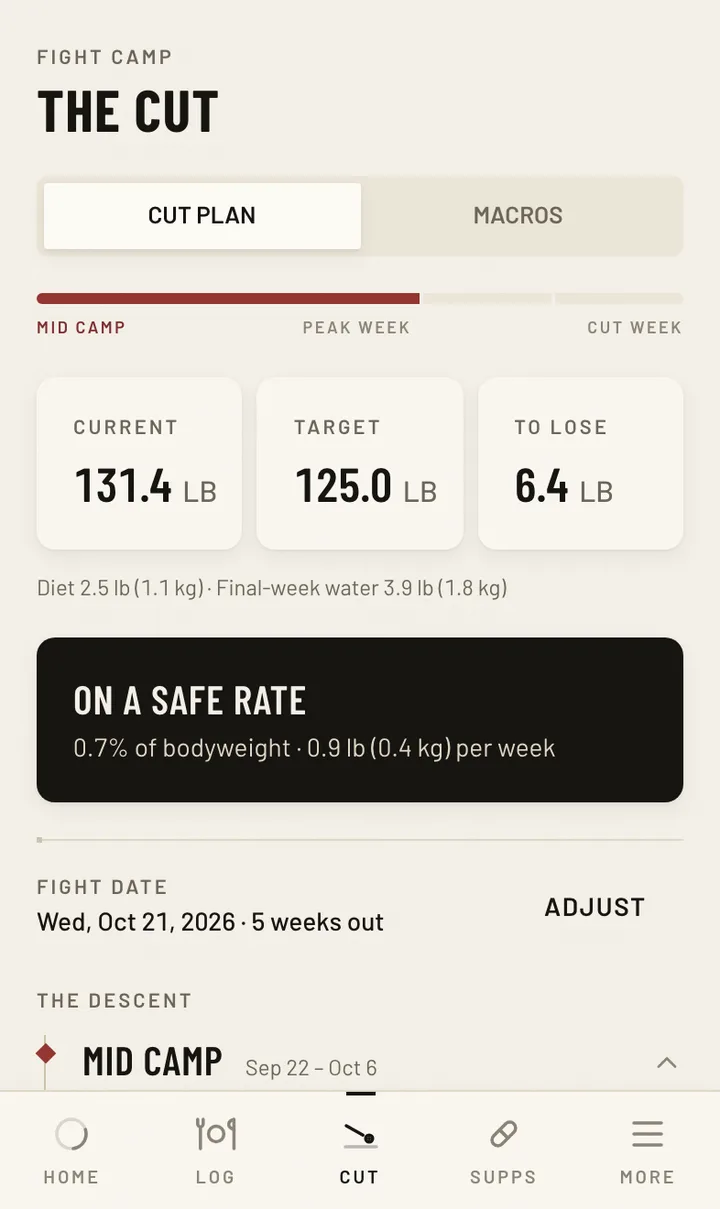
Consider a fabricated example — an invented athlete, used to make a structural point, and not a client of anyone. Mara Delgado is a flyweight, four weeks out, with 6.4 lb to lose. Roughly two-thirds of it is planned as a gradual dietary descent across the four weeks; the remainder is a final-week water reduction before a day-before weigh-in. Her rate over the four weeks classifies one way against the time remaining; the same rate with ten days remaining would classify differently.
Now imagine a second flyweight in the same week with the same numbers on paper. Both are unpleasant to be around. Both are hungry. Both are stiff, both have a headache, both are sleeping badly, both feel exactly as bad as everyone around them expects a fighter to feel in fight week.
The symptom list does not separate them. That is the entire difficulty, and no amount of tracking dissolves it. What differs is checkable by a third party rather than felt by the athlete:
Who is watching. One of them has a named physician or trainer who has seen this athlete's baseline — knows what her resting numbers look like, what her normal fight-week irritability looks like, what she is like when she's fine. The other does not. Every figure in this literature is conditioned on the first case. None exists for the second. That, not a threshold, is the difference this article is actually about.
What the athlete's own report is worth. The wrestler in the cardiac case report was carrying 2,150 ventricular premature beats a day and felt nothing. The judo cohort had CK and myoglobin above reference range with no way to know it. Self-report is a genuinely poor instrument for the specific things that go most wrong, and this is documented rather than asserted.
The one signal that is not subtle. Confusion, aggression, disorientation, collapse, seizure, altered consciousness. NATA names CNS dysfunction as often the first sign of exertional heat stroke. It is the signal the athlete cannot report, and it belongs to whoever is in the room. Pair it with heat injury's cola-coloured urine and severe muscle pain. Then note that the same signs appearing during rehydration after the weigh-in may instead indicate hyponatraemia — the opposite problem, with opposite handling, and distinguishable only by a blood test. Both roads lead to the same instruction: this is a medical emergency, and it is not the corner's to triage.
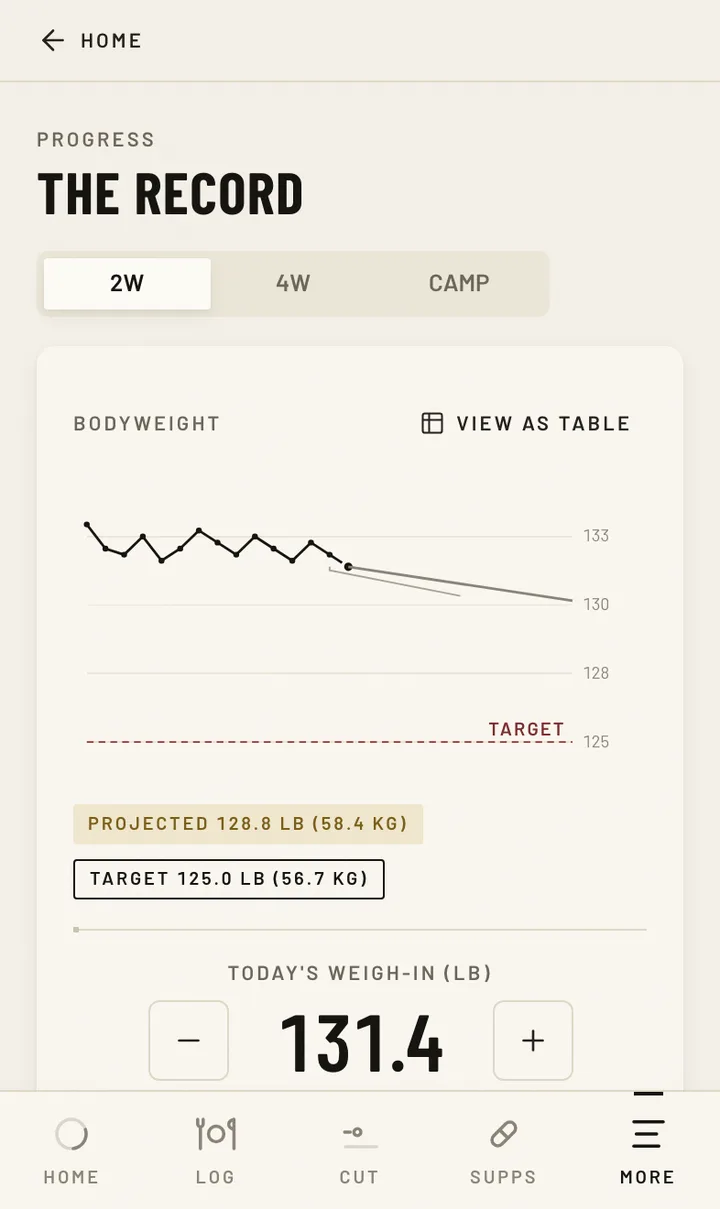
The tracking side of this is worth being modest about. A log can show a rate against a deadline, and a rate against a deadline is a real and useful thing to know — that is what reading a bodyweight trend is for, and it is a different question from whether a body is coping. A tool classifies a rate. It does not assess a person, and it does not clear anyone to continue.
11. What actually stops a cut from outside: the rules
Most fighters assume the sport's baseline rulebook contains a hydration requirement. In North American MMA, it does not.
The ABC Unified Rules of MMA — status: in force. The document's own header records its history: approved April 2001, amended 2010, amended 3 August 2016, amended with procedures 26 July 2017 and 1 August 2018, amended with rule changes 23 July 2024 with a requested implementation date of November 2024, and "AMENDED WITH NONSUBSTANTIAL CHANGES AUGUST 6, 2025." We text-extracted and searched that document on 7 September 2026.
It contains no hydration-testing requirement at all.
What it does contain is weight classes — atomweight at 105 lb and below through super heavyweight above 265 lb — allowances within a division, a five-pound cap on how much heavier the heavier opponent may be in a catch weight arising from a missed weight, and discretion for a commission to deny a catch-weight bout on safety grounds. It also gives the ringside physician authority during a bout: a combatant not cleared by the ringside physician to continue loses the contest, and the physician may evaluate a fighter at any point at the referee's discretion. That is in-bout authority. It is not weight-cut authority, and it should not be overstated into one.
The consequence for a reader is concrete. If you fight under the Unified Rules and nothing else, the rule set itself is not checking your hydration. Where hydration testing exists in MMA, someone added it — a promotion or a commission — and it applies only where they added it.
12. NCAA wrestling: the institutional descendant of 1997
The deaths in 1997 did lead to a rule regime. It was not in MMA. Conflating the two is the most common error in this subject, and it is worth stating the lineage precisely: three collegiate wrestlers died, and collegiate wrestling built the programme.
The NCAA's Wrestling Weight Management Program, in the 2025-26 men's and women's packets, works as a certification system rather than a fight-night check. Its purpose is to establish the lowest weight class an individual wrestler may ever compete at during that season, and it is administered by the institution, not by the athlete.
Urine specific gravity is the hydration measure. The packet states: "If specific gravity is greater than 1.020, the wrestler must return not earlier than 24 hours in a hydrated state for a retest." If the sample passes, the hydrated body weight is recorded and used in the certification. The measurement standard is specified too: "Test strips are not permissible as a measuring device for specific gravity" — a refractometer or urinometer is required.
Body-fat floors are set by rule and differ by sex. The men's packet: "The lowest allowable weight at five percent body fat." The women's: "The lowest allowable weight at 17 percent body fat." These are regulatory floors for certification eligibility, not body-composition goals, and they are one of the very few places in this entire literature where the difference between male and female athletes is legislated with a separate rule and a different number rather than a coefficient.
There is also a descent ceiling: the programme caps the rate at which a wrestler may descend from initial certification, at a fixed percentage of body weight per week, computed for the institution by a named vendor calculator rather than by the athlete. We are not printing the arithmetic, because printing the equation invites a reader to run it, and it is a regulatory ceiling in one sport administered by somebody else — not a rate that transfers to professional MMA, boxing, Muay Thai, judo or BJJ, and not advice to anyone.
Finally, the packets name prohibited and discouraged practices: restricting food, restricting fluids, vomiting, fasting, laxatives, diet pills, diuretics, saunas, vapour-impermeable suits and stimulants, with cross-references to penalties in the rules book. All of that is NCAA collegiate wrestling. None of it is in force anywhere else.
13. Commission and promotion mechanisms, and what their status actually is
Beyond the Unified Rules, weight-cut oversight in professional combat sports comes from commissions and promotions, and their text changes. Status precision matters more here than any individual number.
California. The California State Athletic Commission's 2026–2031 Strategic Plan — an adopted strategic plan, not rule text — lists under Goal 1, Health and Safety, item 1.3: "Increase communication and education about the risks of weight cutting to fighters, matchmakers, and promoters to maintain appropriate matches." Under Goal 3, item 3.1: "Implement the Association of Boxing Commission (ABC) unified rules for all CSAC regulated sports." That tells us weight cutting remains a live CSAC priority through 2031. It does not tell us the operative rule text.
CSAC also approved a ten-point weight-management plan in May 2017. Reported elements included licensing fighters by weight class with physician approval required to compete at a given weight, four added weight classes, 30-day and 10-day weight checks for high-level title fights, day-of-fight weight checks with a large post-weigh-in gain potentially forcing a move up a class, and fines for missing contracted weight. Every one of those is described here as approved in May 2017, on secondary reporting of the 2017 vote. We did not retrieve the current operative regulation text on 7 September 2026, and a plan adopted in 2017 is not necessarily the text in force in 2026.
The WBC. The World Boxing Council's Weight Management Program, as described in the ABC-hosted document captioned "World Boxing Council 2019-20," sets weight checks at 30, 14 and 7 days before a bout with descending ceilings above the division limit, a fight-day dressing-room check against the official weigh-in weight, and an official weigh-in no less than 24 and no more than 30 hours before a WBC bout. Those figures belong to the 2019-20 document. Their 2026 currency is unverified, and they should not be read as the current rules of anything.
ONE Championship. Reported policy places a hydration test alongside a weigh-in 24 to 48 hours before the event, with a urine specific gravity ceiling that must be met to pass, weights checked daily through fight week and specific gravity checked again a few hours before the event; failing the hydration test blocks the weigh-in. This is promotion-level policy, reachable only through secondary sources, adopted after the December 2015 death of Yang Jian Bing. It is not a commission rule and it applies to no other promotion.
The general lesson is more durable than any of the numbers. The mechanisms that exist are: check weights at fixed distances from a bout, hydration tests, day-of weigh-ins, physician clearance, and medical suspension. Which of them applies to a given fighter depends entirely on jurisdiction and promotion, and the only reliable way to know is to ask the commission that licenses the event. Nothing in this article — and nothing an athlete reads anywhere — is a reason to interpret a rule more favourably than the commission does.
14. Who this literature is not about
The evidence base is adult, overwhelmingly male, and institutional. The judo muscle-damage data is eighteen men. The cardiac case is one man. Maurício's cohort is 31 professional MMA athletes, 28 of them men and 3 women, mean age 28 ± 4. A 2024 systematic review of weight-loss practice in combat sports drew on studies that were sex imbalanced — seven male-only, one female-only, the remainder mixed. The 2025 ISSN position stand mentions female athletes essentially once, and never in its weight-cut safety guidance. Nothing here has been measured in an adolescent, and the differences that would matter — body composition, total body water as a fraction of mass, cycle effects on fluid balance — are not adjustable with a coefficient. Where a governing body legislated for the difference, it did so with a separate rule and a different number.
For context on what "normal" looks like so that "wrong" has a reference: that 2024 review found weight loss highly prevalent, at 66–100% of combat-sport athletes, who usually lost less than 5% of body weight in the 7–14 days before competition, with sambo, MMA and Muay Thai athletes losing more. The most common methods were increasing exercise and gradually dieting; extreme practices including diet pills and vomiting were used less frequently. That is self-reported, across mixed sports, levels, weigh-in formats and sexes.
The youth picture is worse-documented and more alarming. Lakicevic and colleagues' 2022 systematic review reports that "RWL is highly prevalent in children and adolescent combat athletes, ranging from 25 to 94% depending on the type of combat sport, age and level of competition." Within that envelope sit single-study point estimates for individual sports that we are not repeating as though they carried a range's authority, because the review rests on seven studies in total — as its own authors write, "our search yielded only 7 studies, illustrating that the topic of weight cycling in youth combat sports is in its infancy."
That same review documents a United States case report of a five-year-old child making weight for a wrestling competition, and judokas in Israel and Brazil reporting that they began cutting weight as young as four and nine years old respectively. The harms it names in youth include delayed prepubertal development from energy and nutrient restriction, "particularly in female athletes"; amenorrhoea, with two of nine girls amenorrhoeic for a year before engaging in rapid weight loss, which means it cannot be attributed to it; significant increases in depression, anger and fatigue in young wrestlers; and 1.7% answering consistently with all five criteria for bulimia nervosa. Small samples throughout.
And then the reader most exposed. The amateur fighter cutting for a local show — no commission physician on site, no hydration test, no certification, no baseline bloods, often a same-day weigh-in — is the least studied person in this entire subject. Every clinical, biochemical and cardiac source collected here studied collegiate, national-level, Olympic-level or professional athletes, all under some institutional medical umbrella. The literature describes the supervised case and is silent on the unsupervised one, which is the exact inverse of where the risk sits. If you want a single reason to be suspicious of any confident number about weight cutting, that is it. Tracking what happens across a camp — including the injuries and symptoms nobody writes down — at least gives a physician something to read when one is finally in the room.
What we could not verify
This section is not a disclaimer. It is a list of fifteen things we went looking for, on 7 September 2026, and could not establish — and in a subject where confident numbers circulate freely, the list is more useful than several of the sections above.
- No fatality count exists. Two peer-reviewed sources assert that deaths are documented and neither counts them. We refused to supply a number, and no number appears anywhere on this page.
- No adverse-event registry exists for combat sports. The MMWR called for strengthened surveillance in 1997. We found no system that produces the resulting figures in 2026.
- No hospitalisation rate exists, in any combat sport, in any jurisdiction we searched. Sources assert hospitalisations occur. None quantifies them.
- The MMWR's percent-of-body-weight figures disagreed between two fetches of the same page. One rendering gave percentages; a careful second pass gave pounds and weight classes only. We print the pounds, which were stable across both, and no percentage. Arbitrating this requires a third careful read of the original page rather than a third summary of it.
- The named modern cases could not be raised above media sourcing. No autopsy report or peer-reviewed case report was retrieved for Yang Jian Bing or for Leandro Souza. They are reported as reported.
- A "WBC announces new weight management program" item dated 18 August 2026 exists in search results and returned a 403 on fetch. It is unverified, and nothing from it appears here in any form. The only WBC document we could reach is captioned 2019-20.
- CSAC's current operative regulation text was not retrieved. Only the 2026–2031 Strategic Plan is primary-verified, and a strategic plan is not a rule.
- ONE Championship's own rule text was not retrieved. Its hydration policy is described here from secondary sources only.
- Women are close to absent from the safety evidence. Eighteen of eighteen men in the judo study. One man in the cardiac case. Three of 31 in the professional MMA cohort. Seven male-only studies to one female-only in the 2024 review. The single source here that legislates for women specifically is the NCAA women's wrestling packet.
- Adolescents rest on seven studies, in a field its own reviewers describe as in its infancy — while the same review documents cutting beginning at ages four and five. The dangerous-signal literature for a growing body essentially does not exist.
- Amateurs are the least studied and the most exposed. Every source here studied athletes under institutional medical oversight.
- No published case report of exercise-associated hyponatraemia in a combat-sport athlete rehydrating after a weigh-in was found. The mechanism is well documented in endurance athletes. The combat-sport case series does not exist.
- Nothing sport-specific was retrieved for BJJ, Muay Thai or kickboxing. No clinical source, no regulatory source. The 2024 review notes Muay Thai athletes lose more than average; that is the extent of it, and wrestling or MMA rules should not be extrapolated onto those sports.
- Long-term effects are unknown, stated as such by the 2025 ISSN position stand itself.
- No safe unsupervised figure exists. We looked. There is no number in this literature offered to an athlete acting alone, and we did not invent one to fill the gap.
Questions fighters ask
How do I know if my weight cut is dangerous?
You cannot reliably know from the inside, and that is the honest answer rather than an evasive one. The published data show damage that the athlete could not feel: eighteen judo athletes with creatine kinase and myoglobin above reference values, detectable only in a blood draw, and a wrestler carrying 2,150 ventricular premature beats in 24 hours who remained asymptomatic. The signs that matter most — confusion, aggression, disorientation, collapse, altered consciousness — are the ones you cannot report about yourself, because by the time they appear the person reporting is impaired. That is why the assessment belongs to a physician or an athletic trainer who has seen your baseline, and why no article, app or wearable can substitute for one.
Is there a safe amount of weight to cut?
There is no published figure offered to an athlete acting without supervision. Every quantitative statement in this literature arrives conditioned on something: on appropriate supervision in the 2025 ISSN position stand, on a multidisciplinary team including a nutritionist and physician in the 2025 Maurício study, on an institutional certification process in the NCAA's wrestling programme, or on a clinician's hands in every heat-illness source. The absence of an unsupervised number is not an oversight in the research. It is the state of the evidence, and filling it with a rule of thumb would be inventing something the literature declines to say.
How many fighters have died from weight cutting?
Nobody publishes a count, and any article giving you one has manufactured it. Two peer-reviewed sources — a 2025 professional-MMA study and a 2022 systematic review of youth combat sports — both state that fatalities are documented, and neither supplies a number, a denominator or a date range. Separately documented cases exist: the CDC investigated three collegiate wrestlers who died between November and December 1997, and media reporting covers named modern cases. Those cannot be added together into a series, because they span different countries, decades, sports and evidence standards. There is no adverse-event registry for combat sports, and that absence is itself part of the problem.
What are the warning signs of heat stroke during a cut?
The National Athletic Trainers' Association gives two diagnostic criteria for exertional heat stroke: central nervous system dysfunction and a core body temperature above 40.5 °C (105 °F). Both must be present. The first sign is often the CNS dysfunction — NATA names collapse, aggressiveness, irritability, confusion, seizures and altered consciousness. Heat exhaustion presents with a core temperature usually below that threshold plus heavy sweating, dizziness, headache, nausea, weakness and impaired coordination, and NATA states plainly that the two cannot be reliably separated by symptoms alone. Any of these signs in a cutting athlete is a reason to involve medical staff, not a reason to interpret a chart.
Can a smart ring or wearable tell me if I'm overheating?
No. NATA's position statement is explicit: "Rectal temperature thermometry is the only method of obtaining an immediate and accurate measurement of core body temperature," and it names oral, axillary, aural canal, tympanic, forehead sticker and temporal artery devices as inaccurate for that purpose. A wrist, finger or forehead reading cannot make the diagnosis of exertional heat stroke and — this is the part that causes harm — cannot exclude it either. A reassuring number from a consumer device is not evidence that a fighter is fine, and treating it as clearance is the specific mistake to avoid.
Does passing a hydration test mean my cut is going well?
No. Urine specific gravity thresholds are pass/fail gates for a specific administrative purpose — a season-long certification in NCAA wrestling, or permission to step on the scale under a promotion's fight-week policy. NATA's own pre-activity reference is for athletes who are not deliberately dehydrating, which makes it a screen rather than a clearance. A passing specific gravity detects no rhabdomyolysis, no hyponatraemia, no arrhythmia and no heat illness. It tells you that one number was within one range at one moment, which is genuinely all it was designed to tell anybody.
Do the Unified Rules of MMA require hydration testing?
No. We text-extracted the Association of Boxing Commissions' Unified Rules of MMA — the version amended with nonsubstantial changes on 6 August 2025 and in force — and searched it on 7 September 2026. It contains no hydration-testing requirement of any kind. What it does contain is weight classes, allowances within a division, a five-pound cap on the heavier opponent in a catch weight arising from a missed weight, and commission discretion to deny such a bout on safety grounds. Where hydration testing exists in MMA, a promotion or an individual commission added it, and it applies only where they added it.
What is rhabdomyolysis and how would anyone know it was happening?
Rhabdomyolysis is the breakdown of skeletal muscle releasing its contents into the bloodstream, and it was the autopsy-recorded cause of death in one of the three wrestlers the CDC investigated in 1997. The layperson-visible half of the picture, as NATA describes it under heat injury, is very dark cola-coloured urine and severe muscle pain. The other half is abnormal blood chemistry, which is a laboratory finding. In the judo study, markers of muscle damage rose above reference values with nothing visible to the athletes — which is exactly why dark urine and severe muscle pain during or after a cut are a reason to seek medical assessment rather than to watch and wait.
Can you drink too much water after a weigh-in?
Yes, and it is a documented and serious failure mode. Exercise-associated hyponatraemia is defined as a serum sodium level below 135 mmol/L developing during or up to 24 hours after activity. Its early symptoms — lightheadedness, malaise, fatigue, irritability, weakness, headache, nausea, sluggish urine output — overlap almost entirely with how a dehydrated athlete already feels, so neither the fighter nor the corner can separate them. Severe cases progress to vomiting, altered mental status, collapse, seizure and coma from cerebral oedema. It is diagnosed by a blood test, and how a given athlete should rehydrate is a question for the professional supervising them, which is why this article gives no fluid figures.
Did the 1997 wrestling deaths lead to hydration testing in MMA?
No, and this is the most common error in the subject. They led to the NCAA's wrestling weight management programme, which is a collegiate-wrestling certification system: a urine specific gravity gate, sex-specific body-fat floors, a weekly descent ceiling from initial certification, and a list of prohibited practices including saunas, diuretics and vapour-impermeable suits. That programme is in force for the 2025-26 season in collegiate wrestling and nowhere else. The baseline North American MMA rule set, as amended in August 2025, contains no hydration test at all.
Are sweat suits actually more dangerous than other methods?
The evidence points that way consistently across three unrelated institutions, though no source ranks methods by risk. All three wrestlers in the CDC's 1997 investigation were using vapour-impermeable suits under warm-up suits while exercising vigorously in hot environments. NATA classes rubber and plastic suits used for weight loss as a barrier to evaporative heat loss, on the mechanism that they prevent water vapour passing from the skin to the environment and inhibit evaporative, convective and radiant heat loss. The NCAA's 2025-26 packets name them among prohibited practices. The same object appears in a public-health investigation, a clinical position statement and a current rulebook, for the same physiological reason.
Does the research apply to women fighters?
Very little of it does, and no coefficient fixes that. The judo muscle-damage study was eighteen men. The cardiac case report is one man. The 2025 professional MMA cohort was 28 men and 3 women. A 2024 systematic review drew on seven male-only studies to one female-only. The 2025 ISSN position stand mentions female athletes essentially once and never in its weight-cut safety guidance. The one place in this entire body of material where the difference is legislated is the NCAA's wrestling programme, which sets a 17% body-fat floor for women against 5% for men — a separate rule with a different number, which is the model, rather than scaling a male figure down.
What about teenagers and children cutting weight?
The evidence is thin and what exists is troubling. A 2022 systematic review reports rapid weight loss prevalence in children and adolescent combat athletes ranging from 25 to 94% depending on sport, age and competition level — built on seven studies, in a field its own authors describe as "in its infancy." The same review documents a US case report of a five-year-old making weight for wrestling, and judokas in Israel and Brazil reporting they began cutting as young as four and nine. Named harms include delayed prepubertal development from energy and nutrient restriction, particularly in female athletes, and increases in depression, anger and fatigue in young wrestlers, all from small samples. Adult figures do not scale downward to a growing body.
Is there anything published for BJJ, Muay Thai or kickboxing specifically?
We retrieved nothing sport-specific for any of the three — no clinical source and no regulatory source — on 7 September 2026. The one adjacent finding is that a 2024 systematic review recorded Muay Thai athletes among those losing more than average. That silence matters more than it first appears, because those three sports commonly run same-day or near-same-day weigh-ins, which is the format in which acute figures measured under a day-before weigh-in describe nothing at all. Extrapolating wrestling or MMA rules onto them is not supported by anything we could find.
Who decides whether a cut should stop?
A qualified person, and in practice that means a physician, an athletic trainer, or the commission licensing the event. Nothing in this article overrides any of them, and nothing here is a reason to present yourself, continue, feel it out on the day, or interpret a rule more favourably than your own commission does. The mechanisms that exist externally are check weights at fixed distances from a bout, hydration tests where a promotion or commission imposes them, day-of weigh-ins, physician clearance and medical suspension — and which apply to you depends entirely on jurisdiction and promotion. The only reliable way to know is to ask the body licensing your event.
Sources
Sourced to
- Hyperthermia and Dehydration-Related Deaths Associated with Intentional Rapid Weight Loss in Three Collegiate Wrestlers — North Carolina, Wisconsin, and Michigan, November–December 1997 — Centers for Disease Control and Prevention, Morbidity and Mortality Weekly Report, 1998. Fetched and verified 2026-09-07
- An alternative structured weight management protocol to rapid weight loss in mixed martial arts: a prospective interventional study of pre-competition weight management strategies in professional athletes — Maurício CA, Artioli GG, et al., Frontiers in Nutrition, 2025;12:1581698. DOI 10.3389/fnut.2025.1581698, PMID 41132567
- International Society of Sports Nutrition position stand: nutrition and weight cut strategies for combat sport athletes — Ricci AA et al., Journal of the International Society of Sports Nutrition, 2025;22(1):2467909. DOI 10.1080/15502783.2025.2467909
- National Athletic Trainers' Association Position Statement: Exertional Heat Illnesses — Casa DJ, DeMartini JK, Bergeron MF, et al., Journal of Athletic Training, 2015;50(9):986–1000. DOI 10.4085/1062-6050-50.9.07, PMID 26381473
- Statement of the Third International Exercise-Associated Hyponatremia Consensus Development Conference, Carlsbad, California, 2015 — Hew-Butler T, Rosner MH, et al., Clinical Journal of Sport Medicine, 2015;25(4):303–320. PMID 26102445. Cited from the PubMed record; full text was not retrievable
- Exercise-Associated Hyponatremia — StatPearls, NCBI Bookshelf NBK572128, last updated 12 June 2023
- ACEP Sports Medicine Section — American College of Emergency Physicians; section article "Exercise-Associated Hyponatremia," Kelleher M and Dolbec K, 19 October 2022, cited for the serum sodium severity thresholds. Linked to the section index rather than a permalink we could confirm
- The effects of rapid weight loss on skeletal muscle in judo athletes — Roklicer R, Lakicevic N, Stajer V, et al., Journal of Translational Medicine, 2020;18:142. DOI 10.1186/s12967-020-02315-x
- Disrupting arrhythmia in a professional male wrestler athlete after rapid weight loss and high-intensity training — Case report — Milovančev A, Miljković T, Ilić A, et al., Frontiers in Cardiovascular Medicine, 2023;10:1091603. DOI 10.3389/fcvm.2023.1091603, PMID 36760566
- Patterns of weight cycling in youth Olympic combat sports: a systematic review — Lakicevic N, Matthews JJ, Artioli GG, et al., Journal of Eating Disorders, 2022;10:75. DOI 10.1186/s40337-022-00595-w, PMID 35614520
- The Practice of Weight Loss in Combat Sports Athletes: A Systematic Review — Zhong Y, Song Y, Artioli GG, et al., Nutrients, 2024;16(7):1050. DOI 10.3390/nu16071050, PMID 38613083
- Association of Boxing Commissions and Combative Sports — publisher of the Unified Rules of MMA; the PDF dated 8.2025, "amended with nonsubstantial changes August 6, 2025," was text-extracted and searched 2026-09-07
- NCAA 2025-26 Women's Wrestling Weight Management Program Packet — National Collegiate Athletic Association, 2025-26 season; the men's packet was text-extracted alongside it and is quoted where the two differ
- California State Athletic Commission — California Department of Consumer Affairs; the 2026–2031 Strategic Plan, an adopted plan rather than rule text, was text-extracted and quoted 2026-09-07
Read next
Plan the descent, don't guess it
Fighter Cut builds a week-by-week plan from today to your weigh-in, classifies the rate you are actually losing at, and logs what you eat against it. It does not make a cut safe — nothing does. It makes the numbers visible early enough to change them.
Open Fighter Cut