Fighter Cut › Articles › Fight camp
Fight camp
The weekly camp review: what to look at, in order
An ordering of questions grounded in what the monitoring literature actually measured — and an admission up front that nobody has ever tested weekly review against daily review.
Monitoring only works if somebody acts on what it says. Mostly, nobody does.
That is not a rhetorical opening. It is the closest thing the athlete-monitoring literature has to a settled finding, and it is stated most plainly by Shona Halson in a 2014 narrative review that remains one of the most cited treatments of the subject: "The ability and opportunity to implement change and provide feedback is critical to a successful monitoring system, and, if this does not occur, many attempts at monitoring are not sustainable." The system does not fail because the questionnaire was badly worded or the scale was cheap. It fails because the loop is open at the far end — data goes in, nothing visible comes out, and the input degrades until it is worthless.
This article describes an order in which a coach and an athlete might look at a camp once a week, and what each thing they look at can and cannot tell them. It is an ordering of questions, not a set of actions. Every source underneath it describes supervised practice — institutional programmes, national teams, professional athletes with a nutritionist and a physician attached — and none of them describes rules an athlete administers to themselves. This article does not convert them into any.
One admission belongs at the top rather than in a caveat at the bottom. No source located for this piece tested a weekly review cadence against a daily one, or against any other. The recommendation of a weekly rhythm here is a reasoned position assembled from two indirect findings — that the signal worth catching accumulates gradually, and that daily repetition degrades the honesty of the answers. It is not an evidence-backed cadence, because no such evidence exists. Where the article reasons, it says so.
The camp-phase rate a weekly review is actually checking against — "commonly recommended," in the position stand's own words, not derived from a trial inside that document. Professional-MMA framing, practitioner-supervised, no sex-specific version given
Ricci AA, Evans C, Stull C, et al., ISSN position stand, J Int Soc Sports Nutr 2025;22(1):2467909
The studies in which subjective self-report measures were more sensitive and consistent than objective ones, within the same conditions. Not a universal law — a majority in a systematic review of 56 studies where meta-analysis was not possible, in mixed non-combat sports
Saw AE, Main LC, Gastin PB, Br J Sports Med 2016;50(5):281–291
Not a gap in this article's search — a gap in the field. Nothing tested review cadence head to head. The nearest evidence is indirect in both directions: overtraining signals accumulate gradually, and daily repetition produces unvarying answers
Absence; nearest support Saw et al. 2016 (chronic signal gradual) and Saw et al., J Sports Sci Med 2015;14(1):137–146 (questionnaire fatigue)
The athletes in a 30-person qualitative interview sample who admitted withholding the truth on their self-report measures, from fear of appearing unprofessional or of punishment. Eight athletes, Australian elite programmes, twenty sports — a very small denominator
Saw AE, Main LC, Gastin PB, J Sports Sci Med 2015;14(1):137–146
- The review's output is a decision, not a dashboard. Halson's review states that without the ability and opportunity to implement change and provide feedback, "many attempts at monitoring are not sustainable" — and that "very few of these markers have strong scientific evidence supporting their use, and there is yet to be a single, definitive marker described in the literature." No one number is the camp.
- The rate a weekly meeting checks against is 0.5–1 kg per week, which the 2025 ISSN position stand describes as commonly recommended for combat athletes, with the energy deficit based largely on total daily energy needs. That figure sits in a document whose framing throughout is professional MMA with a sports nutrition professional attached.
- The one published elite camp that ran close to that reference averaged 0.68 kg per week — 81.6 kg to 75.4 kg over nine weeks, a loss of 6.2 kg or 8.2%. That is a single male athlete in a ten-week nutritionist-supervised camp, published as a SportRxiv preprint and not peer-reviewed.
- Self-report tracked training load better than blood or heart-rate markers, more often than not. Within studies, subjective measures were more sensitive and consistent than objective ones in 22 of the 54 studies permitting the comparison; objective measures "were generally unresponsive to acute changes in training load." Meta-analysis was precluded by heterogeneity, so this is a count of studies, not a pooled effect.
- The measurement decays because the loop is open. Interviewees in the 2015 qualitative study described both failure modes directly: repetition produces unvarying answers, and invisibility produces invented ones — "if they think that no-ones looking at it then they'll just give dummy responses."
- A weekly review is a reasoned cadence, not a tested one. The "two to three times a week" figure that circulates in coaching writing is one interviewee's opinion inside a qualitative study of thirty people. It has never been trialled, and this article does not present it as a recommendation.
- Composite numbers can manufacture signal that is not there. The acute:chronic workload ratio, the most widely adopted composite monitoring metric in team sport, was assessed by Impellizzeri and colleagues in 2020 with the conclusion that "there is no evidence supporting the use of ACWR in training-load-management systems or for training recommendations aimed at reducing injury risk."
- Every body-mass figure in this article is effectively a male number. The governing position stand offers no sex-specific guidance; the one cohort containing women folds three of them into means with twenty-eight men and never separates them; the only female data point is a single case study in an athlete with pre-existing amenorrhoea whose authors state it cannot generalise.
1. What the weekly review is for, and what it is not
A weekly review is a scheduled conversation in which somebody looks at what the camp produced over seven days and decides one thing. That is the whole job. It is not a data audit, it is not a dashboard, and it is not a wellness score with a threshold attached to it.
The reason to define it that narrowly is Halson's, and it is worth stating twice because everything downstream depends on it. Her 2014 review of load monitoring lists what an effective monitoring system has to do, and the list is not about measurement at all. Systems must "provide efficient data analysis and interpretation, and enable efficient reporting of simple, yet scientifically valid, feedback." The barriers she names are not technical either: "a lack of knowledge or experience with monitoring techniques can result in an inability to implement a practical and sustainable system and/or an inability to interpret the data collected," and insufficient resources — "time, money or the human resources."
Read that against how monitoring is usually sold, which is as a collection problem. Collect more, more often, from more sensors. Halson's framing says the collection was never the constraint. The constraint is the thirty minutes on a Sunday in which somebody who understands what they are looking at reads it and changes something.
Two conditions travel with that review, and both matter for how much weight a reader should put on it. It is a narrative review, published in 2014, drawing on general athlete populations rather than combat sport. And the governing caveat over the whole of it is Halson's own sentence: "very few of these markers have strong scientific evidence supporting their use, and there is yet to be a single, definitive marker described in the literature."
That sentence should sit over this entire article. There is no single definitive marker. No one number is the camp.
2. Why the monitoring dies, and why that is the first thing to design against
The failure mode is well described, and it is social rather than statistical.
Saw, Main and Gastin conducted semi-structured interviews with thirty people across twenty Australian elite sport programmes — eight athletes, seven coaches, fifteen sport-science and sports-medicine staff — and asked what made athlete self-report measures work or stop working. The answers are unusually blunt for a published paper.
On invisibility: "if they think that no-ones looking at it then they'll just give dummy responses." On repetition: "when you're asking the same questions all the time day after day after day, some of them will just keep the same responses and they won't be honest," which the authors formalise as "questionnaire fatigue where athletes respond in an unvarying or random manner." On the coach's role: "if it doesn't have a reinforcement from the coaches [compliance] tends to fall away." On collapse: "people stop [completing their ASRM] and then everyone stops doing it and it stops completely."
Those four sentences describe a single mechanism. The input is only as honest as the athlete's belief that it changes something. Break that belief and you do not get missing data, which would at least be visible. You get filled-in data that is wrong, which looks exactly like compliance.
The authors also note what makes it fail faster. "Uncertainty over data security, or use of coercion or punishment to enforce ASRM completion reduces an athlete's sense of autonomy. This is not only detrimental to the ASRM process but may also impair their self-esteem and the athlete-coach relationship." And what makes it hold: buy-in improved when athletes understood "why an ASRM is to be used, the purpose of questions, who looks at the data and how data is to be used to their benefit."
Some conditions on all of it. This is qualitative interview data from thirty people in one country, in team and individual Olympic sports, with no combat sport identified. The dynamic described in the collapse quote is a team dynamic — a solo fighter with one coach has a different failure geometry, and nobody has studied it. And the honesty figure that gets quoted most often — that half of athletes admitted withholding the truth — has a denominator of eight interviewed athletes. Four of eight is what the study supports. Half of athletes is not.
There is one more piece of evidence worth putting beside this, hedged appropriately. Neupert, Holder and Jobson ran a six-month behaviour-change intervention in an elite programme explicitly designed to raise monitoring engagement, and reported that adherence declined across it, though coaches reported improved athlete awareness; the decline was partly attributed to partial implementation after coaching personnel changes. Athletes in that study reported "considerable intercoach variability" in how the system was used and in what feedback came back. The sample is three coaches and eight athletes and the primary was not obtained for this article, so it is an illustration rather than a result. But it points the same direction as everything above: the intervention that fails is the one that raises collection without closing the loop.
3. First: the trajectory, before today's number
Start with the slowest-moving thing, because it is the only one a week of data can actually speak to.
The reference rate for the camp phase comes from the 2025 ISSN position stand on nutrition and weight cut strategies for combat sports: "Combat athletes are commonly recommended to aim for weight loss of 0.5–1 kg of body mass each week with the resulting energy deficit being based largely on total daily energy needs." Two conditions attach to that sentence and neither is decorative. It is described as commonly recommended rather than derived from a trial inside the document. And the position stand is a narrative synthesis, not a systematic review — its authors state that "although few published studies address the complexities and unique training demands of combat sports, relevant articles were selected, regardless of any methodological limitations." Three of its authors are affiliated with the UFC Performance Institute, and the society that publishes it takes supplement-industry funding. None of that makes the figure wrong. It makes it a consensus figure rather than a measurement, and it should be read that way.
What does a camp that ran to that reference look like? There is one published account with enough detail to answer. Matthews documented a ten-week camp in an elite male mixed martial artist preparing for a world lightweight title bout: body mass fell from 81.6 kg to 75.4 kg over nine weeks, a total of 6.2 kg or 8.2%, which the author reports as 0.68 kg per week. A further 5.2 kg (7.4%) came off in the final five days, 5.8 kg was regained, and he competed at 76 kg. That is one man, in a camp with a sports nutritionist attached, and the document is a SportRxiv preprint that has not been peer-reviewed. It is a description of what one supported professional did, not a rate anyone should be measured against.
The reason to look at trajectory rather than at Sunday's reading is that a single weight is mostly noise about a body's water and gut contents, and the weekly reference rate is a slope. Four Sundays give you a slope. One Sunday gives you a number that could mean anything. If the review has a single job in its first five minutes, it is to answer whether the last four weeks are steeper, shallower or roughly on the line — and to notice that "roughly on the line" is the answer most weeks, which is exactly why a weekly cadence is bearable and a daily one is not.
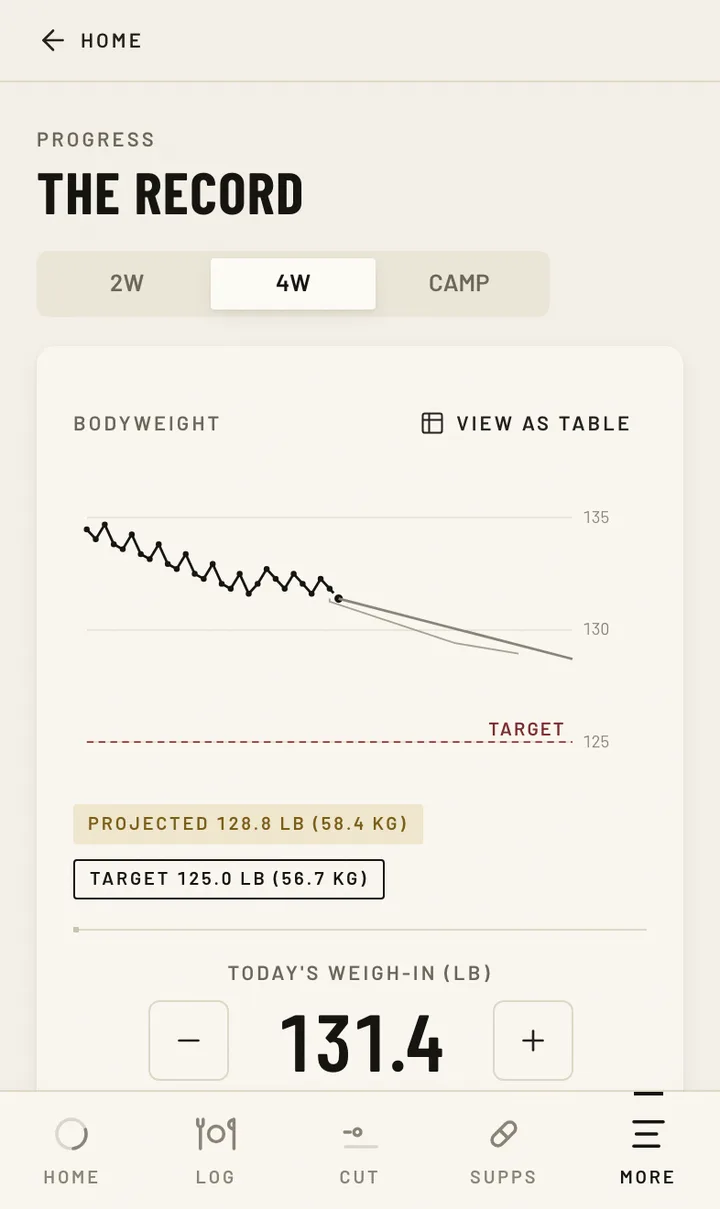
Mara Delgado is a fabricated example built for this article — an amateur flyweight, four weeks from a bout, sitting at 59.6 kg against a 56.7 kg division. She is not a client and she is not drawn from anyone's camp; Fighter Cut has no coached roster. She exists so the ordering below has something to be applied to.
4. Second: the acute figures belong to fight week, not to this meeting
The position stand contains a set of graded figures that get quoted more than anything else in it, and a weekly review is exactly the wrong place for them. They belong here only so a reader knows what they are and what they are not.
Before the figures, the format. Every percentage of body mass in this literature was measured under a particular weigh-in format, and the formats are not interchangeable. Professional MMA typically weighs in roughly 24 to 36 hours before the bout; much amateur boxing, BJJ and Muay Thai weigh in the same day, sometimes minutes before a match; wrestling runs a certification system; judo uses random weigh-ins. The position stand's own sentence does not name a weigh-in window, though the document's framing throughout is professional MMA. At a same-day weigh-in, figures measured under a day-before format describe nothing at all.
The sentence itself: "Suitable losses in body mass range from 6.7% at 72 h, 5.7% at 48 h, and 4.4% at 24 h, prior to weigh-in."
These are three answers to one question asked at three different moments. The question is how much body mass may be lost in the window that remains. They are not sequential stages, they do not stack, and they do not sum. The misreading — adding them into a cumulative figure near 17% — is a fabrication, and it is common enough that it deserves naming rather than assuming away. Read correctly, the numbers describe a descent that gets smaller as the runway shortens. Read as a ladder, they describe a cut nobody in that document proposed.
Two more conditions. The position stand gives no sex-specific version of these figures, no age breakdown, and no amateur-versus-professional distinction. And every acute figure in this literature sits inside a document that assumes practitioner supervision: "It is advisable that the sports nutrition professional carefully monitor changes in body mass and body composition." There is no figure in this literature established as safe to attempt without that supervision. The absence of an unsupervised figure is itself the finding, and this article does not fill it.
None of this is weekly-review material. Eight weeks out, or four, the relevant number is the 0.5–1 kg per week slope. The fight-week figures answer a different question at a different moment, and importing them into a Sunday meeting turns a review into a schedule. Our companion piece on when tracking says stop the cut deals with the signals that end a descent; this one deals with the ones that shape it.
5. Third: how the athlete says they feel — and why that outranks the blood test
The most useful thing a weekly review has access to is also the cheapest, and the evidence for that is stronger than most coaches expect.
Saw, Main and Gastin screened 4,244 records and reviewed 56 studies comparing subjective self-report measures against objective ones — biochemical, hormonal, immunological, heart-rate and performance markers — in their response to training load. Their abstract's headline is direct: "Subjective and objective measures of athlete well-being generally did not correlate. Subjective measures reflected acute and chronic training loads with superior sensitivity and consistency than objective measures." And: "Objective measures were generally unresponsive to acute changes in training load."
Be precise about what that means. Within studies — under the same conditions — subjective measures were more sensitive and consistent than objective measures in 22 of the 54 studies that permitted the comparison. That is a majority of a mixed field, not a clean sweep. Meta- analysis was precluded due to heterogeneity in methods and reporting, so there is no pooled effect size behind the claim, only a count. The authors also flag that "presentation of group responses may have discounted potentially relevant individual responses," which matters enormously for a single fighter. And the cohorts are trained and elite athletes across mixed sports, both sexes, with no combat sport identified in the review's framing.
Two findings from that review bear directly on how to read a week rather than a day.
The acute one: "Subjective measures consistently identified impaired well-being with acute increases in training load, and improved well-being with an acute reduction in training load." That is the taper reading. A wellness measure that does not improve when load comes down in the final block is telling you something the schedule is not.
The chronic one, which is the closest thing this article has to positive support for a weekly look: subjective measures also identified impaired well-being in response to chronic training load, and the authors note that progression towards overtraining syndrome may be gradual. A gradual signal is a signal you read across weeks. It is not visible in Tuesday's score, and staring at Tuesday's score is how a coach ends up reacting to yesterday's sparring session instead of to the trend.
That is a reason to look weekly. It is not evidence that weekly beats daily, because nobody ran that comparison. Section 11 handles that distinction properly.
6. Fourth: whether the athlete has stopped telling the truth
This is the question a review has to ask about its own instrument, and it is the one most review structures skip.
Two failure modes are described in the 2015 interview data, and they have different tells.
The first is repetition fatigue. "When you're asking the same questions all the time day after day after day, some of them will just keep the same responses and they won't be honest." The tell is an unvarying series — a sleep score that has read 4 for eleven straight days through a hard week and an easy one. Real wellness data moves. A flat line through a varying training week is more likely a measurement artefact than a physiological finding.
The second is invisibility. "If they think that no-ones looking at it then they'll just give dummy responses." The tell is harder, because dummy responses can look plausible. The practical check is not in the data at all: it is whether the athlete can name a single thing that changed because of what they reported. If they cannot, the data is decorative and probably already degraded.
The third failure, which is not about honesty, is the athlete who reports accurately into a system that overrules them anyway. One athlete interviewee described it: "I think [our coach is] a bit old fashioned…so no matter how you're feeling, how you're sleeping, you do the yards on the field." That athlete has not stopped telling the truth. They have learned the truth does not matter, which produces the same end state by a different route.
The honesty figure that circulates from this study needs its denominator attached every time it appears. Four of the eight athletes interviewed admitted withholding the truth on occasions, from fear of appearing unprofessional or of punishment. Eight athletes, one country, twenty programmes. That is a real and useful observation about a real mechanism. It is not a prevalence estimate, and rendering it as "half of athletes lie" gives a number the study cannot support.
The authors' own conclusion on what protects the instrument is worth repeating because it is cheap to act on: buy-in improved when athletes understood why the measure is used, what the questions are for, who looks at the data, and how the data is used to their benefit. All four of those are things a coach can say out loud in ninety seconds at the start of a camp.
7. Fifth: what was actually done, against what was planned
The least glamorous item on the list is the one with the least ambiguity, and it should be read before anything derived from it.
Sessions attended. Sessions completed as written. Sessions cut short, and why. Weight of work where it is countable. This is not a physiological measure and it makes no claim to be one — it is bookkeeping, and its value is that it is the only thing in the review with almost no measurement error attached.
It also protects the interpretation of everything else. A wellness score that fell in a week where two sessions were missed and one was cut short is not a mystery requiring a hypothesis. A wellness score that fell in a week where every session was completed as written is a different object, and the difference is only legible if the attendance record was read first.
Halson's framing of what load monitoring is for lands here: "Appropriate load monitoring can aid in determining whether an athlete is adapting to a training program and in minimizing the risk of developing non-functional overreaching, illness, and/or injury." Note the verb — aid in determining. Not determine. That review is a 2014 narrative synthesis across general athlete populations, and the same document that says monitoring can aid this also says no definitive marker exists.
For what the individual measures in that bookkeeping can and cannot support in a combat-sport context specifically, our piece on what to track in a fight camp goes through them one at a time, including where the validity evidence was borrowed sideways from other sports.
8. Sixth: the things that do not show on the scale
Injuries, illnesses, and the accumulating small complaints that an athlete does not report because they do not feel like injuries yet.
There is no combat-sport weekly-review evidence for this item. What there is, is the structural argument that a log fixes a definition and a date, which is the thing memory does not do. A fighter asked in week eight whether the shoulder has been a problem will answer from the most recent week available to recall; the same fighter's own weekly entries from weeks two through seven answer differently. That is a reason to record, not evidence about what recording achieves. Our piece on what an injury log is for covers the surveillance evidence and its limits.
The boundary matters and is worth stating flatly: a log records what an athlete could and could not do. It does not diagnose tissue, it does not replace an examination, and nothing in a weekly review overrides a physician or a commission.
9. What not to react to: the composite-number problem
The hardest discipline in a weekly review is not noticing things. It is declining to act on things that look like signal and are not.
The cautionary tale here is the acute:chronic workload ratio, which for roughly a decade was the most widely adopted composite monitoring number in team sport — a single figure, easy to compute, with published thresholds attached and an intuitive story behind it. In 2020, Impellizzeri, Tenan and colleagues published a conceptual critique in the International Journal of Sports Physiology and Performance. Their conclusion:
"There is no evidence supporting the use of ACWR in training-load-management systems or for training recommendations aimed at reducing injury risk. The statistical properties of the ratio make the ACWR an inaccurate metric and complicate its interpretation for practical applications. In addition, it adds noise and creates statistical artifacts."
And on the causal claim the metric was used to justify:
"Because no studies have even tried to estimate causal effects properly, manipulating ACWR in practical settings in order to change injury rates remains a conjecture and an overinterpretation of the available data."
Two things about how to use that. First, the context is team-sport injury risk; no combat sport appears in the ACWR literature, so this is not a finding about fighters. Second, one criticism frequently attached to this paper does not belong to it: the mathematical-coupling argument — that sharing a term between numerator and denominator manufactures correlation — is argued elsewhere in that critical literature, not in this paper's stated case, which rests on the failure to establish causality, inaccuracy that persists even when the terms are uncoupled, a missing background rationale, ambiguity, and non-unidirectionality. Attributing the coupling argument here would be convenient and wrong.
The transferable lesson is narrower than "composite numbers are bad." It is that a number which compresses several inputs into one figure can produce apparent signal out of arithmetic, and that the compression is invisible at the point of use. A fighter's weekly review is full of candidates for the same failure: readiness scores, recovery percentages, strain indices, any single figure that arrives already interpreted. The question to ask of each is what would have to be true of the underlying inputs for this number to change, and whether that is a thing worth changing training over.
And the more mundane version, which costs more camps than the exotic version: a one-day dip is not a camp. A Tuesday in which everything read badly, inside a week in which everything else read normally, is a Tuesday.
10. The output is a decision, written down
A review that ends with a chart ends. A review that ends with one written decision closes the loop that Halson names as the thing monitoring cannot survive without.
Kwon's 2026 piece in Frontiers in Sports and Active Living makes an argument for the same ordering from the other end, and it should be labelled precisely: it is an opinion and conceptual piece with no data, arguing about football and team-sport analytics, and none of it is a finding. The argument is that metrics "describe what occurred, but do not automatically clarify what coaches should do next"; that the order should be decision-first rather than data-first — "define the coaching problem before selecting metrics, integrating contextual information, synthesizing technical, tactical, and physical data"; and that analysis is better treated as "a practical conversation tool as much as an analytical model," favouring brief decision notes over lengthy reports.
As an argument it is unremarkable and probably right; it is worth citing because it names the inversion most monitoring performs by default. The dashboard exists, so the meeting becomes about reading the dashboard, so the question the camp actually faces never gets asked. Reversing that costs nothing.
A related observation, hedged: Akenhead and Nassis surveyed high-level football clubs on training load and player monitoring — 82 invited, 41 responding — and reported that limited human resources scored highest as a perceived barrier, followed by coach buy-in, with the gap between expected and actual effectiveness attributed to "suboptimal integration with coaches, insufficient human resources, and concerns over the reliability of assessment tools." That primary was not obtained directly for this article and the cohort is the male professional football game in 2016, not combat sport. It is offered as a third independent voice arriving at the same place — the failure is at the integration and decision layer, not the measurement layer.
11. The cadence question, answered honestly
Here is the part where an article like this normally tells you how often to do it. This one cannot, and the reason is worth more than the recommendation would be.
No source located for this article compared weekly review against daily review, or against any other cadence, in any sport. That trial does not appear to exist. Nor does any study comparing camps that ran a structured weekly review against camps that did not — the position stand's monitoring advice is described as advisable, not tested.
There is a figure that circulates. In the 2015 interview study, an interviewee suggested that "two to three times a week would prevent the chronic stuff and still give a good feel for acute responses and trends," in contrast to daily completion, which they described as increasing fatigue and response bias. That is one practitioner's opinion, recorded inside a qualitative study of thirty people. It is not a validated recommendation, it was not tested against anything, and it should never be printed as a monitoring prescription. It is included here because it is honest about what the field's best-known cadence claim actually is.
What can be said, and where it comes from:
- Overtraining signals accumulate gradually, so the thing worth catching is visible in a shape across weeks rather than in a score on a day. That is the systematic review's finding about chronic load, carrying all of its conditions — 22 of 54, no meta-analysis, non-combat cohorts.
- Daily interrogation degrades the answers. That is interview evidence, not a measurement of degradation rates, and no source reports a compliance curve across an eight-to-twelve-week camp.
- Programmes surveyed in Halson's review reported monitoring daily 55% of the time, multiple times weekly 24%, and weekly 18%, with self-report questionnaires the most commonly adopted tool. Those are descriptions of what programmes did, drawn from surveys cited inside a narrative review, in non-combat settings. They describe practice. They do not evaluate it.
Put together, those three support a weekly rhythm as a defensible position. They do not establish it, and the difference between those two claims is the entire reason this section exists. Descriptions of what most programmes do are the weakest kind of evidence there is, and the most frequently mistaken for the strongest.
The cadence of the review is a separate question from how many weeks the camp itself should run. How long should a fight camp be covers that question on its own terms, with the same honesty about where the evidence stops.
12. The ordering applied, once
Mara Delgado — the invented amateur flyweight introduced above, four weeks out, 59.6 kg against a 56.7 kg division. She has no nutritionist, no team doctor, and a coach who runs the gym and holds pads for eleven other people. She is the reader this literature does not describe.
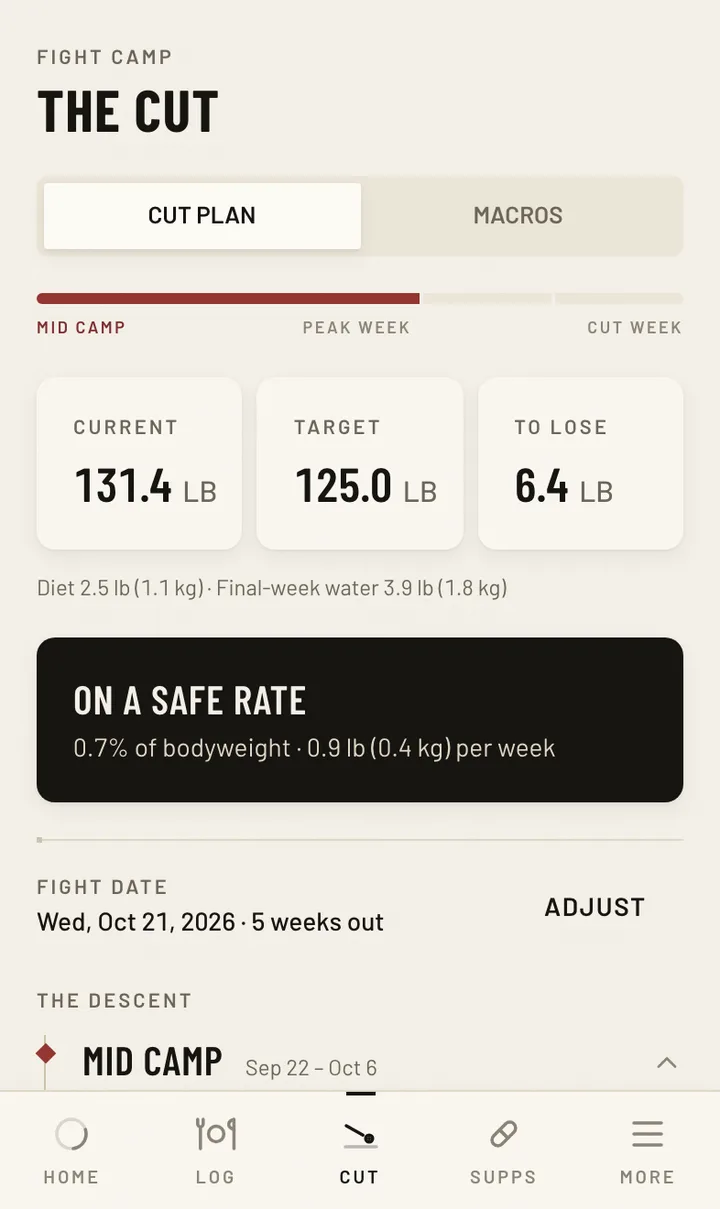
The ordering, as questions:
Trajectory. Where do the last four Sundays sit relative to a 0.5–1 kg per week reference, and is the slope steeper or shallower than it was a fortnight ago? The reference is a consensus figure from a narrative position stand with professional-MMA framing and a supervision assumption; it is not a rule and it is not sex-specific. What her four points can answer is direction. What they cannot answer is whether she will make weight, because the arithmetic of the last week before a weigh-in belongs to a different question and, in her case, to a weigh-in format nobody in this literature segmented by.
Wellness shape. Not Sunday's score. Four weeks of shape, read for the gradual drift the systematic review describes rather than for the acute dips it also describes. Does the series move at all? A flat series through a varying block is a measurement problem.
Instrument check. Has anything visibly changed as a result of what she has reported? If the honest answer is no, the wellness series above is decorative and the review has been reading its own noise. This is the item most likely to be skipped and the one with the clearest evidence behind it.
Attendance. What was planned, what was done, what was cut short. Read before anything derived from it.
Complaints. What hurt, for how long, and what it stopped her doing. Recorded with a date, not recalled at the end.
One decision. Written down, with the thing that would make her revisit it. Not five.
Note what the ordering does not contain: any number computed on her body and any action prescribed from one. There is no threshold in this article at which something happens. The sources describe supervised practice by people with a nutritionist in the room, and converting that into rules for an unsupervised amateur would be inventing the thing the literature most conspicuously lacks. If Mara's descent is not going where it should, the answer in every one of these documents is a qualified person, not a formula.
The camp-phase distinction is also worth holding: the position stand's separate figure that "the ideal maximum walk-around weight should range from 12% to 15% above the athlete's desired weight class" describes the off-camp phase, not this one. Its worked example is a professional male UFC middleweight at 185 lb sitting at 207–212 lb between camps. Applied to a fighter already four weeks into a descent, it answers a question that was settled months ago.
13. Who is actually in the room
Every source underneath this article assumes support staff, and the reader of it usually has none.
Maurício and colleagues followed 31 professional MMA athletes through a structured pre-competition weight-management programme and reported a mean loss of 7.25 kg — 10.6% of initial body weight — in the seven days before weigh-in, with 7.5 kg (11.2%) regained within 30 hours. Twenty-eight men, three women, mean age 28 ± 4 years, data collected 2021 to 2023, no control group, and the results are not disaggregated by sex, so the three women are invisible inside the means. Those athletes had daily meal photograph checks, an evening adherence checklist, weekly contact and supervision on weigh day. It is a description of what a supervised cohort did, not a recommendation and not a model of an unsupported camp.
The single-athlete accounts carry the same shape. Matthews's preprint camp had a sports nutritionist. Bulínová and colleagues' case study — the only female combat athlete in this article's evidence base — followed a 23-year-old professional Muay Thai bantamweight with 48 career bouts and pre-existing hypothalamic secondary amenorrhoea through a 28-day diet phase (−1.6 kg) and a four-day fight week (−2.1 kg), weighing in at 53.7 kg and regaining about 2 kg within four hours. There was no actual bout; the weigh-in was simulated. The authors write that the study "is hampered by its single-subject design" and that "findings cannot be generalized to all female combat sport athletes due to variability among individuals."
That is the honest inventory. It is why this article gives an ordering of questions and no thresholds, and why the most useful thing a weekly review can produce for an unsupported athlete is a written record clear enough that a qualified person could read it quickly if one ever enters the room.
What we could not verify
No source tested review cadence. Weekly versus daily, weekly versus fortnightly, structured versus unstructured — none of it was compared in any study located for this article. The frequently quoted "two to three times a week" is one interviewee's opinion inside a qualitative study of thirty people. The weekly rhythm this article describes is a reasoned position, not a finding.
No study compared camps with a structured weekly review against camps without one. The position stand's monitoring advice is described as advisable. It has not been trialled.
Every rate figure here is effectively a male, professional, nutritionist-supported number. The governing position stand gives no sex-specific guidance. The n = 31 MMA cohort never disaggregates its three women. The one elite camp account is a single man in a preprint. The only female data point is a single case study in an athlete with pre-existing amenorrhoea whose authors state it cannot generalise. Sex differences in body composition and fluid balance are not adjustable with a coefficient, and this article does not offer one.
Adolescents are absent entirely. No source here addresses under-18 combat athletes. Wrestling and judo carry large adolescent populations and none of this evidence speaks to them.
Amateurs are absent. The interview study notes limited discussion of the amateur–professional distinction; the cohort and case studies are professionals with support staff. The most exposed reader of this article is the least studied.
BJJ, judo, wrestling and kickboxing appear in no camp-monitoring source found. Only MMA and Muay Thai appear at all. The monitoring literature (rowing, swimming, football, national-team programmes) and the combat-sport literature do not overlap in any source located here.
Weigh-in format is almost never stated. None of the sources segment by it, and the difference between a same-day weigh-in, a 24-to-36-hour window, a certification system and a random weigh-in is large enough that a figure measured under one describes little under another.
Compliance decay is described qualitatively and never quantified. No source reports a compliance curve across an eight-to-twelve-week camp, so nothing here supports a claim about when a monitoring system typically dies.
Two sources are secondary here. The Akenhead and Nassis survey and the Neupert behaviour-change evaluation were read through search-result summaries rather than obtained in full, and both are flagged as such in the text. A third paper considered for this article — a 2024 Journal of Sports Sciences paper on socio-environmental factors in athlete monitoring — could not be retrieved at all, and nothing from it appears here.
Questions fighters ask
How often should a fight camp be formally reviewed?
Nobody knows, and any article that answers with a number is answering from preference rather than evidence. No study located for this piece compared weekly review against daily, fortnightly or any other cadence, in any sport. The most-quoted figure — two to three times a week — is one interviewee's opinion inside a qualitative study of thirty people in Australian elite programmes, and it was never tested. A weekly rhythm is defensible on two indirect grounds: the overtraining signal that matters accumulates gradually, so it is read across weeks, and daily repetition of the same questions degrades the honesty of the answers. That is a reasoned position. It is not proof.
Is subjective wellness data better than heart-rate variability or blood markers?
More often, yes — but "more often" is doing real work in that sentence. A systematic review of 56 studies found that subjective and objective measures of athlete well-being generally did not correlate, that subjective measures reflected acute and chronic training loads with superior sensitivity and consistency, and that objective measures "were generally unresponsive to acute changes in training load." Within studies, the subjective measures came out ahead in 22 of the 54 that permitted the comparison. Meta-analysis was not possible because of heterogeneity, so there is no pooled effect behind it, and the cohorts are mixed trained and elite athletes in non-combat sports.
What weekly rate of weight loss should a camp be aiming at?
The reference figure in the 2025 ISSN position stand is 0.5 to 1 kg of body mass per week, with the energy deficit based largely on total daily energy needs. Read the conditions before using it: the stand describes this as commonly recommended rather than derived from a trial inside the document, its framing throughout is professional MMA, and it assumes a sports nutrition professional is doing the individualising and the monitoring. It is not sex-specific, has no adolescent version, and no study has tested it against alternatives in combat sport. It is a consensus reference, useful as something a trend can be read against, not a target with a threshold attached.
Do the 6.7%, 5.7% and 4.4% figures add up to a 17% cut?
No, and that misreading is the single most common error made with this sentence. The position stand states that "suitable losses in body mass range from 6.7% at 72 h, 5.7% at 48 h, and 4.4% at 24 h, prior to weigh-in." Those are three answers to one question — how much body mass may be lost in the window that remains — asked at three separate moments. They are not sequential stages and they do not stack. Summing them produces a figure nobody in that document proposed. The figures also come with no sex breakdown, no age breakdown, and a supervision assumption that runs through the whole document.
Why does monitoring stop working after a few weeks?
Because the athlete stops believing anyone reads it. Interviewees in a 2015 qualitative study described both mechanisms directly: repetition produces unvarying answers — "when you're asking the same questions all the time day after day after day, some of them will just keep the same responses and they won't be honest" — and invisibility produces invented ones — "if they think that no-ones looking at it then they'll just give dummy responses." The failure does not show up as missing data, which would be noticeable. It shows up as complete data that is wrong, which looks like compliance.
Is it true that half of athletes lie on their wellness questionnaires?
No, and the figure needs its denominator every time it is used. In one qualitative study of thirty people across twenty Australian elite programmes, eight of whom were athletes, four of those eight admitted withholding the truth on occasions — from fear of appearing unprofessional or of punishment. Four of eight interviewed athletes is a real observation about a real mechanism. It is not a prevalence estimate for athletes generally, and rendering it as a percentage gives it an authority the study cannot support.
What is the single most important thing to change if a monitoring system is failing?
Make the response visible. The best-supported sentence in this whole literature is Halson's: "The ability and opportunity to implement change and provide feedback is critical to a successful monitoring system, and, if this does not occur, many attempts at monitoring are not sustainable." The corollary from the interview evidence is that coach reinforcement is the linchpin — "if it doesn't have a reinforcement from the coaches [compliance] tends to fall away" — and that coercion backfires, reducing the athlete's sense of autonomy and potentially damaging the athlete–coach relationship as well as the data.
Should a readiness score or recovery percentage drive training decisions?
Treat any single figure that arrives already interpreted with suspicion, and ask what would have to change in its inputs for the number to move. The cautionary case is the acute:chronic workload ratio, for years the most widely adopted composite in team sport, which Impellizzeri and colleagues assessed in 2020 with the conclusion that "there is no evidence supporting the use of ACWR in training-load-management systems or for training recommendations aimed at reducing injury risk," adding that its statistical properties make it an inaccurate metric and that "it adds noise and creates statistical artifacts." That analysis addressed team-sport injury risk; no combat sport appears in that literature at all.
Does a weekly review beat a daily check-in?
Nobody has run that comparison, so the honest answer is that it is unknown. The two findings that point toward a weekly rhythm are indirect: the chronic signal the review is looking for accumulates gradually, which makes it a shape rather than a score, and daily repetition of the same questions produces unvarying and less honest responses. Neither of those is a head-to-head test. Surveys cited inside a 2014 review found programmes monitoring daily 55% of the time, multiple times weekly 24% and weekly 18% — but that describes what programmes did in non-combat settings, and describing practice is not evaluating it.
What does a weekly review actually produce?
One decision, written down, with the thing that would cause it to be revisited. That framing comes from the failure mode rather than from a trial: a review that produces a chart produces nothing the athlete can see, and the interview evidence is that invisible use is what degrades the input. An opinion piece in a 2026 sports-science journal makes the same argument from the analytics side, observing that metrics "describe what occurred, but do not automatically clarify what coaches should do next" and favouring brief decision notes over lengthy reports — an argument rather than evidence, and labelled that way here.
In what order should things be looked at?
Slowest-moving first, noisiest last, is the ordering this article argues for — trajectory across several weeks, then the shape of the wellness series, then a check on whether the instrument itself is still honest, then what training was actually completed against what was planned, then complaints and injuries, then one decision. No source prescribes this order; it is reasoned from what each measure can support. The load-bearing item is the instrument check, because if nothing visibly changes in response to what the athlete reports, everything above it in the list is degraded data.
Is any of this validated in BJJ, judo, wrestling or kickboxing?
No. Those four sports appear in no camp-monitoring source located for this article. The monitoring evidence comes from rowing, swimming, football and national-team programmes; the combat-sport weight-management evidence comes from MMA and Muay Thai. The two literatures do not overlap in any source found here, which means every monitoring recommendation a grappler or a kickboxer reads has been borrowed sideways from another sport — a fact worth knowing before weighting it heavily.
Does this evidence apply to female fighters?
Not in any direct sense, and the gap is severe enough to state rather than soften. The governing position stand offers no sex-specific guidance. The 31-athlete MMA cohort contained three women whose results are never separated from twenty-eight men's. The one female-specific account is a single case study of a professional Muay Thai athlete with pre-existing hypothalamic secondary amenorrhoea, whose authors write that findings "cannot be generalized to all female combat sport athletes." Body composition, total body water as a fraction of mass and cycle effects on fluid balance all differ, and none of them is adjustable by scaling a male number.
Does this apply to a 16-year-old wrestler or judoka?
No. No source in this article addresses under-18 combat athletes at all, in either the monitoring literature or the weight-management literature. Adult figures do not scale downward to a growing athlete, and the sports with the largest adolescent participation — wrestling and judo — are the ones with the least applicable evidence here. Anything involving a minor's body mass belongs with a physician and, where one exists, the governing body's own certification process, not with an article.
Can this article be used to plan a weight cut?
No, and it is structured to make that refusal explicit. It reports what published guidance states, with citations that can be opened and checked, and it names the places where the guidance is consensus rather than measurement. It contains no thresholds, no per-kilogram targets and no actions, because every source underneath it describes supervised practice by professionals with a nutritionist and a physician attached. It does not know your division, your weigh-in format, your body composition, your training load or your medical history, and each of those changes everything. Nothing here overrides a physician or a commission.
Sources
Sourced to
- International society of sports nutrition position stand: nutrition and weight cut strategies for mixed martial arts and other combat sports — Ricci AA, Evans C, Stull C, et al., Journal of the International Society of Sports Nutrition, 9 March 2025;22(1):2467909. DOI 10.1080/15502783.2025.2467909, PMID 40059405
- Monitoring the athlete training response: subjective self-reported measures trump commonly used objective measures: a systematic review — Saw AE, Main LC, Gastin PB, British Journal of Sports Medicine, March 2016;50(5):281–291. DOI 10.1136/bjsports-2015-094758, PMID 26423706
- Monitoring athletes through self-report: factors influencing implementation — Saw AE, Main LC, Gastin PB, Journal of Sports Science and Medicine, March 2015;14(1):137–146. PMID 25729301
- Monitoring training load to understand fatigue in athletes — Halson SL, Sports Medicine, November 2014;44(Suppl 2):S139–S147. DOI 10.1007/s40279-014-0253-z, PMID 25200666
- Acute:Chronic Workload Ratio: Conceptual Issues and Fundamental Pitfalls — Impellizzeri FM, Woodcock S, Coutts AJ, Fanchini M, McCall A, Vigotsky AD, International Journal of Sports Physiology and Performance, 2020;15(6):907–913. DOI 10.1123/ijspp.2019-0864, PMID 32502972
- An alternative structured weight management protocol to rapid weight loss in mixed martial arts: a prospective interventional study of pre-competition weight management strategies in professional athletes — Maurício CA et al., Frontiers in Nutrition, 2025;12:1581698. DOI 10.3389/fnut.2025.1581698
- Weight cycling and relative energy deficiency in sport syndrome in an elite female muaythai athlete: a case study — Bulínová V, Wagner A, Kumstát M, Frontiers in Sports and Active Living, 15 May 2025;7:1599131. DOI 10.3389/fspor.2025.1599131
- Combat Sport Nutrition: A Pragmatic Case Study in an Elite Mixed Martial Arts Athlete — Matthews JJ, SportRxiv, 2020. DOI 10.31236/osf.io/bgnst. **Preprint — not peer-reviewed**
- The analytics–practice gap: why sports data fails to translate into coaching decisions — Kwon JW, Frontiers in Sports and Active Living, 2026;8:1866960. DOI 10.3389/fspor.2026.1866960. Opinion/conceptual piece, no data
- Training load and player monitoring in high-level football: current practice and perceptions — Akenhead R, Nassis GP, International Journal of Sports Physiology and Performance, July 2016;11(5):587–593. DOI 10.1123/ijspp.2015-0331, PMID 26456711
- Evaluating a behaviour change intervention to enhance athlete monitoring system engagement: insights from elite sport — Neupert EC, Holder T, Jobson SA, International Journal of Sports Science & Coaching, 2025. DOI 10.1177/17479541251338804
Read next
Plan the descent, don't guess it
Fighter Cut builds a week-by-week plan from today to your weigh-in, classifies the rate you are actually losing at, and logs what you eat against it. It does not make a cut safe — nothing does. It makes the numbers visible early enough to change them.
Open Fighter Cut