Fighter Cut › Articles › Supplements & nutrition
Supplements & nutrition
Eating around two sessions a day and a job
Most of the timing rules a fighter gets told do not survive being chased to their source. What survives is narrower than the rules, and none of it was measured on someone in a deficit with work in between.
Two sessions a day and a job between them is the most common training week in combat sports, and it is the one nobody has studied.
That sentence is not a rhetorical opening. It is the finding. Across every source consulted for this article — two position stands, three meta-analyses, a systematic review of 23 studies of combat athletes, and a dozen controlled trials — not one measured meal timing, adherence, or outcomes in a fighter training around employment. The literature that gets quoted at amateurs was collected in university labs, mostly on young men, mostly in resistance training, and almost entirely in people eating enough. The reader of this article is usually none of those things.
So this piece does two jobs. The first is demolition: the 30-minute anabolic window and "eat every three hours" are the two rules most often handed to a fighter, and both fall apart when you follow them to their primary sources. The second is what remains standing afterwards, which is a smaller and more honest set of statements than the rules were.
Every figure in this piece was measured in a described group of people under described conditions. None of it is a plan for your body, and a fight camp is the wrong time to experiment on yourself without a sports dietitian or a physician who can see you.
There is no study establishing a 30-minute post-exercise protein window. The meta-regression that tested timing found no effect on strength or hypertrophy once covariates were controlled, across 478 and 525 subjects
Schoenfeld, Aragon & Krieger, J Int Soc Sports Nutr 2013;10:53, PMID 24299050
The condition the ISSN combat stand attaches to its rapid-refuelling advice: carbohydrate 0.6–1.0 g/kg within 30 min, then every 2 h for 4–6 h, for fight-camp athletes training up to three times a day
Ricci et al., ISSN combat position stand, J Int Soc Sports Nutr 2025;22(1):2467909
What the same stand's practical-applications box says protein intake "should be" during a longitudinal weight descent — above its own stated floor of 1.2–2.0 g/kg
Ricci et al., ISSN combat position stand, 2025
The size and length of the only energy-deficit trial in this article's evidence base. Five days at a reduced intake lowered resting muscle protein synthesis by 27%; resistance exercise restored it
Areta et al., Am J Physiol Endocrinol Metab 2014;306(8):E989–97, PMID 24595305
- The 30-minute anabolic window has no primary study behind it. The paper usually invoked, Ivy 1988, is about carbohydrate and muscle glycogen in 12 trained male cyclists, and it compared immediate feeding against a two-hour delay — not 30 minutes against 45. The protein-timing trial most often cited alongside it, Tipton 2001, had six subjects and found pre-exercise feeding superior to post-exercise feeding.
- Total daily protein, not its timing, is what predicted muscle gain once the confounders were controlled. A pooled analysis without covariate control showed a small-to-moderate timing effect; it disappeared in the full model. That is the precise mechanism by which the myth stays alive — the unadjusted number gets quoted and the adjusted one does not.
- "Eat every three hours" is a protein-distribution finding, not a clock. It traces to a single acute study: 24 trained men, eight per group, 80 g of whey over a 12-hour recovery, in energy balance. It has never been tested for adherence, fat loss, performance, or in anyone in a deficit.
- Almost all of this was measured in fed people in energy balance. The reader of this article is not in energy balance, and that changes which findings survive. Only two sources here are deficit-specific.
- The ISSN combat stand's refuelling advice has a condition on it: it is written for sessions less than six hours apart. A 6am session and a 7pm session are about 13 hours apart, which is outside the situation that literature describes.
- The stand gives four different protein figures in four places. A floor of 1.2–2.0 g/kg/day, a narrative recommendation of 1.2–2.2, a practical-applications instruction of 1.6–2.2 during a descent, and a general-preparation range of 1.2–2.4 with roughly 2 as a target. The floor is the number not to go under, not the number to aim at.
- Nobody has studied a fighter training at six in the morning and seven at night around a working day. No source measures meal timing in combat athletes by employment status at all, and women appear in four of the 22 sources behind this article.
- Across 23 studies, most combat athletes were already eating below energy and carbohydrate recommendations, and intake fell further before competition at the expense of lean mass. The timing question is downstream of a bigger one.
1. The rule you were given, and where it is not
Ask ten fighters what happens if they miss the post-training shake and most will describe something that sounds like spoilage — a window that closes, work that is lost, a session that does not count. The phrasing varies. The structure does not: there is a short interval after training in which protein must arrive, and outside it the training was worth less.
Aragon and Schoenfeld went looking for the evidence behind that structure in a 2013 review and opened with the conclusion: "Despite claims that immediate post-exercise nutritional intake is essential to maximize hypertrophic gains, evidence-based support for such an 'anabolic window of opportunity' is far from definitive."
That is a narrative review, so it is an argument rather than a measurement. The measurement came in the same year. Schoenfeld, Aragon and Krieger ran a meta-analysis and then a meta-regression on protein timing: 478 subjects across 20 studies for strength, 525 subjects across 23 studies for hypertrophy. Pooled without covariate control, timing showed a small-to-moderate effect on hypertrophy. Once the covariates were controlled, the effect was not significant, and the strongest predictor of hypertrophy effect size turned out to be total protein intake.
Their own summary is blunt: "These results refute the commonly held belief that the timing of protein intake in and around a training session is critical to muscular adaptations and indicate that consuming adequate protein in combination with resistance exercise is the key factor for maximizing muscle protein accretion."
Two conditions travel with that. The trials pooled were randomised trials in exercising adults, predominantly in energy balance, and predominantly using resistance training. Nobody in that pool was cutting weight for a fight. But the direction of the finding matters more than its transfer: the effect that was supposed to exist did not survive adjustment, and the thing that did survive was how much protein someone ate in a day.
2. Where the thirty minutes actually came from
Chase the number rather than the claim and it lands in 1988, in a paper about carbohydrate.
Ivy and colleagues had 12 trained male cyclists complete 70 minutes of cycling at 68% of VO₂max with six two-minute intervals at 88% — a protocol designed to empty muscle glycogen. Then they gave a 2 g/kg carbohydrate bolus either immediately or two hours later, and took muscle biopsies. In the first two hours, glycogen storage ran at 7.7 µmol per gram wet weight per hour in the immediate group against 2.5 in the delayed group. In the second two hours the rates converged, 4.3 against 4.1.
That study is real, well-designed, and about something else. It is carbohydrate, not protein. It is glycogen resynthesis, not muscle protein synthesis or hypertrophy. It is 12 trained male cyclists in energy balance, not a fighter in a descent. And the comparison is immediate against two hours, which cannot support a claim about the difference between 30 and 45 minutes.
One figure from it circulates in a distorted form and is worth correcting explicitly. You will read that delayed feeding leaves glycogen storage "45% lower at four hours." What the paper shows is that the delayed group's second-two-hour rate of 4.1 was about 45% slower than the immediate group's first-two-hour rate of 7.7. That is a comparison across two different time blocks, not a 45% deficit measured at the four-hour mark. Anyone quoting it as the latter has not read the design.
The other ancestor of the window is Tipton 2001, an acute study of amino-acid and carbohydrate timing around resistance exercise. Net phenylalanine uptake was 209 ± 42 mg when the drink was taken before exercise and 81 ± 19 mg when it was taken afterwards, p = 0.0002. Six subjects. The study most often waved at the post-exercise window found the pre-exercise condition superior.
Aragon and Schoenfeld make the mechanical point that follows: a pre-session meal "can conceivably function as both a pre- and an immediate post-exercise meal, since the time course of its digestion/absorption can persist well into the recovery period." Amino acids from something eaten before training are still arriving during recovery. There is no clean boundary for a window to close at.
3. The one 30-minute figure that is real, and what it is about
The combat position stand does contain a 30-minute number, which is exactly why this gets muddled. It reads:
Due to the multiple training sessions scheduled during fight camp, rapid refueling strategies may be adopted for sessions less than 6 h apart. The ISSN recommends a carbohydrate intake of 0.6 to 1.0 g/kg of body mass within the first 30 min after exercise, followed by carbohydrate intake every 2 h for the next 4 to 6 h to promote maximal glycogen replenishment.
Read the conditions rather than the number. It is carbohydrate. It is glycogen replenishment. It applies to sessions less than six hours apart. It is written for fight-camp athletes training up to three times a day, and it is a repletion statement, not a fat-loss or muscle-retention statement.
That is a different claim from the anabolic window in every respect except the digits, and the two should never be merged. A fighter who hears "30 minutes" and reaches for a protein shake has taken a carbohydrate recommendation for athletes in a compressed multi-session day and applied it as a protein rule.
It is also reported here as what the stand says, with its condition attached, and not as a clock to run. Converting it into grams for a particular body mass turns a threshold written for a specific camp phase into a meal, which is the single most common way this document gets misused.
4. Almost none of this evidence is in a deficit
This is the fact that reorganises everything else on the page.
Of the studies behind the timing and distribution advice a fighter receives, the overwhelming majority were run in energy balance. The every-three-hours trial: energy balance. The even-versus- skewed distribution trial: explicitly isoenergetic. The per-dose ceiling studies: fed young men. The pre-sleep protein work: energy balance, with the supplement adding calories the placebo did not. The evening-meal-and-sleep study: energy balance, in adolescents. The nutrient-timing position stand assumes healthy exercising adults in balance throughout.
Two sources here are deficit-specific. Areta and colleagues put eight men and seven women on five days at a reduced intake and measured muscle protein synthesis: resting, postabsorptive MPS fell by 27% against the energy-balance condition, p < 0.001. A bout of resistance exercise restored it to the resting values seen in energy balance, and adding 15 g or 30 g of whey afterwards raised it roughly 16% and 34% above that. Five days is not a camp, and the exercise was resistance exercise, not sparring or rolling — but it is the only hard number here about what a deficit does to the fasted state.
The other is Helms and colleagues' systematic review of protein during caloric restriction in resistance-trained lean athletes: six studies, 13 groups, males at or below 23% body fat and females at or below 35%. Their conclusion is that protein needs in that population "are likely 2.3-3.1g/kg of FFM scaled upwards with severity of caloric restriction and leanness."
Note the denominator there. Fat-free mass, not body mass. Those two get conflated constantly, and the conflation inflates the number for anyone who is not extremely lean.
The practical consequence of the balance-versus-deficit gap is this: the findings about when to eat were established in people who were eating enough, and a deficit changes the resting baseline those findings were measured against. Treat the timing literature as describing a fed athlete, because that is who was in the chair.
5. "Eat every three hours" is a finding, not a clock
The distribution advice has a cleaner evidential story than the window, and it still does not support the instruction it has become.
Areta and colleagues gave 24 healthy trained men 80 g of whey over a 12-hour recovery from resistance exercise, eight per group, in three patterns: 8 × 10 g every 1.5 hours, 4 × 20 g every 3 hours, or 2 × 40 g every 6 hours. All three raised myofibrillar protein synthesis 88–148% above rest. The four-doses-every-three-hours pattern produced rates 31–48% greater than the other two, p < 0.02. Their conclusion: "20 g of whey protein consumed every 3 h was superior to either PULSE or BOLUS feeding patterns for stimulating MPS throughout the day."
Twenty-four trained men. Eight per group. One acute 12-hour measurement after a single resistance bout. Energy balance. No women, no fighters, and no outcome beyond a synthesis rate.
Mamerow and colleagues point the same way in a different population: eight healthy adult men and women, mean age 36.9, not athletes, on an isoenergetic diet, compared an even protein distribution across three meals against one skewed toward dinner. Twenty-four-hour mixed muscle fractional synthetic rate was about 25% higher on the even pattern, 0.075 ± 0.006 against 0.056 ± 0.006 %/h, p = 0.003, and it held after seven days of habituation.
Both of those are worth knowing. Neither is a rule. The ISSN protein and nutrient-timing stands codify them as 20–40 g, or 0.25–0.40 g/kg per dose, every three to four hours as the pattern that "appears to most favorably affect MPS rates when compared to other dietary patterns" — which is a statement about synthesis rates in exercising adults, not an adherence instruction and not a schedule.
And set it against the meta-regression from section one, which found total daily protein rather than its timing predicted hypertrophy across 525 subjects. Spreading protein across the day is a reasonable default that costs nothing. It is not the variable with the strongest evidence behind it, and a fighter who hits the day's total in three meals instead of four has not made an error.
6. Per meal: twenty grams, forty grams, and an unresolved disagreement
There is a live disagreement inside this literature that most summaries flatten.
Moore and colleagues gave six healthy young men 0, 5, 10, 20 or 40 g of whole egg protein after leg resistance exercise and measured over four hours. Muscle protein synthesis plateaued at 20 g; intakes above that increased irreversible leucine oxidation. That is where "20 g is the ceiling" comes from — a dose-response in six men after a single-limb protocol.
Macnaughton and colleagues then ran 30 resistance-trained men through whole-body resistance exercise and compared 20 g against 40 g of whey. Forty grams produced greater MPS: 0.059 ± 0.020 against 0.049 ± 0.020 %/h, p = 0.005. They had deliberately split the cohort into 15 men with lower lean body mass and 15 with higher, expecting size to drive the response, and it did not — total lean body mass did not change the result.
A combat session is whole-body. That is an argument for the second study being the more relevant one, and it is an argument rather than a finding, because nobody has run either protocol after sparring or rolling. Both cohorts are young men. Neither was in a deficit.
The honest reading is that the per-dose ceiling is lower than people think when the training is local and higher than people think when the training is general, and that the difference between the two conditions has been measured exactly once each.
7. The stand's four protein numbers, and the one nobody quotes
If you want one number from this article, this is where it lives — and the position stand gives four of them.
Position Statement 6, the numbered list, is the floor: "Macronutrients should not drop below the following: carbohydrates 3.0–4.0 g/kg, protein 1.2–2.0 g/kg, and fat 0.5 to 1.0 g/kg/day." The fight-camp narrative says a protein intake of 1.2–2.2 g/kg/d is advised to preserve lean tissue and aid recovery during the energy deficit. The practical-applications box says protein intake during weight descent should be 1.6–2.2 g/kg/d. And for general preparation, the stand puts combat athletes' requirements at 1.2–2.4 g/kg, with amounts closer to 2 g/kg considered a target, or equivalently 15–30% of total calories.
The ISSN's combat-sports stand sets a protein floor of 1.2–2.0 g/kg/day that intake should not drop below during a descent, while its own descent guidance is 1.6–2.2 g/kg/day and its general-preparation range is 1.2–2.4 g/kg with about 2 g/kg as the target. The floor is the number not to go under, not the number to aim at.
That distinction matters because of what sits opposite it. The ISSN protein stand says 2.3–3.1 g/kg/day may be needed to maximise lean-mass retention in resistance-trained subjects during hypocaloric periods, and Helms puts the figure at 2.3–3.1 g/kg of fat-free mass for energy-restricted resistance-trained athletes. Quote the combat stand's floor alone and those two bodies of guidance look irreconcilable. Quote its descent figure of 1.6–2.2 and the gap is real but considerably narrower.
It does not close, and it should not be averaged. The two literatures describe different populations — combat athletes in a camp phase on one side, lean resistance-trained adults in caloric restriction on the other — and they use different denominators, one body mass and one fat-free mass. Record it as unresolved. A dietitian who can see the athlete is the person to resolve it for a particular body, which is what the stand itself assumes is happening. The narrower question of what protein does and does not protect during a descent is worked through in protein during a weight cut.
8. The six o'clock session, fed or fasted
Here is where the guidance runs out in a way worth naming.
The combat stand says: "It is recommended athletes consume a meal two to 3 h prior to their first training session." For a 6am start that means eating at three in the morning, and the stand does not say what to do when that is not possible. Confirmed by reading the full document: it says nothing at all about training fasted. That is a genuine gap in the guidance, not an omission to paper over with inference.
What has been measured, in other populations:
Aird, Davies and Carson pooled 46 studies on fasted versus fed exercise. Pre-exercise feeding improved prolonged aerobic performance, p = .012, and did not improve shorter-duration aerobic performance, p = .687. Fasted exercise raised post-exercise circulating free fatty acids, p = .023, and pre-exercise feeding blunted some skeletal-muscle and adipose signalling implicated in mitochondrial adaptation. Their own caution is that "further research is required to fully elucidate the acute and chronic physiological adaptations to fasted vs fed exercise." No combat session appears anywhere in that pool, and nothing in it addresses skill work, sparring or grappling.
On body composition, Schoenfeld and colleagues ran 20 healthy young women through four weeks of one-hour steady-state aerobic work three times a week on customised hypocaloric plans, with a meal-replacement shake given either before or after. Both groups lost weight, p = 0.0005, and fat mass, p = 0.02. There was no significant between-group difference in any outcome. Their conclusion: body composition changes "are similar regardless whether or not an individual is fasted prior to training." Four weeks, 20 subjects, aerobic exercise, not fighters — and the only female-only trial in this article.
One argument does point toward eating around a morning session, and it is worth stating precisely because it is not the usual one. Aragon and Schoenfeld say prompt post-exercise protein "seems warranted" mainly when training begins more than about three to four hours after the preceding meal. An overnight-fasted athlete is by definition in that state. Add the deficit finding — postabsorptive MPS down 27% after five days of reduced intake, restored by the exercise itself — and the case is for feeding somewhere around the session, in either direction, rather than for a particular side of it.
Which leaves the honest statement: for a fighter, training the 6am session fed or fasted is a tolerance-and-preference question with no combat-sport evidence on either side. It is not a performance emergency, and it is not a fat-loss lever either.
9. Before the evening session, and the stomach
The single most directly applicable sentence in the combat literature for a fighter about to train in the evening is about the gut rather than about fuel. The stand's acute pre-session guidance, at roughly 60 minutes out, is to consume "high glycemic, carbohydrates (1–4 g/kg) while limiting fat and fiber intake to minimizing gastrointestinal distress during exercise."
Notice the width of that carbohydrate band — one to four grams per kilogram is a fourfold range — and notice that the sentence's stated purpose is minimising GI distress, not improving performance. Read as what it is, it is a tolerance instruction with a very wide fuel range attached.
On how common the problem is, the best available figure is from a review of gastrointestinal complaints during exercise: "Generally, studies suggest that 30-50% of athletes experience such complaints." The condition on that number is large. The literature it summarises is overwhelmingly endurance athletes — the authors say so — and there is no combat-sport incidence figure in it at all. Nobody has measured how a full stomach behaves under a body lock, a clinch, or twenty minutes of guard passing.
The mechanism the review considers most likely is reduced mesenteric blood flow during intense exercise, worse when the athlete is hypohydrated. Most symptoms are mild; the review also notes that haemorrhagic gastritis, haematochezia and ischaemic bowel can present serious medical challenges, which is a sentence to take to a physician rather than to a supplement shelf.
And on the fixes that circulate — multiple transportable carbohydrates, nitric-oxide-stimulating nutrients — the same authors are explicit that "at this stage, evidence for beneficial effects of such interventions is lacking." They are candidates, not solutions. What that means for a fighter whose gut stops cooperating in camp is covered in gut problems in fight camp.
10. After the late session, and the question about eating late
Finishing at half past eight and eating afterwards is the situation most amateur fighters are actually in, and it is the one they most often apologise for.
The closest cohort in the literature: Res and colleagues had 16 healthy young men train at 8pm, gave them recovery nutrition at 9pm, and then 40 g of casein or a placebo at 11:30pm. Whole-body protein synthesis over the following 7.5 hours was higher with the casein, 311 ± 8 against 246 ± 9 µmol/kg, and net protein balance went from −11 ± 6 to +61 ± 5. Mixed muscle fractional synthetic rate was about 22% higher — at p = 0.05, which is borderline and should be read as such. Sixteen men, in energy balance, with their diets standardised. The evening-session timing maps onto a 7pm training slot well. The energy status does not map onto a descent at all.
Snijders and colleagues ran the chronic version: 44 young men, 12 weeks of progressive resistance training, a pre-sleep supplement of 27.5 g protein and 15 g carbohydrate against a non-caloric placebo. The supplement group gained more in 1RM, +164 ± 11 against +130 ± 9 kg, p < 0.001, and more quadriceps cross-sectional area, +8.4 ± 1.1 against +4.8 ± 0.8 cm², p < 0.05. Read the design before the result: the supplement added roughly 170 kcal and 27.5 g of protein that the placebo did not. The groups differed in total daily energy and protein, not only in timing. That is not a timing trial.
Then there is the sleep question, and it points the opposite way to the folk advice. Lehmann and colleagues put 12 adolescent male rugby players, 15.8 ± 0.7 years old, through five days each of dinner 1.5 hours before bed and dinner 3.5 hours before bed, with polysomnography and with diet and activity held constant. The earlier-to-bed meal — the later dinner — produced 24 more minutes of total sleep, p = .001, 4.8% higher sleep efficiency, p = .001, 25 fewer minutes awake after sleep onset, p = .014, 25% fewer microarousals and 30% fewer awakenings of 90 seconds or more.
Twelve adolescent boys, rugby not combat, in energy balance. Observational data on late eating point the other way. That is an unresolved question, and it is reported here as unresolved rather than as permission. What can be said is narrower: there is no evidence in these sources that a fighter who trains until 8:30pm and eats afterwards has made a mistake, and the assumption that they have is not coming from this literature. Sleep is the outcome that most reliably suffers in a camp, and sleep and recovery in fight camp takes that up properly.
11. Thirteen hours is not the problem the refuelling literature describes
Here is the structural point about the two-a-day-plus-job week, and it is the most useful thing in the article after the demolition.
The refuelling guidance a fighter finds — the combat stand's 0.6–1.0 g/kg carbohydrate within 30 minutes then every two hours for four to six hours, and the nutrient-timing stand's more aggressive advice for recoveries under four hours — is written for compressed days. Sessions less than six hours apart. Athletes training up to three times daily in camp, where the next session arrives before glycogen has had time to come back on its own.
A 6am session and a 7pm session are roughly 13 hours apart. That is more than twice the window those recommendations were written for. The urgency the 1988 cycling study describes — 7.7 against 2.5 µmol per gram wet weight per hour in trained male cyclists after a glycogen-depleting protocol — is not the constraint in a 13-hour gap. There is a whole working day of eating opportunities in between.
What is the constraint is the working day itself: when food can be eaten, what can be carried, and whether the day's total gets hit at all. Which points at the thing the timing literature cannot help with. On the carbohydrate side, note also that the nutrient-timing stand's premise for maximal glycogen is a daily intake of 8–12 g/kg in trained adults in energy balance. A fighter in a descent is usually far below that, and the combat stand's own descent floor for carbohydrate is 3.0–4.0 g/kg. The refuelling advice was written on top of an intake most readers of this article are nowhere near.
12. A scenario, not a schedule
This is one scenario, not a schedule. No study has tested a fighter training at 6am and 7pm around a working day, so what follows is what the evidence about each separate piece would and would not say about one hypothetical day. The clock times are a worked example. They are not targets, and nothing breaks if yours look nothing like them.
The athlete is invented: an amateur flyweight, four weeks out, desk job, sessions at 6am and 7pm, in a deficit.
The morning. The stand's two-to-three-hours-before-the-first-session guidance would put a meal at 3am, and the stand does not address what to do instead. There is no combat-sport evidence on either side of fasted morning training, and the only hypocaloric trial on the question — 20 women, four weeks, aerobic — found no between-group difference in any outcome. Fed or fasted here is a preference and tolerance decision, and it is not worth agonising over.
The gap. Roughly 13 hours, which is outside the under-six-hours condition on the rapid-refuelling advice entirely. The compressed-recovery numbers are not describing this day.
The working day. The distribution evidence — 24 trained men in energy balance, and eight non-athletes on an isoenergetic diet — would favour spreading protein across meals rather than skewing it to the evening. It costs nothing and the evidence for it is acute and in fed people. The variable with stronger evidence behind it is the daily total, and in a deficit that total is a contested number: the combat stand's descent figure of 1.6–2.2 g/kg/day against 2.3–3.1 g/kg of fat-free mass from the restriction literature.
Before the evening session. The most applicable sentence in the combat literature is the one about limiting fat and fibre roughly an hour out, and its stated reason is GI tolerance rather than performance. Thirty to fifty percent of athletes report GI complaints, in a literature that is almost entirely endurance sport, and nobody has measured what a full stomach does under a body lock.
Afterwards. The evening-session protein work is 16 men in energy balance with a borderline muscle result, and the sleep work pointing against eating late is 12 adolescent rugby players pointing the other way. Nothing here says eating after a late session is an error.
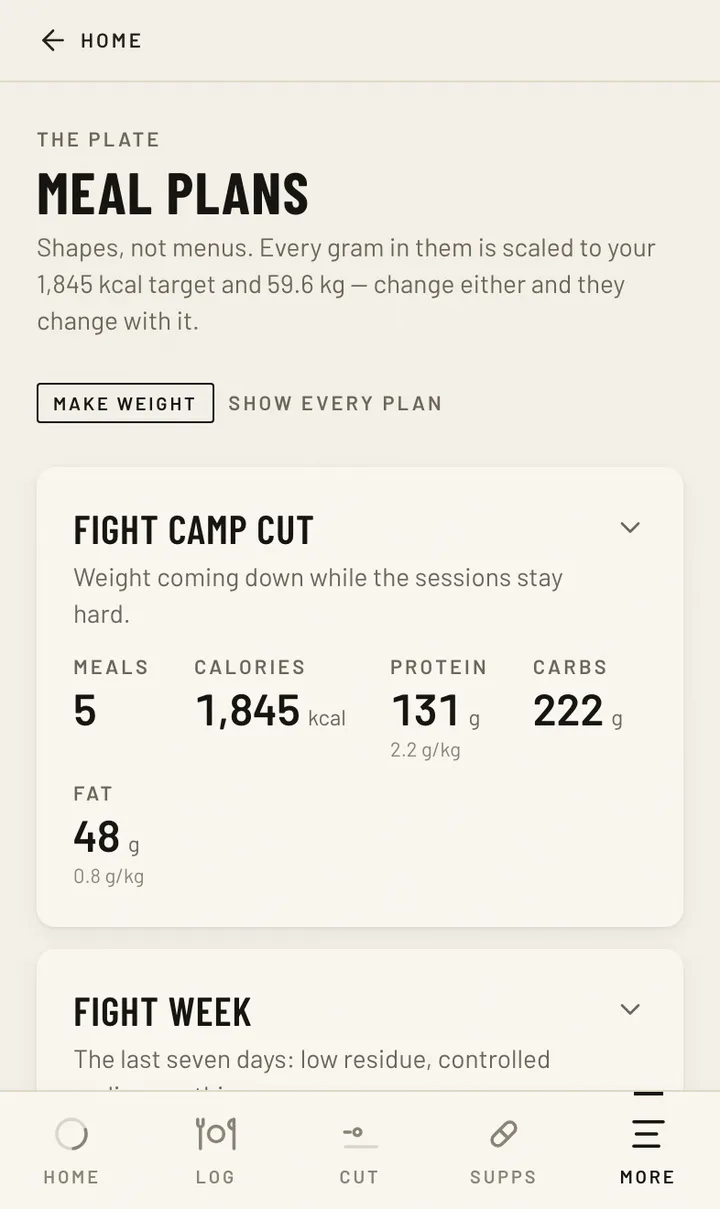
The only reason to log a day like that at all is the daily total, which is the variable the meta-regression actually found. The clock beside each entry is descriptive. Whether a log of it is accurate enough to act on is its own problem, taken up in food logging accuracy in fight camp.
13. What fighters are actually eating
End here, because it reframes the whole question.
Herrero Barceló and colleagues reviewed 23 studies of boxing, karate, kickboxing, jiu-jitsu, taekwondo, judo, muay thai and MMA athletes, amateur through professional, men and women, using PRISMA and formal risk-of-bias assessment. Most of those athletes had energy and carbohydrate intakes below official recommendations, despite normal BMI and adequate muscle mass. Energy and nutrient intake decreased further during pre-competition periods as a rapid-weight-loss strategy, which the authors say "mainly occurred at the expense of lean mass."
Their conclusion: "Despite maintaining adequate body composition, combat sports athletes reported an inadequate dietary pattern, especially during pre-competitive periods, which may negatively affect athletic performance."
For a reader in a deficit, that puts the timing question in its place. A fighter eating below their energy and carbohydrate needs does not have a timing problem that timing can fix. Rearranging an inadequate intake across the clock produces a differently arranged inadequate intake.
The position stand is candid about why so little of this is combat-specific: "While there is ample research available on optimal dietary practices for athletes in various sports, there is a noticeable lack of data specifically tailored to combat sports." Its authors selected relevant articles "regardless of any methodological limitations," which is a reasonable choice for a field this thin and a reason to hold every figure in it loosely. The wider nutrition material here is written on the same footing.
What we could not verify
Nothing anywhere measures combat athletes with jobs. This is the reader's actual situation and it is absent from the entire evidence base. No source found measures meal timing, eating frequency, adherence or outcomes in combat athletes stratified by employment status, shift work, or full-time versus amateur status. The combat position stand assumes a fight camp with up to three sessions daily and no employment constraint anywhere in it. The 23-study systematic review reports what fighters eat, not when, and not by level of professionalism.
Women appear in four of the 22 sources behind this article. Absent entirely from the cycling study (12 men), the distribution study (24 men), both dose-response studies (six and 30 men), both pre-sleep studies (16 and 44 men) and the sleep study (12 boys), and 96% absent from the glycogen meta-analysis. Present in the distribution study of non-athletes (eight, mixed), the five-day deficit study (seven women), the four-week hypocaloric trial (20 women, the only female-only trial here) and the combat systematic review. The combat position stand mentions sex once, in a karate match-analysis aside about oxidative contribution. There is no sex-specific nutrient-timing recommendation in it. These are population limits to state, not multipliers to apply.
Adolescents appear in one source — the 12 rugby players, on evening meal timing and sleep. Everything about protein dose, distribution and fasted training here is adult work. Adolescent fighters in a deficit are not represented at all.
The "45% lower at four hours" figure is refused as usually written. It is a comparison between two different time blocks in the 1988 cycling study, not a deficit measured at four hours. The version that circulates misstates the design.
A widely repeated GI symptom breakdown could not be traced. The specific percentage split of stomach pain, intestinal discomfort, side stitch, urge to defecate and bloating that appears in many summaries, and a "30–90% of distance runners" range, did not resolve to a primary source. Neither is printed here. Only the 30–50% figure, with its endurance-athlete condition, is.
A figure for eating occasions per day in BJJ athletes is not reported here as a finding. It comes from a conference abstract that never states its sample size and whose authors describe it as limited preliminary data. That is not a measurement anyone should plan around.
No combat-sport gastrointestinal incidence exists. Nothing measures GI distress during grappling, clinch work or body contact on a full stomach. The available literature is endurance-dominated.
Every dose-response and distribution study used resistance exercise, and the glycogen work used cycling. Nothing measured muscle protein synthesis or glycogen after sparring, rolling or pad work.
Acute surrogates are not outcomes. Most of the distribution and dose evidence measures synthesis rates over hours. The two chronic-outcome sources are the 12-week training study, which is confounded by the extra calories in its supplement, and the meta-analysis, whose result is the null one. A synthesis difference is not a performance or body-composition difference.
The protein disagreement is unresolved and is recorded as such. The combat stand's descent guidance of 1.6–2.2 g/kg/day of body mass and the restriction literature's 2.3–3.1 g/kg of fat-free mass are not two estimates of one quantity to be averaged. They describe different populations with different denominators, and nobody has reconciled them.
Questions fighters ask
Do I need to eat within 30 minutes of training?
No study establishes a 30-minute protein window. The paper usually cited for it, Ivy 1988, is about carbohydrate and muscle glycogen in 12 trained male cyclists, and it compared immediate feeding against a two-hour delay — not 30 minutes against 45. The acute protein-timing study most often invoked alongside it had six subjects and found pre-exercise feeding produced greater net amino-acid uptake than post-exercise feeding. A meta-regression across 478 subjects for strength and 525 for hypertrophy found no significant timing effect once covariates were controlled, with total daily protein the strongest predictor. There is a real 30-minute figure in the ISSN combat position stand, but it is a carbohydrate recommendation for glycogen repletion when sessions are less than six hours apart, which is a different claim entirely.
Does missing a post-workout shake cost me muscle?
Nothing in the sources behind this article supports that. The meta-regression that tested protein timing across 23 hypertrophy studies found the effect disappeared once confounders were controlled, and total daily protein was what predicted the result. Amino acids from a pre-session meal are still being absorbed during recovery, which is one reason the boundary is not sharp. The one relevant deficit finding points the other way from the panic: after five days of reduced intake in eight men and seven women, resting muscle protein synthesis was 27% lower, and a bout of resistance exercise by itself restored it to energy-balance resting values before any protein was given.
How far apart do sessions have to be before refuelling urgency matters?
The ISSN combat position stand attaches its rapid-refuelling advice specifically to sessions less than six hours apart, in a fight camp where athletes may train up to three times a day. The nutrient-timing stand's most aggressive refuelling guidance is scoped to recoveries under four hours. A morning session and an evening session around a working day are typically 12 to 14 hours apart, which is well outside both conditions. In that situation the constraint is not how fast glycogen comes back but whether the day's total intake gets hit at all around work.
Should I train fasted at 6am?
There is no combat-sport evidence on either side, and the combat position stand says nothing at all about fasted training. A meta-analysis of 46 studies found pre-exercise feeding improved prolonged aerobic performance but not shorter-duration aerobic performance, with no combat session in the pool and nothing on skill work, sparring or grappling. On body composition, four weeks of hypocaloric training in 20 women found no between-group difference in any outcome between fasted and fed. Treat it as a tolerance and preference decision, not a performance or fat-loss lever.
Does fasted cardio burn more fat?
Not in terms of body-composition outcomes. The only hypocaloric trial here — 20 healthy young women, four weeks, an hour of steady-state work three times a week — found both groups lost weight and fat mass with no significant difference between fasted and fed training on any measure. A separate meta-analysis of 46 studies did find fasted exercise raised post-exercise circulating free fatty acids and altered some metabolic signalling, but its authors state that further research is required to establish the acute and chronic adaptations. A signalling difference is not a fat-loss difference.
Do I really have to eat every three hours?
That is a finding converted into an instruction it does not support. It traces to a study of 24 trained men, eight per group, given 80 g of whey over a 12-hour recovery from resistance exercise in energy balance; four 20 g doses every three hours produced synthesis rates 31–48% greater than eight small doses or two large ones. One acute measurement, no women, no fighters, nobody in a deficit, and no outcome beyond a synthesis rate. The position stands codify it as a protein-distribution pattern of 20–40 g every three to four hours, not as a rule about total eating occasions, and the meta-regression found daily total mattered more than distribution.
How much protein should I eat in a day during a weight descent?
The evidence disagrees and should be reported that way. The ISSN combat-sports stand sets a floor of 1.2–2.0 g/kg/day that intake should not drop below during a descent, while its own practical-applications guidance says descent intake should be 1.6–2.2 g/kg/day and its general-preparation range is 1.2–2.4 g/kg with roughly 2 g/kg as the target. Separately, the ISSN protein stand and a systematic review of energy-restricted resistance-trained athletes put the figure at 2.3–3.1 g/kg — and in the review's case that is per kilogram of fat-free mass, not body mass, which is a distinction that gets lost constantly. The floor is the number not to go under, not the number to aim at, and a registered dietitian who can see you is the person to settle the rest.
Is 20 g of protein per meal the ceiling?
It depends on what was trained, and the two studies that tested it used different protocols. In six young men after leg resistance exercise, muscle protein synthesis plateaued at 20 g and higher intakes increased irreversible leucine oxidation. In 30 resistance-trained men after whole-body resistance exercise, 40 g produced greater synthesis than 20 g, and total lean body mass did not change the response. A combat session is whole-body work, which is an argument for the larger figure being more relevant — but it is an argument, since neither protocol has been run after sparring or grappling, and both cohorts were young men in energy balance.
Is it bad to eat late after an evening session?
The evidence does not support that as a general rule, and the clearest study points the other way. Twelve adolescent male rugby players slept better on dinner 1.5 hours before bed than 3.5 hours before: 24 minutes more total sleep, 4.8% higher sleep efficiency, 25 fewer minutes awake after sleep onset, and fewer microarousals. Twelve adolescents, rugby, energy balance — and observational research on late eating points the opposite way, so the question is open. What can be said is that there is no finding here making a post-session meal at 9pm a mistake.
Does protein before bed help?
The acute evidence is suggestive and the chronic evidence is confounded. In 16 young men who trained at 8pm and had recovery nutrition at 9pm, 40 g of casein at 11:30pm raised whole-body protein synthesis and turned net protein balance positive overnight, with mixed muscle fractional synthetic rate about 22% higher at a borderline p = 0.05. A 12-week trial in 44 young men found greater strength and quadriceps size gains with a pre-sleep supplement, but that supplement added roughly 170 kcal and 27.5 g of protein the non-caloric placebo did not, so the groups differed in total daily energy and protein rather than only in timing. All of it was in energy balance.
What should I eat before an evening session so my stomach copes?
The most directly applicable guidance in the combat literature is to limit fat and fibre for acute fuelling roughly 60 minutes out, with high-glycaemic carbohydrate in a very wide 1–4 g/kg range — and the stated purpose of that sentence is minimising gastrointestinal distress during exercise rather than improving performance. Around 30–50% of athletes report GI complaints, in a literature that is overwhelmingly endurance sport; there is no measured incidence for grappling or body contact on a full stomach in any source consulted. The proposed nutritional fixes that circulate are described by the reviewers themselves as lacking evidence at this stage.
Does adding protein to carbohydrate speed up glycogen refuelling?
A meta-analysis of 29 trials found it did not. Compared against carbohydrate alone at matched intakes, adding protein produced a difference in muscle glycogen resynthesis rate of 0.4 mmol per kg dry mass per hour, 95% CI −2.7 to 3.4, p = 0.805. The pooled participants were 246 across the review and 96% male, trained, with recovery periods up to eight hours and muscle biopsy as the measure. There may be other reasons to eat protein alongside carbohydrate after training; faster glycogen restoration at a matched carbohydrate intake is not one the data support.
Do any of these timing figures apply to women or junior fighters?
Poorly, and the gaps should be stated rather than adjusted for. Women appear in four of the 22 sources behind this article, and the combat position stand contains no sex-specific nutrient-timing recommendation — it mentions sex once, in a match-analysis aside. Adolescents appear in exactly one source, a study of 12 male rugby players on evening meal timing and sleep. Everything about protein dose, distribution and fasted training here is adult, mostly male work. These are population limits, and there is no coefficient that converts a figure measured in young men into one for a woman or a teenager.
If timing barely matters, what should I actually pay attention to?
The daily total, and whether it is being hit at all. A systematic review of 23 studies of combat athletes across eight sports found most had energy and carbohydrate intakes below official recommendations despite normal BMI and adequate muscle mass, with intake falling further before competition at the expense of lean mass. The timing literature's own strongest signal points the same way: total daily protein, not its timing, predicted hypertrophy once confounders were controlled. A fighter eating below their needs does not have a timing problem, and rearranging an inadequate intake across the clock produces a differently arranged inadequate intake.
Sources
Sourced to
- International Society of Sports Nutrition position stand: nutrition and weight cut strategies for mixed martial arts and other combat sports — Ricci AA, Evans C, Stull C, et al., Journal of the International Society of Sports Nutrition, 9 March 2025;22(1):2467909. DOI 10.1080/15502783.2025.2467909, PMID 40059405
- Muscle glycogen synthesis after exercise: effect of time of carbohydrate ingestion — Ivy JL, Katz AL, Cutler CL, Sherman WM, Coyle EF, Journal of Applied Physiology, April 1988;64(4):1480–1485. DOI 10.1152/jappl.1988.64.4.1480, PMID 3132449
- The Effect of Consuming Carbohydrate With and Without Protein on the Rate of Muscle Glycogen Re-synthesis During Short-Term Post-exercise Recovery: a Systematic Review and Meta-analysis — Craven J, Desbrow B, Sabapathy S, Bellinger P, McCartney D, Irwin C, Sports Medicine – Open, 28 January 2021;7:9. DOI 10.1186/s40798-020-00297-0, PMID 33511490
- Nutrient timing revisited: is there a post-exercise anabolic window? — Aragon AA, Schoenfeld BJ, Journal of the International Society of Sports Nutrition, 29 January 2013;10:5. DOI 10.1186/1550-2783-10-5, PMID 23360586
- The effect of protein timing on muscle strength and hypertrophy: a meta-analysis — Schoenfeld BJ, Aragon AA, Krieger JW, Journal of the International Society of Sports Nutrition, 3 December 2013;10(1):53. DOI 10.1186/1550-2783-10-53, PMID 24299050
- Timing and distribution of protein ingestion during prolonged recovery from resistance exercise alters myofibrillar protein synthesis — Areta JL, Burke LM, Ross ML, et al., The Journal of Physiology, 1 May 2013;591(9):2319–2331. DOI 10.1113/jphysiol.2012.244897, PMID 23459753
- Dietary protein distribution positively influences 24-h muscle protein synthesis in healthy adults — Mamerow MM, Mettler JA, English KL, et al., The Journal of Nutrition, June 2014;144(6):876–880. DOI 10.3945/jn.113.185280, PMID 24477298
- Ingested protein dose response of muscle and albumin protein synthesis after resistance exercise in young men — Moore DR, Robinson MJ, Fry JL, et al., The American Journal of Clinical Nutrition, January 2009;89(1):161–168. DOI 10.3945/ajcn.2008.26401, PMID 19056590
- The response of muscle protein synthesis following whole-body resistance exercise is greater following 40 g than 20 g of ingested whey protein — Macnaughton LS, Wardle SL, Witard OC, et al., Physiological Reports, August 2016;4(15):e12893. DOI 10.14814/phy2.12893, PMID 27511985
- International Society of Sports Nutrition Position Stand: protein and exercise — Jäger R, Kerksick CM, Campbell BI, et al., Journal of the International Society of Sports Nutrition, 20 June 2017;14:20. DOI 10.1186/s12970-017-0177-8, PMID 28642676
- International society of sports nutrition position stand: nutrient timing — Kerksick CM, Arent S, Schoenfeld BJ, et al., Journal of the International Society of Sports Nutrition, 29 August 2017;14:33. DOI 10.1186/s12970-017-0189-4, PMID 28919842
- A systematic review of dietary protein during caloric restriction in resistance trained lean athletes: a case for higher intakes — Helms ER, Zinn C, Rowlands DS, Brown SR, International Journal of Sport Nutrition and Exercise Metabolism, April 2014;24(2):127–138. DOI 10.1123/ijsnem.2013-0054, PMID 24092765
- Reduced resting skeletal muscle protein synthesis is rescued by resistance exercise and protein ingestion following short-term energy deficit — Areta JL, Burke LM, Camera DM, et al., American Journal of Physiology – Endocrinology and Metabolism, 15 April 2014;306(8):E989–E997. DOI 10.1152/ajpendo.00590.2013, PMID 24595305
- Effects of fasted vs fed-state exercise on performance and post-exercise metabolism: A systematic review and meta-analysis — Aird TP, Davies RW, Carson BP, Scandinavian Journal of Medicine & Science in Sports, May 2018;28(5):1476–1493. DOI 10.1111/sms.13054, PMID 29315892
- Body composition changes associated with fasted versus non-fasted aerobic exercise — Schoenfeld BJ, Aragon AA, Wilborn CD, Krieger JW, Sonmez GT, Journal of the International Society of Sports Nutrition, 18 November 2014;11(1):54. DOI 10.1186/s12970-014-0054-7, PMID 25429252
- Gastrointestinal complaints during exercise: prevalence, etiology, and nutritional recommendations — de Oliveira EP, Burini RC, Jeukendrup A, Sports Medicine, May 2014;44(Suppl 1):S79–S85. DOI 10.1007/s40279-014-0153-2, PMID 24791919
- Protein ingestion before sleep improves postexercise overnight recovery — Res PT, Groen B, Pennings B, et al., Medicine & Science in Sports & Exercise, August 2012;44(8):1560–1569. DOI 10.1249/MSS.0b013e31824cc363, PMID 22330017
- Protein Ingestion before Sleep Increases Muscle Mass and Strength Gains during Prolonged Resistance-Type Exercise Training in Healthy Young Men — Snijders T, Res PT, Smeets JS, et al., The Journal of Nutrition, June 2015;145(6):1178–1184. DOI 10.3945/jn.114.208371, PMID 25926415
- A Delayed Evening Meal Enhances Sleep Quality in Young Rugby Players — Lehmann L, Saidi O, Giacomoni M, et al., International Journal of Sport Nutrition and Exercise Metabolism, 1 January 2023;33(1):39–46. DOI 10.1123/ijsnem.2022-0107, PMID 36410338
- Body Composition and Dietary Intake of Combat Sports Athletes: A Systematic Review — Herrero Barceló JF, Martínez Sanz JM, Martínez MC, Nutrients, 10 March 2026;18(6):884. DOI 10.3390/nu18060884, PMID 41901059
- Timing of amino acid-carbohydrate ingestion alters anabolic response of muscle to resistance exercise — Tipton KD, Rasmussen BB, Miller SL, et al., American Journal of Physiology – Endocrinology and Metabolism, August 2001;281(2):E197–E206. DOI 10.1152/ajpendo.2001.281.2.E197, PMID 11440894
Read next
Plan the descent, don't guess it
Fighter Cut builds a week-by-week plan from today to your weigh-in, classifies the rate you are actually losing at, and logs what you eat against it. It does not make a cut safe — nothing does. It makes the numbers visible early enough to change them.
Open Fighter Cut