Fighter Cut › Articles › Weight cut & fight week
Weight cut & fight week
What should you weigh between fights?
There is one published figure, it comes with its authors' own warning that it is not substantiated, and nobody has ever measured whether sitting there helps you win.
Nobody has measured what fighters weigh between fights.
That is the honest starting point, and it is startling once you sit with it. There are cohorts of two thousand professional athletes with their weigh-in numbers recorded to the tenth of a kilogram. There are studies that follow a fighter from the scale to the cage thirty hours later. There are commissions with hydration testing and descent formulas and fines. And there is not one dataset anywhere in the searched literature that records what a professional fighter weighed in the ordinary months when they had nothing booked.
The entire practice of "walking around" at a chosen weight — the thing every gym has an opinion about, the thing a fighter's whole camp is shaped by — rests on a number that has never been collected.
There is one published figure. The 2025 International Society of Sports Nutrition position stand on combat sports says an athlete should sit 12% to 15% above their division during the off-camp phase. It is the only sourced answer that exists. It is also a back-calculation from an assumed eight-week camp rather than an observation of anybody, and the authors who published it wrote, in the same document, that these numbers "have not yet been fully substantiated through research."
This article is what that figure is, where it came from, what happens to it in a gym, and what the outcome literature does and does not say about whether carrying more mass between fights buys you anything on fight night. Every figure in this piece was measured in a described group of people under described conditions. None of it is a plan for your body, and a fight camp is the wrong time to experiment on yourself without a sports dietitian or a physician who can see you. This article will not hand you a weight, because the evidence does not contain one.
No study has measured off-camp body mass in combat athletes. Every cohort located records weigh-in day, fight night or camp — never the months between
Literature search, 23 September 2026; no primary source located
The ISSN's off-camp/general-preparation figure, a stated *maximum*, back-calculated from an assumed 8-week camp — and published with the authors' own note that it is not substantiated
Ricci et al., ISSN position stand, J Int Soc Sports Nutr 2025;22(1):2467909
Body mass the stand describes as suitable to lose at 72, 48 and 24 hours before weigh-in. Three answers to one question at three moments — not stages, and they do not sum
Ricci et al., ISSN position stand, 2025
The share of variance in who won a bout that the largest rapid-weight-change model explained. The other 89–90% is everything else about a fight
Doherty et al., Sports 2024;12(10):280
- The only published off-camp figure in the literature is the ISSN's 12–15% above the division, and it is a derivation rather than a measurement: it was back-calculated from a typical fight-week loss plus 0.5–1% body mass lost per week across an assumed eight-week camp, with no cohort, no sex split and no weigh-in format attached.
- The same position stand states in its own words that "these numbers have not yet been fully substantiated through research." That sentence is not a caveat to trim; it is the most important thing about the figure.
- Nobody has tested whether an off-camp weight of 12% versus 18% versus 25% changes anything on fight night. Every outcome study in this field measures post-weigh-in regain, which is a different variable entirely.
- The outcome literature is genuinely split. Three cohorts found a positive association between regain and winning; two found none; one found it in Muay Thai and not in the MMA arm of the same study. The largest model explained 10–11% of the variance in who won.
- In the biggest cohort — 708 professional MMA athletes at CSAC events — winners regained 8.7 ± 3.7% and losers 7.9 ± 3.8% (p<0.01), an effect size of about d = −0.23. Its authors explicitly say they cannot claim regain caused the outcomes, and offer a different explanation: the winners recovered better.
- The heavier athlete on the night won 60.4% of MMA bouts and 58.5% of boxing bouts, which also means the lighter athlete won roughly two in five.
- The fight-week figures — 6.7% at 72 h, 5.7% at 48 h, 4.4% at 24 h — are three answers to the same question asked at three different moments. They do not add up to 17%, and anyone who has added them has misread the source.
- The cost side is measurable. In one supervised elite female Muay Thai athlete across a five-week camp, peak power fell 27% and average power 17% by weigh-in, with resting metabolic rate down 253 kcal/day at its lowest point — which came a week after the low-energy-availability period, not during it. That is n = 1 and its authors say plainly it cannot be generalised.
- The only bodies that have written rules here regulate the rate of descent and the hydration state, not the walk-around number: NCAA wrestling caps descent at 1.5% of body weight per week and gates certification on a urine specific gravity of 1.020 or below, and the WBC's published programme asks for check weights at 30, 14 and 7 days.
- The long-term effects of frequent weight cuts on health and performance are unknown. That is the position stand's own conclusion, and it is the ceiling on everything above.
The one number that exists, and what it actually is
Here is the sentence, in full, from the 2025 ISSN position stand on nutrition for combat sports:
During the off camp/general preparation phase, athletes should maintain a weight ranging 12% to 15% above the weight division requirement.
That is the whole published evidence base for off-camp weight in combat sports. One sentence, in one document, from 2025.
Read on its own it sounds like a finding — as though someone weighed a large group of successful fighters in their off-season, found they clustered at 12–15% above their divisions, and reported it. That is not what happened. The stand says how it got there two paragraphs along:
Based on typical loss during RWL and weekly body mass loss of 0.5–1% over an 8-week camp, the authors suggest that the ideal maximum walk-around weight should range from 12% to 15% above the athlete's desired weight class.
That is arithmetic, not observation. Take a plausible fight-week loss. Add eight weeks of camp at a rate the literature supports for preserving lean tissue. Work backwards. The answer is where you would have to start in order for that camp to end at the division limit. It is a planning assumption someone wrote down, derived from a model of a camp, and it answers the question "where would you have to begin?" rather than "where do winners actually live?"
Three things follow from that, and all three get lost the moment the figure leaves the paper.
It is a maximum, not a target. The stand's own phrasing is "ideal maximum walk-around weight." A ceiling read as a goal is a different instruction entirely.
It is conditional on the camp length it assumes. Eight weeks at 0.5–1% per week. A fighter taking a bout on three weeks' notice, or one who trains year-round without discrete camps, is not the athlete that arithmetic describes.
And it comes with its authors' own disclaimer, which I will quote once more because it is the load-bearing sentence of this article:
these numbers have not yet been fully substantiated through research.
A position stand is a committee of experts reading a field and stating what the evidence collectively supports. When such a committee attaches that sentence to one of its own numbers, it is telling you where the edge of the map is. The gyms that quote 12–15% almost never quote the disclaimer. The two travel together or neither travels.
The 17% that does not exist
The same position stand contains the figures that get misread more often than any others in fight nutrition:
Suitable losses in body mass range from 6.7% at 72 h, 5.7% at 48 h, and 4.4% at 24 h, prior to weigh-in.
Those are fight-week figures. They have nothing to do with the off-camp number above, and they belong to a different phase with a different physiology — we cover the fight-week question in detail.
They are also not stages. Three answers to one question, asked at three different moments: how much is it reasonable to still have left to lose, if you start now? At seventy-two hours there is room for more, because there is more recovery time on the other side. At twenty-four hours there is less. The number falls as the clock runs out, which is the opposite of how a budget behaves.
Add them and you get roughly 17%, and that number does not exist. It is a fabrication by arithmetic, and it is the single most likely misreading of this paper you will meet in a gym. The stand's own narrative makes the non-additivity explicit — it describes UFC fighters as approximately 6.7% above their weight class 72 hours before weigh-ins but "only 4.4% over their weight classes 24 h prior," which is one population descending past three checkpoints, not three losses stacked on each other.
If someone quotes you a seventeen percent fight week, they have added three answers to the same question.
What the outcome studies actually measured
Now the question the reader came for: does carrying more weight between fights make you more likely to win?
Every study that looks like it answers this is measuring something else. The variable in the literature is rapid weight gain — the mass an athlete puts back on between the official weigh-in and the bout. It is easy to measure, because both numbers are recorded by a commission in a controlled setting. Off-camp weight is not recorded by anybody.
Regain and off-camp weight are related in the way a symptom is related to a cause you have not observed. A fighter who sits further above the division might cut more, and so regain more. Or might not — they might cut the same amount from a higher start and simply miss weight, or move up. Or a fighter who sits close to the division might regain a great deal because they rehydrated well. The inference from "winners regained more" to "walk around heavier" passes through at least two unmeasured steps, and the literature has tested neither of them.
Hold that in mind through everything below, because the studies themselves are careful about it and the summaries of them are not.
The three cohorts that found an association
The largest is Baribeau and colleagues, published in 2023: 2,100 professional combat athletes at CSAC-sanctioned events between 2015 and 2019, comprising 708 MMA athletes and 1,392 male boxers.
In MMA, winners regained 8.7 ± 3.7% of their weigh-in mass and losers 7.9 ± 3.8% (p<0.01). In boxing, winners regained 8.0 ± 3.0% and losers 6.9 ± 3.2% (p<0.01). Modelled as odds, each additional percentage point of body mass regained was associated with roughly 7% higher likelihood of victory in MMA and 13% in boxing — international boxing came out at an odds ratio of 1.17 (95% CI 1.09–1.26), regional boxing at 1.11 (1.07–1.16).
Four conditions travel with those numbers and none of them are optional.
The MMA effect size is about d = −0.23 — small. The difference between 8.7% and 7.9% is real in a sample of 708 and slight in any individual bout.
The boxing arm is male only. All ten female boxers in the dataset were excluded, as were 38 heavyweights. There is no female boxing result here.
Regain is near-universal, so it does not distinguish anybody in the way a diagnostic would: 98.3% of MMA athletes and 98.8% of boxers gained mass between the weigh-in and the bout. Almost every fighter in the cohort did the thing. The question was only ever how much.
And the heavier athlete on the night won 60.4% of MMA bouts and 58.5% of boxing bouts. Stated the other way, which nobody ever does: the lighter athlete won nearly two in five.
A separate analysis of around 1,400 weigh-ins reported a positive association in the same direction. We could read it at abstract level only, so it belongs here as a pointer rather than a source of figures.
The two that found nothing
Peacock and colleagues studied 20 Bellator MMA athletes (16 men, 4 women, mean age 30.0 ± 3.8 years) with the official weigh-in about 36 hours before the bout. Mean regain was 9.47 ± 4.57% — higher than in the CSAC cohort — split as 9.80 ± 4.83% in the men and 7.81 ± 1.23% in the women. Their finding:
percentage weight regain was not a significant predictor of fight outcomes (win and loss) (p = 0.798).
And their conclusion:
Despite the significant weight changes observed between weigh-ins and fight-night, these shifts were not predictive of success during competition.
Twenty athletes is a small sample and the authors flag it themselves. A null in n = 20 is weak evidence of absence. But it is not nothing, and it points the other way.
Kirk, Langan-Evans and Morton ran a Bayesian comparison of 62 professional MMA bout winners against 62 losers at CSAC events, with two weigh-ins — 24 hours before and immediately before the bout. Their title states the result: post-weigh-in rapid weight gain is not related to winning or losing. (An erratum was published on that paper. We retrieved it: it corrects the abstract's sample count from 31/31 to 62/62 and nothing else. The null finding is untouched.)
So: two nulls, one of them with a sample twice the size of the Bellator study, both in professional MMA at commission-supervised events.
Muay Thai, but not MMA, in the same study
Doherty and colleagues tracked 24 combat sports events in Western Australia over 14 months, weigh-ins no earlier than 24 hours out, gathering 263 responses from 185 athletes — 204 male observations (106 wins, 98 losses) and 59 female observations (36 wins, 23 losses).
In the Muay Thai arm, winners showed greater rapid weight loss (5.9 ± 2.6% vs 4.6 ± 2.7%), greater regain (6.2 ± 2.9% vs 4.7 ± 2.8%), and a regain-to-loss ratio of 108% against the losers' 86%. On its face that is the cleanest version of the story: the winners took more off and put more than all of it back.
It was not replicated in the MMA arm of the same study, with the same researchers, the same events, the same fourteen months and the same measurement protocol. Whatever produced the Muay Thai result did not survive the crossing into a different sport with different rounds, different scoring and different physical demands. A finding that appears in one sport and vanishes in its sibling under identical methodology is a finding you quote with the sport attached, every time.
Two further conditions. All the rapid-weight-loss data in that study were self-reported. And the models explained only 10–11% of the variance in fight outcome. Even where the association appeared, roughly nine tenths of what decides a fight sat outside it.
The study also reported a female-specific result: a 1% increase in female rapid weight loss at 24 hours was associated with a 1.57× higher likelihood of winning. That comes from 59 female observations in total, and the authors themselves describe the female MMA sub-sample as small. It is an association, in a small group, in one region, over fourteen months.
The authors put the general caution better than I can:
We emphasise that associations do not imply causation, and it is possible that other factors which align with rapid weight change practices may impact the observed relationship.
What one measured cycle cost, in one athlete
Against the possible benefit, the cost. There is exactly one source in this set that instruments a fighter through a whole camp, and it is a case study: an elite female Muay Thai athlete, 23 years old, 57.5 kg, 1.65 m, with pre-existing hypothalamic secondary amenorrhoea, followed through a five-week camp.
n = 1. The authors say so themselves:
This case study, despite yielding helpful information about physiological implications of weight cycling in a female Muaythai athlete, is hampered by its single-subject design
and
Findings cannot be generalized to all female combat sport athletes due to variability among individuals in training history, physiological adaptation, and prior experience
With that stated as loudly as they state it, here is what was measured in her.
Resting metabolic rate fell by 253 kcal/day, and its lowest point came one week after the low-energy-availability period rather than during it. Energy availability went from 42 ± 6 kcal per kg of fat-free mass per day in a control week to 25–26 during camp, 22 ± 1 in fight week, and back to 41 ± 3 after the fight. Luteinising hormone fell from 2.3 to 0.4 U/L, free T3 from 3.7 to 2.7 pmol/L, IGF-1 from 188 to 175 to 151 µg/L; oestradiol sat below the assay's detection limit throughout. Creatinine rose to 104 µmol/L against a reference range of 44–80, urea to 11.8 mmol/L against 2.5–7.4, and plasma osmolality to 296 against 275–295 at weigh-in and fight. The authors read those last three as transient renal stress.
The performance cost was measured on a critical-power test between three weeks out and weigh-in: peak power −27%, average power −17%, fatigue rate +18%.
One thing in that camp went well, and it is worth naming because it shows the trade is not fixed. Over five weeks she lost 3.7 kg (−6.4%), of which 1.8 kg was fat mass and only 0.6 kg was fat-free mass. Her researchers attribute that to strength training maintained through the descent and protein at 2 g per kg of body weight — which is the same conclusion reached from the other direction by the work on what a long deficit costs beyond calories.
Despite the LEA during the fight camp, a modest FFM reduction of −0.6 kg occurred. This phenomenon is attributed to the inclusion of strength training and a protein intake of 2 g/kg BW
Lean mass can be defended through a descent. In one supervised athlete, it was.
So the trade has both sides measured, though never in the same study and never at the same level of evidence: on one side, a small association between greater regain and winning in some cohorts and not others; on the other, in one instrumented athlete, a quarter of her peak power gone by the scale. Neither side of that trade is free, and no study has priced them against each other.
What weight cycling does over a career — and what is imported folklore
Most of what a fighter has absorbed about weight cycling comes from general-population obesity research, and does not transfer.
Two syntheses sit at the centre of this question. One is a 2024 systematic review and meta-analysis of weight regain and body composition in weight-cycling athletes, reported as including 74 studies with 32 in the meta-analyses. The other is a 2022 review revisiting 25 years of weight-cycling evidence in combat sports. Neither could be fetched in full on 23 September 2026 — the publishers and index hosts refused the requests — so both appear here only at the level their index records support, and no body-text detail is asserted from either.
At that level, the first reports that post-loss body weight and fat-free mass in cycling athletes broadly appear to return to pre-loss values, with strength-sport athletes — whose loss and regain periods are longer — not appearing to fully recover initial fat mass. The second reports that weight cycling carries serious acute and chronic consequences and that the effect on performance remains equivocal. Both call for more work on long-term physical, metabolic and mental health.
Note which way the first of those points. The popular claim is fat overshoot — the idea that you come back from a cut fatter than you left. That idea comes from general-population data. In athletes, the best available synthesis does not support it, and that synthesis is one we could not read in full. Say which is which every time you meet the claim.
There is also a widely circulated finding from a ten-year twin cohort linking the number of weight cycles to later weight gain. It surfaces constantly alongside combat-sports results in search. It is a non-athlete population and it does not transfer to weight-category athletes.
And the position stand's own ceiling on this whole section:
The long-term effects of frequent weight cuts on health and performance are unknown, necessitating further research.
Disordered eating, and what a screening score is not
A prospective study across 24 Western Australian events between September 2022 and 2023 screened combat competitors with the Athletic Disordered Eating questionnaire. Among 132 respondents at seven days post-competition (79% male) and 89 at 28 days (74% male), 83% of males and 89% of females scored moderate to very high.
Those numbers need two conditions or they mislead badly.
The instrument is the ADE questionnaire — not EAT-26, not the EDE-Q, not a clinical interview. A screening score is not a diagnosis. Reported prevalence of disordered eating in athletes generally spans something like 6–45% in women and 0–19% in men, and that range is as wide as it is partly because studies use different instruments. The spread is a measurement artefact as much as a finding.
And the same study found no significant relationship between the magnitude of rapid weight loss and overall disordered-eating score, in either sex. The obvious causal story — bigger cuts, worse eating — is not what the data showed. Whatever is going on in that population is not simply a dose response to how much weight comes off.
We read this study at abstract level only, and a related karate cohort at index level only. Both are pointers here, not sources of argument.
The rules that exist, and what they actually constrain
If off-camp weight mattered the way the folklore says it does, you would expect somebody to regulate it. Almost nobody does — and the two bodies that reach backwards from competition into an athlete's ordinary weight both regulate something other than the walk-around number.
NCAA wrestling — in force for the 2025-26 season (men's packet; a separate women's packet exists and its numbers are not quoted here). The programme sets a floor rather than a ceiling:
The lowest allowable weight at five percent body fat.
Certification requires a hydrated state, assessed by urine specific gravity, with body density measured by skinfold, hydrostatic weighing or Bod Pod. Test strips are explicitly not permitted.
If specific gravity is greater than 1.020, the wrestler must return not earlier than 24 hours in a hydrated state for a retest.
And the descent is rate-capped:
The lowest allowable weight is calculated by using 1.5 percent of body weight lost per week from the initial certification to certification date.
The formula the programme applies is BW − (.015/7) × number of days × BW, and the minimum wrestling weight is the higher of the two calculated lowest allowable weights. Certification comes before competing; wrestlers added after 1 November certify before they compete. The stated purpose is not to make anyone lighter:
The primary purpose of the weight certification program is to assist wrestlers in determining the weight class that is best for them, based on their current body composition.
WBC boxing — as published in the 2019-20 programme document; current text unverified. The WBC's weight management programme, which states it took effect on 1 January 2019, is the one instrument located anywhere that bounds an athlete's weight before fight week:
Safety weigh-in 30-14-7: 30 day (10%); 14 day (5%); 7 day (3%)
plus a fight-day check on site capped at 10% above the official weigh-in weight, and mandatory disclosure of weight at contract signing. Penalties run from a warning through fines up to $5,000 for the first two infractions to withdrawal of sanctioning and up to 30% of the purse on a third. The document's stated aim:
Our main goal has always been the security and wellbeing of all boxers.
The version we could read is the 2019-20 document, hosted by the Association of Boxing Commissions. On 23 September 2026 the WBC's own site was behind a bot-verification wall and the current text could not be verified. Treat those thresholds as published in 2019-20, not as confirmed current.
CSAC — announced, not adopted. California announced a package of measures on 9 March, with the missed-weight fine rising from 20% to 30% reported effective 1 July 2026, alongside physician verification that a fighter's weight class is appropriate, urine specific-gravity testing for water loading, and mandatory next-day rechecks. The meeting report we read states that the commission did not adopt new statutory language at the meeting and that staff and medical advisors were to develop operational rules and return. No threshold values have been published. It is announced and pending, not in force, and we did not verify it against a CSAC primary document.
Everywhere else, nothing. We located no federation rule setting a maximum off-camp body weight for MMA, Muay Thai, BJJ, judo or kickboxing. For most fighters reading this, off-camp weight is entirely unregulated.
Notice the shape of the two rules that do exist. One caps the rate of descent and gates it on hydration. The other asks for check weights that measure how close you are getting, on a schedule. Neither sets a walk-around weight, because neither body has the evidence to set one either. The regulators are working with the same empty dataset you are.
What you can actually do with this
Not a target. There isn't one to give, and the honest article stops short of inventing it.
What you can do is turn an unmeasured question into a recorded one — for yourself, and more importantly for the coach and the physician who will eventually have to advise you. The literature's hole is that nobody has this data. Your own hole is the same hole, at n = 1, and it is the one you can close.
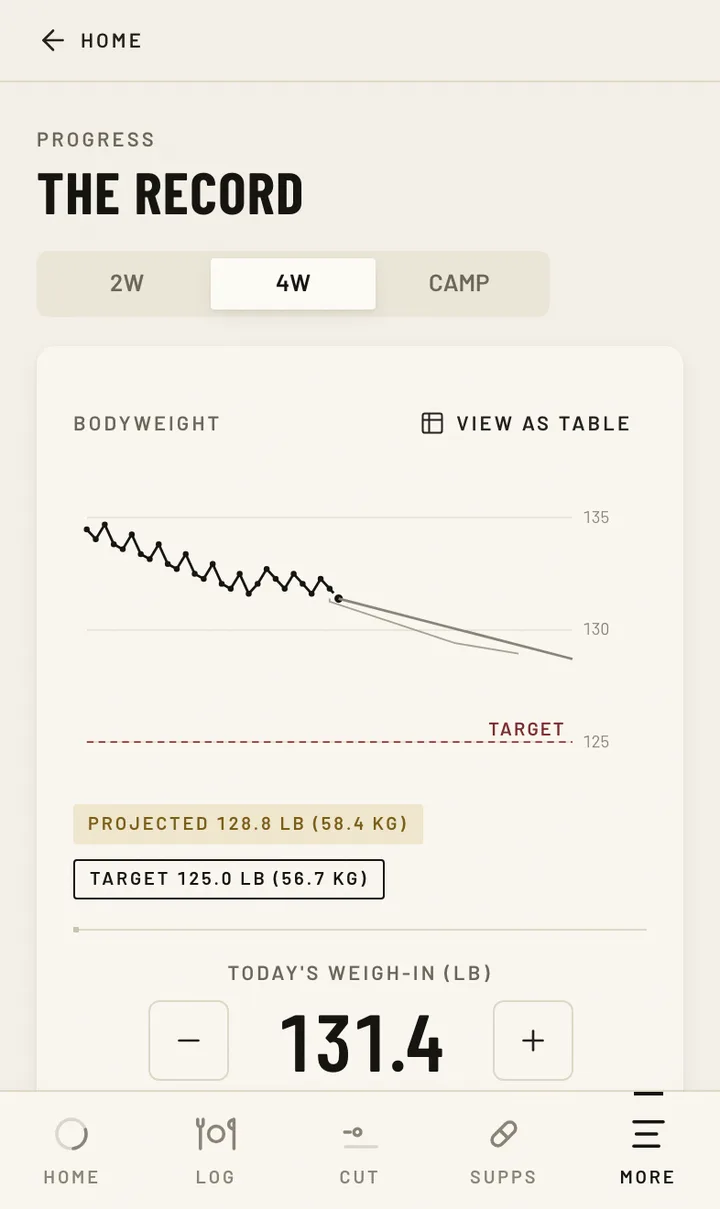
A weight trend is a different object from a weight. One morning's number carries a night's fluid, a late meal, a hard session and a bad sleep inside it; the line through a month carries the descent. The same is true of the off-camp months, where nothing is being chased and nobody is watching — which is exactly the period no study has ever recorded, in anybody.
Logging that period costs nothing and it changes what a conversation with a dietitian can be about. Without it, the conversation starts at "roughly what do you think you sit at?" With it, it starts at a shape. Fighter Cut exists to keep that record, and keeping it is the whole contribution — the app has no opinion about what the number should be, because nobody has earned one.
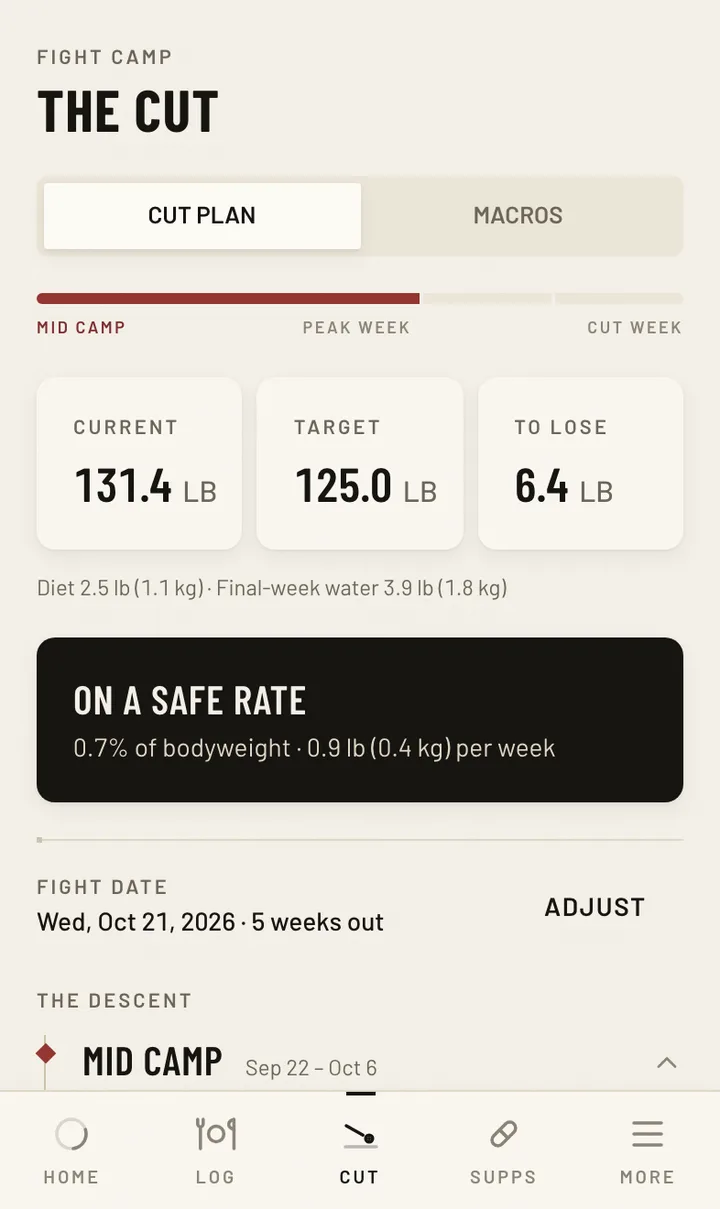
Three things are worth understanding rather than calculating.
The percentage is a maximum from a model, and whatever it works out to for a given fighter, that number was never measured in anyone. It came out of an eight-week camp assumption, and the authors published it with a note saying it is not substantiated.
The fight-week figures are a separate set, three answers to one question, and they do not sum to 17%.
And the trade is real in both directions: mass relative to an opponent, against condition relative to yourself. Three cohorts found the first side worth something small; two found nothing; the largest model explained a tenth of the variance in who won. The one athlete measured through a camp lost a quarter of her peak power on the way to the scale. Where the trade balances for a specific person is a question for a coach, a physician and — if there is a commission sanctioning the bout — the rules that commission actually publishes. It is not a question this page can answer, and nothing here should be used to override either of them.
Where the evidence runs out for women, juniors and amateurs
Every cohort in this article is adult and mostly professional, and the gaps are not small.
Women. The largest cohort here, at 2,100 athletes, excluded all ten of its female boxers, so its boxing result is male-only. The 245-athlete regain analysis does not report sex at all. The Bellator study has four women out of twenty; the Frontiers protocol study has three out of thirty-one. The Western Australian study is the only source with a usable female sub-sample — 59 observations — and its authors call the female MMA arm small. The one source that follows a woman in depth is n = 1, with pre-existing amenorrhoea. There is no female-specific off-camp weight figure anywhere. The 12–15% was derived without a sex split and is applied to women by assumption.
Adolescents. Every source here is adult. The only youth-adjacent regulatory instrument we located is the NCAA's college programme. No adolescent off-camp weight evidence exists in this set at all.
Amateurs. The professional cohorts dominate. The Western Australian events are the closest thing to non-elite data and their weight figures are entirely self-reported.
Sports. The evidence is MMA, boxing, Muay Thai and wrestling. BJJ, judo and kickboxing appear in none of the primary cohorts, and the figures above do not describe them.
None of these gaps closes with a multiplier. A population that was not studied is not a population whose numbers you can scale into existence.
What we could not verify
An article that quotes figures this precisely owes you its holes.
- No measured inter-camp body mass exists, anywhere. We searched on 23 September 2026 and found forum threads, gym blogs and listicles. Every study located measures weigh-in day, fight night or camp. The one number this entire practice revolves around has never been collected.
- Nothing answers the fast-versus-gradual regain question. Whether it matters how quickly mass comes back after a weigh-in is open. The case study observed one week post-fight in one athlete and named the short observation window as a limitation of its own.
- Female boxers were excluded entirely from the largest cohort. All ten of them. Its boxing result cannot be applied to women.
- The two main weight-cycling syntheses could not be fetched in full — the 2024 meta-analysis and the 2022 25-year review. Both appear above only at index level, and no body-text detail is asserted from either.
- The WBC's current rule text is behind a bot wall. We read the 2019-20 programme document. The thresholds above are as published then, and we could not confirm on 23 September 2026 that they are current.
- CSAC's 2026 measures were verified only against a meeting report, not a commission primary document. They are announced with operational rules pending, not adopted.
- We refused several numbers you will meet in a gym. "Walk around 20% above your division" has no source — it is forum and gym-blog content, and the only sourced off-camp figure in existence is the 12–15% derivation with its own disclaimer attached. "Fighters add 10–15 lb in the off-season" traces to forum threads and commercial training blogs and is measured nowhere. "Keep your walking weight close enough that the cut is water, not structure" came back from commercial nutrition and gym sites; it may be sensible, but it is unsourced and it is a protocol, and we will not launder it into evidence.
- No death or hospitalisation count. The Frontiers paper states that severe events "including hospitalizations and even athlete fatalities" are documented, and gives no tally. Neither does the 2,100-athlete cohort, which notes that extreme dehydration has been linked to acute kidney injury and fatalities. No figure may be attributed to either, and any specific count you are offered should be traced before it is repeated.
- Nothing here is specific to you — not your division, your body composition, your medical history, your weigh-in format or your training load.
Questions fighters ask
How much should I weigh between fights?
The only published figure is the ISSN's 12% to 15% above your weight division during the off-camp or general-preparation phase, and three things about it matter more than the number. It is a stated maximum, not a target. It was back-calculated from an assumed eight-week camp at 0.5–1% body mass lost per week plus a typical fight-week loss — it is arithmetic, not a measurement of anybody. And its authors wrote in the same document that "these numbers have not yet been fully substantiated through research." On top of that, nobody has ever tested whether sitting at that percentage helps you win: every outcome study in this field measures post-weigh-in regain, which is a different variable. The number is a starting point for a conversation with a coach and a physician, not a finding you can act on alone.
Has anyone measured what fighters actually weigh between fights?
No. Searching the literature on 23 September 2026 returned no dataset of professional fighters' inter-camp body mass. Every cohort located measures the official weigh-in, fight night, or the camp itself. Commissions record weigh-in weights because they are taken in a controlled setting on a fixed date; nobody records what an athlete weighs in March with nothing booked. This is the central gap in the subject, and it means the question most fighters are actually asking has not been answered by research at all.
Does walking around heavier make you more likely to win?
Nobody has tested it. What has been tested is rapid weight gain — the mass regained between the weigh-in and the bout — and even there the literature is split. Three cohorts found a positive association, two found none, and one found it in Muay Thai but not in the MMA arm of the same study. The largest model explained 10–11% of the variance in who won. Getting from "winners regained more" to "walk around heavier" requires two unmeasured steps, and no study has taken either.
What did the biggest study actually find?
Baribeau and colleagues studied 2,100 professional combat athletes at CSAC events between 2015 and 2019 — 708 MMA athletes and 1,392 male boxers. MMA winners regained 8.7 ± 3.7% versus losers' 7.9 ± 3.8% (p<0.01), an effect size of about d = −0.23; male boxing winners regained 8.0 ± 3.0% versus 6.9 ± 3.2%. The authors state they cannot claim regain caused the outcomes and suggest the advantage "may be related more to the use of more appropriate RWL/RWG strategies... enabling more effective post weigh-in recovery." All ten female boxers were excluded from the cohort.
Is it true that fight week allows a 17% total weight loss?
No. That figure is produced by adding the ISSN's 6.7% at 72 hours, 5.7% at 48 hours and 4.4% at 24 hours. They are not stages of a plan. They are three answers to the same question — how much is it reasonable to still have left to lose, if you start now — asked at three different moments, and the number falls as the weigh-in approaches because the recovery time on the other side is what constrains it. The position stand's own narrative describes one population passing three checkpoints, not three losses stacking. Anyone quoting you 17% has misread the source.
Does the heavier fighter usually win?
In the 2,100-athlete cohort, the heavier athlete on fight night won 60.4% of MMA bouts and 58.5% of boxing bouts. That is a real edge and it is worth stating the other way round as well: the lighter fighter won roughly two in five. It is also an association measured without control for baseline body mass, rehydration strategy or anything else about the two fighters, in professional bouts at commission-supervised events.
Why do some studies find no relationship at all?
Two did. A Bellator study of 20 MMA athletes with a weigh-in about 36 hours out found percentage weight regain was "not a significant predictor of fight outcomes (win and loss) (p = 0.798)" despite mean regain of 9.47 ± 4.57%. A Bayesian comparison of 62 bout winners against 62 losers at CSAC events reached the same conclusion. Sample sizes differ, weigh-in timings differ, and regain happens to nearly every fighter — 98.3% of the MMA athletes in the largest cohort gained mass between the scale and the cage — so a variable almost everybody shares is a poor candidate for separating winners from losers.
Is there a different off-camp figure for women?
There is not. No sex-specific off-camp weight figure exists anywhere in this literature. The 12–15% was derived without a sex split and is applied to women by assumption. The largest cohort excluded all ten of its female boxers; the 245-athlete regain analysis does not report sex; the studies with female participants have four women out of twenty, three out of thirty-one, and 59 observations respectively. The one source that instruments a woman in depth is a single case study of an athlete with pre-existing amenorrhoea. A population that was not studied is not one whose numbers can be scaled into existence.
What does a weight cut actually cost in performance?
The only measurement of that across a whole camp is a case study of one elite female Muay Thai athlete, and n = 1 is the condition on every number in it. Between three weeks out and weigh-in, her peak power fell 27%, average power 17%, and fatigue rate rose 18%. Resting metabolic rate dropped 253 kcal/day, hitting its lowest point a week after the low-energy-availability period rather than during it, and markers of renal stress — creatinine 104 µmol/L against a 44–80 reference range, urea 11.8 against 2.5–7.4 — appeared around weigh-in. Her authors state explicitly that these findings cannot be generalised.
Will I lose muscle if I sit closer to my division?
The relevant evidence is about descent rather than walk-around weight, and it is cautiously encouraging. In the same single-athlete case study, a 3.7 kg loss over five weeks (−6.4%) was 1.8 kg of fat mass and only 0.6 kg of fat-free mass. The researchers attribute that preservation to strength training maintained through the camp and protein intake at 2 g per kg of body weight. That is one supervised athlete, so it demonstrates that lean mass can be defended rather than that it will be — but it argues that how a descent is run matters more to body composition than where it starts.
Do fighters come back fatter after a cut? Is fat overshoot real?
The fat-overshoot idea comes from general-population obesity research, not from athletes, and the best athlete-specific synthesis does not support it. That 2024 meta-analysis, reported as covering 74 studies with 32 in the meta-analyses, describes post-loss body weight and fat-free mass in cycling athletes broadly returning to pre-loss values, with strength-sport athletes not appearing to fully recover initial fat mass. We could not fetch it in full, so that stands as an index-level pointer. The honest summary is that the popular claim is imported from a different population and the athlete data currently points the other way.
Are there rules about how much I can weigh between fights?
Almost nowhere. We found no federation rule setting a maximum off-camp weight for MMA, Muay Thai, BJJ, judo or kickboxing. NCAA wrestling, in force for 2025-26, sets a lowest allowable weight at five percent body fat, gates certification on a urine specific gravity of 1.020 or below with a 24-hour wait before retest, and caps descent at 1.5 percent of body weight per week. The WBC's published programme asks for check weights at 30 days (10%), 14 days (5%) and 7 days (3%) over the limit — that is from the 2019-20 document, and the current text could not be verified on 23 September 2026. Both regulate the rate of descent and the hydration state, not the walk-around number.
Is California's new weight-cutting programme in force?
Not as far as we could verify. The measures were announced on 9 March, with the missed-weight fine rising from 20% to 30% reported effective 1 July 2026, alongside physician verification of weight-class appropriateness, urine specific-gravity testing for water loading and mandatory next-day rechecks. The meeting report states the commission did not adopt new statutory language at the meeting and that staff and medical advisors would develop operational rules and return. No threshold values have been published, and we did not verify any of this against a CSAC primary document. Check the current text with the commission sanctioning your bout.
How many fighters have died from cutting weight?
We cannot tell you, and neither can the sources here. The 2025 Frontiers paper states that severe health events "including hospitalizations and even athlete fatalities" associated with poorly managed rapid weight loss are documented in media and the scientific literature — and gives no tally. The 2,100-athlete cohort similarly notes links to acute kidney injury and fatalities without a count. No number may be attributed to either paper. If you are offered a specific figure, trace it to a source before repeating it.
Can I use this article to plan what I weigh between fights?
No, and that is not modesty. The one published figure is a derivation whose own authors call it unsubstantiated; the outcome literature measures a different variable and disagrees with itself; the long-term effects of frequent cuts are, in the position stand's words, unknown. This page has no way to know your division, your body composition, your medical history, your weigh-in format or your training load, and every one of those changes the answer. Use it to ask sharper questions of a coach, a physician or a registered dietitian who can see you — and to recognise a confident number that the literature does not contain.
Sources
Sourced to
- International Society of Sports Nutrition position stand: nutrition and weight cut strategies for mixed martial arts and other combat sports — Ricci AA et al., Journal of the International Society of Sports Nutrition, 2025;22(1):2467909. DOI 10.1080/15502783.2025.2467909, PMID 40059405
- Rapid Weight Gain and Weight Differential Predict Competitive Success in 2,100 Professional Combat Sports Athletes — Baribeau V, Kirk C, Le D et al., International Journal of Sports Physiology and Performance, 2023;18(1):85–94. PMID 36473482 (accepted manuscript, Sheffield Hallam University repository)
- The Impact of Rapid Weight Regain on Fight Outcomes in Bellator Mixed Martial Arts Athletes — Peacock CA, Byers P, Silver T, Antonio J, Sanders GJ, Schwarz A, Stern L, Cureus, 21 January 2025;17(1):e77785. DOI 10.7759/cureus.77785, PMID 39981492
- Worth the Weight? Post Weigh-In Rapid Weight Gain is Not Related to Winning or Losing in Professional Mixed Martial Arts — Kirk C, Langan-Evans C, Morton JP, International Journal of Sport Nutrition and Exercise Metabolism, 2020;30(5):357–361. PMID 32663387
- Erratum: Kirk, Langan-Evans, & Morton (2020) — International Journal of Sport Nutrition and Exercise Metabolism, 1 March 2021;31(2):206. DOI 10.1123/ijsnem.2020-0388, PMID 36626616 (corrects the abstract's sample count to 62 winners and 62 losers)
- Rapid Weight Changes and Competitive Outcomes in Muay Thai and Mixed Martial Arts: A 14-Month Study of 24 Combat Sports Events — Doherty CS, Fortington LV, Barley OR, Sports, 2024;12(10):280. DOI 10.3390/sports12100280, PMID 39453246
- An alternative structured weight management protocol to rapid weight loss in mixed martial arts: a prospective interventional study — Maurício CA et al., Frontiers in Nutrition, 2025;12:1581698. DOI 10.3389/fnut.2025.1581698, PMID 41132567
- Relationships of rapid weight regain variables in professional MMA fighters between 2018–2023 — Calleja S et al., Journal of the International Society of Sports Nutrition, 2025;22(Suppl 2):2550158. DOI 10.1080/15502783.2025.2550158
- Weight cycling and relative energy deficiency in sport syndrome in an elite female muaythai athlete: a case study — Bulínová V, Wagner A, Kumstát M, Frontiers in Sports and Active Living, 2025;7:1599131. DOI 10.3389/fspor.2025.1599131, PMID 40443978
- Rapid weight gain predicts fight success in mixed martial arts — evidence from 1,400 weigh-ins — Faro H et al., European Journal of Sport Science, 2023. DOI 10.1080/17461391.2021.2013951 (abstract level only; full text not retrieved)
- Weight regain, body composition, and metabolic responses to weight loss in weight cycling athletes: A systematic review and meta-analyses — Bagot S et al., Obesity Reviews, 2024. DOI 10.1111/obr.13658, PMID 38096860 (index level only; full text not retrieved)
- Weight cycling in combat sports: revisiting 25 years of scientific evidence — Roklicer R et al., BMC Sports Science, Medicine and Rehabilitation, 2022;14:1. DOI 10.1186/s13102-021-00381-2 (index level only; full text not retrieved)
- Prevalence of disordered eating and its relationship with rapid weight loss amongst male and female combat sport competitors: A prospective study — Doherty CS, Fortington LV, Barley OR, Journal of Science and Medicine in Sport, 2024 (abstract level only; full text not retrieved)
- 2025-26 NCAA Men's Wrestling Weight Management Program Packet — National Collegiate Athletic Association, official PDF, in force for the 2025-26 season
- WBC Weight Management Program 2019–20 — World Boxing Council, hosted by the Association of Boxing Commissions and Combative Sports (current WBC text unverified as of 23 September 2026)
Read next
Plan the descent, don't guess it
Fighter Cut builds a week-by-week plan from today to your weigh-in, classifies the rate you are actually losing at, and logs what you eat against it. It does not make a cut safe — nothing does. It makes the numbers visible early enough to change them.
Open Fighter Cut